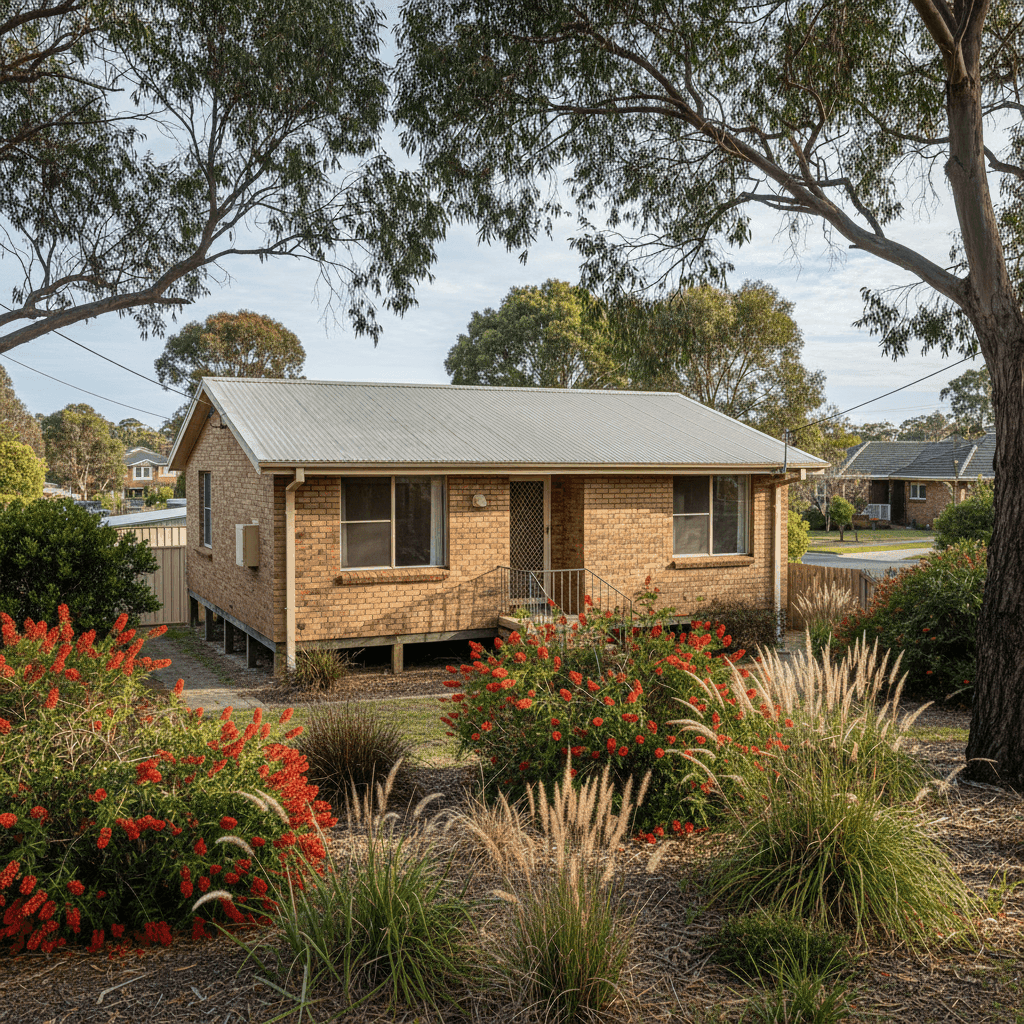
Hawks Nest is a relaxed coastal town on the Mid North Coast of New South Wales, known for its beaches, waterways, and laid-back lifestyle. It's an increasingly popular spot for both permanent residents and holiday homeowners — but like any coastal location, insuring a property here comes with its own set of considerations. This article breaks down a real building insurance quote for a three-bedroom, free-standing home in Hawks Nest (postcode 2324), and puts it in context against local, state, and national benchmarks.
---
Is This Quote Fair?
The quote in question is $2,716 per year (or $260/month) for building-only cover on a 139 sqm brick veneer home, with a sum insured of $519,000 and a $2,000 building excess.
Our price rating for this quote is FAIR — Around Average, and the data backs that up. At $2,716/yr, this premium sits above the suburb median of $2,157/yr but comfortably within the suburb's interquartile range ($1,638/yr at the 25th percentile to $2,826/yr at the 75th percentile). In plain terms: most homeowners in Hawks Nest are paying somewhere in this ballpark, and this quote isn't an outlier in either direction.
It's worth noting that "fair" doesn't necessarily mean "the best available." It means you're not being significantly overcharged relative to the local market — but there may still be room to find a more competitive premium by comparing multiple insurers. More on that below.
---
How Hawks Nest Compares
Understanding where your premium sits relative to broader benchmarks is a useful exercise. Here's how Hawks Nest stacks up:
| Benchmark | Premium |
|---|---|
| This Quote | $2,716/yr |
| Hawks Nest Suburb Average | $2,457/yr |
| Hawks Nest Suburb Median | $2,157/yr |
| NSW State Average | $9,528/yr |
| NSW State Median | $3,770/yr |
| National Average | $5,347/yr |
| National Median | $2,764/yr |
| LGA (Maitland) Average | $13,875/yr |
A few things stand out here. First, Hawks Nest premiums are significantly lower than the NSW state average of $9,528/yr — though that figure is heavily skewed by high-risk and high-value properties across the state. The NSW median of $3,770/yr is a more useful comparison, and Hawks Nest sits well below it.
Second, the Maitland LGA average of $13,875/yr looks striking, but this likely reflects a wide mix of property types and risk profiles across a large local government area — including flood-prone zones and higher-value properties. Hawks Nest, as a coastal township within the MidCoast Council area (not Maitland), should be interpreted separately from that LGA figure.
Third, this quote is actually very close to the national median of $2,764/yr, suggesting Hawks Nest is broadly in line with typical Australian home insurance costs — a reassuring sign for prospective buyers or homeowners in the area.
You can explore more local data on the Hawks Nest suburb stats page, or compare against NSW state-wide figures and national benchmarks.
---
Property Features That Affect Your Premium
Several characteristics of this particular home influence how insurers price the risk:
Brick Veneer Walls Brick veneer is one of the most common external wall types in Australia and is generally viewed favourably by insurers. It offers good fire resistance and durability, which can help keep premiums more competitive compared to timber-clad or weatherboard homes.
Steel/Colorbond Roof A Colorbond steel roof is a practical and popular choice in coastal NSW. It's durable, low-maintenance, and performs well in high-wind conditions. Insurers typically regard steel roofing positively, particularly in areas that can experience strong coastal storms.
Stump Foundation The property sits on stumps, which is a traditional foundation style common in older Australian homes. While stumps can be inspected and replaced, they may attract slightly more scrutiny from insurers compared to slab foundations — particularly if the stumps are timber and showing signs of age. This home was built in 1987, so it's worth ensuring the stumps are in good condition.
Construction Year: 1987 At nearly 40 years old, this home falls into a mid-age bracket. Insurers may factor in the likelihood of wear on key systems — plumbing, electrical wiring, and roofing — when pricing older homes. Keeping maintenance up to date is both a safety measure and a way to avoid complications at claim time.
Ducted Climate Control The presence of ducted climate control adds to the replacement value of the home and is factored into the sum insured. It's one of those features that's easy to overlook but can meaningfully impact rebuild costs if it needs to be replaced after a major event.
Sum Insured: $519,000 For a 139 sqm home, this works out to roughly $3,734/sqm — a reasonable figure for a brick veneer home with standard fittings in regional coastal NSW. It's important that the sum insured reflects the actual cost to rebuild (not the market value), including demolition, site clearance, and professional fees.
---
Tips for Homeowners in Hawks Nest
1. Review your sum insured annually Construction costs have risen sharply in recent years across Australia. A sum insured that was accurate two or three years ago may now be insufficient to fully rebuild your home. Use a building cost calculator or speak with a quantity surveyor to make sure you're not underinsured.
2. Consider your excess carefully This quote carries a $2,000 building excess. A higher excess generally reduces your annual premium, but make sure it's an amount you could comfortably cover out of pocket in the event of a claim. If cash flow is a concern, it may be worth comparing quotes with a lower excess to see the premium difference.
3. Maintain the property — especially the stumps and roof For a 1987 home on stumps, regular inspections of the subfloor and foundation are a smart investment. Insurers can decline or reduce claims if damage is attributed to gradual deterioration or lack of maintenance. Similarly, keeping the Colorbond roof clear of debris and checking for any corrosion near the coastal air will extend its life and protect your cover.
4. Shop around at renewal time Loyalty doesn't always pay in home insurance. Insurers frequently offer better rates to new customers, meaning your renewal premium can creep up year after year without a corresponding increase in risk. Comparing quotes before your renewal date is one of the simplest ways to ensure you're getting value.
---
Compare Home Insurance Quotes in Hawks Nest
Whether you're a long-time Hawks Nest resident or you've recently purchased in the area, it pays to know what the market looks like. CoverClub makes it easy to compare building and contents insurance quotes side by side, so you can make a confident, informed decision.