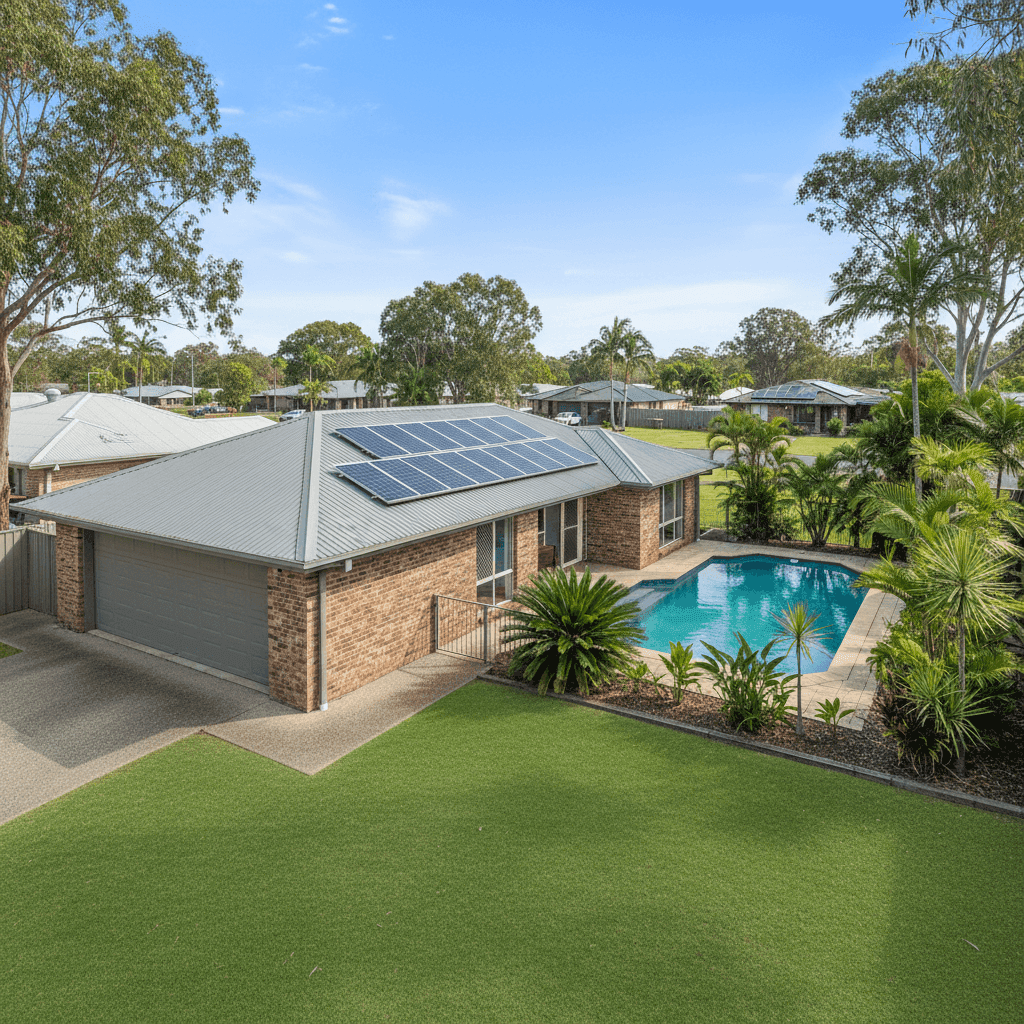
If you own a free standing home in Hay Point, QLD 4740, you already know this coastal Queensland suburb comes with its own unique set of considerations — from its proximity to the Mackay region's industrial coastline to the warm, humid climate that can take a toll on building materials over time. Getting the right building insurance cover at a fair price matters, and understanding what's behind your quote can help you make smarter decisions.
This article breaks down a real building-only insurance quote for a 3-bedroom, 2-bathroom brick veneer home in Hay Point, compares it against local, state and national benchmarks, and offers practical tips for homeowners in the area.
---
Is This Quote Fair?
The annual premium for this property came in at $4,702 per year (or $422/month), covering building only with a $1,000 excess. Our pricing engine rates this quote as FAIR — around average for the area.
So what does "fair" actually mean in dollar terms? Based on 25 quotes collected for the Hay Point suburb:
- The suburb average sits at $4,561/yr
- The suburb median is $4,218/yr
- The 25th percentile is $3,125/yr — meaning a quarter of comparable properties pay less than this
- The 75th percentile is $5,469/yr — meaning three-quarters of properties pay less than this
At $4,702, this quote lands just above the suburb average and comfortably within the middle band of what Hay Point homeowners are typically paying. It's not the cheapest on the market, but it's well short of the upper end — and for a property with above-average fittings, a pool, solar panels and ducted climate control, that's a reasonable outcome.
---
How Hay Point Compares
One of the most striking data points here is the contrast between local and state-level figures. Check out the full QLD home insurance statistics and you'll see why Queensland is one of the most expensive states in the country for home insurance.
| Benchmark | Average Premium | Median Premium |
|---|---|---|
| Hay Point (suburb) | $4,561/yr | $4,218/yr |
| Mackay LGA | $8,458/yr | — |
| Queensland (state) | $9,129/yr | $3,903/yr |
| National | $5,347/yr | $2,764/yr |
The Mackay LGA average of $8,458/yr and the QLD state average of $9,129/yr are both significantly higher than what this Hay Point quote reflects — largely because those figures are pulled up by high-risk coastal and cyclone-prone properties across the broader region. Hay Point itself, while coastal, is not classified as a cyclone risk area for this property, which makes a substantial difference to the premium.
Compared to national benchmarks, this quote is also below the national average of $5,347/yr, though above the national median of $2,764/yr. The higher national median reflects the large volume of lower-risk properties in southern states like Victoria and South Australia, where premiums are structurally cheaper.
The takeaway: for a Queensland coastal suburb, $4,702/yr for building-only cover on a well-appointed home is a genuinely competitive result.
---
Property Features That Affect Your Premium
Several characteristics of this property play a meaningful role in shaping the premium — some working in the homeowner's favour, others adding modest cost.
Brick Veneer Walls & Colorbond Roof Brick veneer construction is generally viewed favourably by insurers. It's more fire-resistant than timber weatherboard and holds up well in Queensland's heat. The steel Colorbond roof is similarly well-regarded — durable, low-maintenance and resistant to corrosion — which can help keep premiums in check compared to older roofing materials like terracotta tiles or fibrous cement sheeting.
Slab Foundation & Tile Flooring A concrete slab foundation is a solid, low-risk base that insurers tend to price positively. Combined with tile flooring throughout, the property has a resilient bones that reduces the likelihood of certain types of water and structural damage claims.
Above-Average Fittings Higher-quality fittings — think stone benchtops, premium appliances, quality tapware — increase the cost to rebuild or repair, which is reflected in the $698,000 sum insured. This is an important figure to get right; underinsuring a well-fitted home can leave you significantly out of pocket after a major claim.
Pool, Solar Panels & Ducted Climate Control These three features add replacement value to the property and are factored into the building sum insured. Solar panels in particular are worth confirming are explicitly covered under your policy, as some insurers treat them differently depending on how they're mounted and whether they're integrated into the roofline.
Slight Elevation (Less Than 1m) The property is listed as slightly elevated — less than 1 metre — which provides a marginal buffer against surface water ingress. It's not enough elevation to attract significant flood-risk discounts, but it's a positive characteristic in a coastal Queensland setting.
No Cyclone Risk Classification This is arguably the single biggest premium driver avoided here. Properties formally classified as being in cyclone-risk zones across northern Queensland can face premiums two to three times higher than comparable properties outside those zones. Hay Point sitting outside this classification is a meaningful financial advantage.
---
Tips for Homeowners in Hay Point
1. Review your sum insured annually Construction costs in regional Queensland have risen sharply in recent years. A sum insured of $698,000 may be appropriate today, but it's worth revisiting each year — particularly if you've made improvements like adding solar panels, upgrading the kitchen, or extending the home. Underinsurance is one of the most common and costly mistakes homeowners make.
2. Confirm what's covered under your building policy A building-only policy covers the structure and permanently fixed elements — but the definition of "fixed" can vary between insurers. Make sure your solar panels, pool equipment, ducted air conditioning system and any outdoor structures (like a pergola or garden shed) are explicitly listed or covered under your policy wording.
3. Don't skip the excess calculation With a $1,000 building excess on this policy, it's worth understanding the trade-off. A higher excess typically lowers your premium, while a lower excess increases it. If you're in a low-claim period and financially comfortable absorbing a $1,000 cost, maintaining or slightly increasing your excess can be a smart way to reduce your annual outlay.
4. Compare quotes at renewal — every year Insurance loyalty rarely pays off. Insurers regularly reprice their books, and the market for Hay Point properties is active enough (25 quotes in our dataset) to make comparison worthwhile. Even if your current insurer offers a competitive renewal price, seeing what else is available takes minutes and could save you hundreds.
---
Ready to Compare?
Whether you're renewing your current policy or shopping for the first time, CoverClub makes it easy to see how your quote stacks up. Get a home insurance quote today and compare your options side by side — so you can be confident you're getting the right cover at a fair price for your Hay Point home.