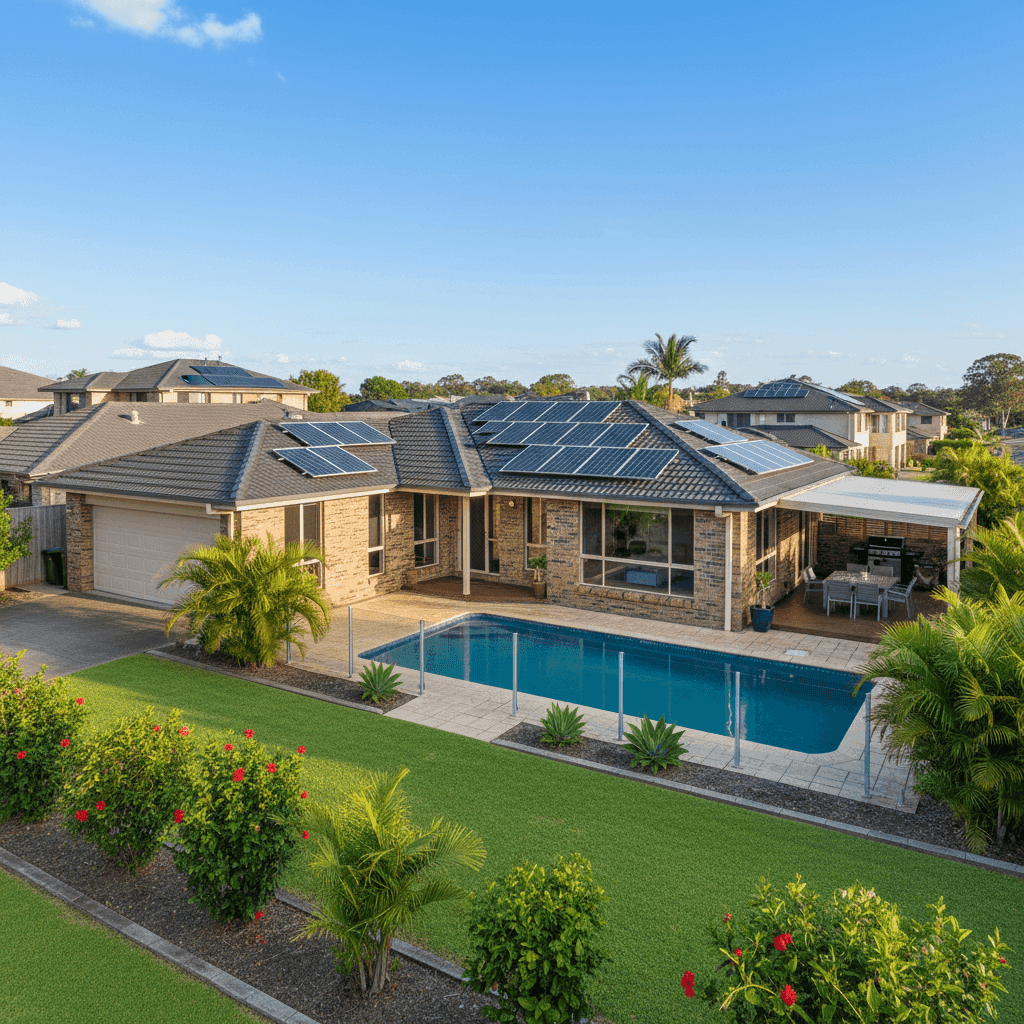
Helensvale is one of the Gold Coast's most sought-after family suburbs — a leafy, master-planned community with excellent schools, easy motorway access, and a strong mix of established and newer homes. If you own a free standing home here, understanding what you should be paying for home and contents insurance is an important part of protecting one of your biggest assets. This article breaks down a real insurance quote for a four-bedroom, two-bathroom brick veneer home in Helensvale (postcode 4212), and puts the numbers into context against local, state, and national benchmarks.
---
Is This Quote Fair?
The quote in question comes in at $3,894 per year (or $366 per month) for combined home and contents cover, with a building sum insured of $1,050,000 and contents valued at $256,250. Both the building and contents excess are set at $2,000.
Our analysis rates this quote as Fair — Around Average, which is a solid result for a property of this size and specification in South-East Queensland. It sits comfortably within the middle band of what homeowners in this suburb are paying, meaning you're neither getting an exceptional bargain nor being significantly overcharged.
For context, the suburb median premium in Helensvale sits at $4,102 per year, based on a sample of 150 quotes. This quote comes in roughly $208 below that median, which is a meaningful saving over the life of a policy. It also falls within the interquartile range — between the 25th percentile of $2,967 and the 75th percentile of $5,828 — suggesting it reflects a realistic, market-consistent price for this type of property.
---
How Helensvale Compares
One of the more striking aspects of home insurance pricing in Helensvale is the significant gap between the average and median premium in the suburb. The suburb average is $14,169 per year — nearly three and a half times the median of $4,102. This kind of disparity is usually driven by a small number of very high-value or high-risk properties pulling the average upward. For most homeowners, the median is a far more useful reference point.
Here's how the numbers stack up across different benchmarks:
| Benchmark | Average | Median |
|---|---|---|
| Helensvale (4212) | $14,169/yr | $4,102/yr |
| Gold Coast LGA | $8,161/yr | — |
| Queensland | $9,129/yr | $3,903/yr |
| National | $5,347/yr | $2,764/yr |
You can explore the full Queensland insurance data or dive into national home insurance statistics to see how your situation compares more broadly.
A few things stand out here. Queensland's average premium is notably higher than the national average — a reflection of the state's elevated exposure to extreme weather events, including storms, flooding, and hail. However, the QLD median of $3,903 is actually quite close to this quote's $3,894, reinforcing the "around average" rating. At a national level, this quote is above the median of $2,764, but that's expected given the Gold Coast's higher property values and subtropical climate risks.
---
Property Features That Affect Your Premium
Every insurer prices a policy based on the specific characteristics of the property. For this Helensvale home, several features are worth examining:
Brick Veneer Walls and Tiled Roof Brick veneer construction with a tiled roof is generally viewed favourably by insurers. Brick is fire-resistant and durable, while tiles offer good longevity and weather resistance compared to corrugated iron or Colorbond in certain storm scenarios. This combination typically attracts more competitive premiums than, say, weatherboard cladding.
Slab Foundation A concrete slab foundation is standard for Queensland homes built from the 1980s onwards and is considered low-risk by most insurers. It reduces exposure to subfloor moisture issues and pest damage that can affect older homes on stumps.
Swimming Pool A pool adds value to the property but also increases the sum insured required to accurately cover the full replacement cost of the home. It can also introduce a small liability element, though most home and contents policies include legal liability cover as standard.
Solar Panels Solar panels are increasingly common on Gold Coast homes, and most insurers now include them under building cover automatically — though it's worth confirming this with your insurer. Their presence can slightly increase the building replacement cost, which flows through to the premium.
Ducted Climate Control Ducted air conditioning is considered an above-average fitting and contributes to both the building sum insured and the overall quality rating. This home is noted as having "above average" fittings quality, which is consistent with the $1,050,000 building sum insured for a 139 sqm home.
No Cyclone Risk Unlike homes in Far North Queensland, Helensvale is not classified as a cyclone risk area. This is a meaningful premium advantage — cyclone loading can add hundreds or even thousands of dollars to annual premiums for properties in affected zones.
Body Corporate / Strata It's worth noting that this property has a body corporate or strata component. Homeowners in this situation should clarify with their insurer exactly what is covered under the building policy versus what falls under the strata/body corporate insurance. Typically, the body corporate covers common areas and the building structure, while individual owners are responsible for contents and any internal improvements.
---
Tips for Homeowners in Helensvale
1. Review your building sum insured regularly Construction costs have risen sharply across Queensland in recent years. A sum insured that was accurate three years ago may now fall short of what it would actually cost to rebuild your home. Use a building cost calculator or speak with a quantity surveyor to ensure your cover keeps pace with reality.
2. Confirm solar panels are covered under your policy Not all insurers automatically include solar panels in building cover, and some treat them as a separate item. Check your Product Disclosure Statement (PDS) carefully, and ask your insurer directly if you're unsure. Given the cost of a full solar system, this is not a gap worth leaving open.
3. Understand your excess before you claim Both the building and contents excess on this policy are set at $2,000. That's a reasonable level for most claims, but it's worth making sure you have that amount readily accessible. Some homeowners opt for a higher excess in exchange for a lower premium — just make sure the trade-off makes financial sense for your situation.
4. Don't rely on the suburb average as your benchmark As discussed above, the average premium in Helensvale ($14,169) is heavily skewed by outliers. Use the median ($4,102) as your primary reference point when evaluating whether a quote is reasonable. If you're being quoted significantly above the median without a clear reason, it's worth shopping around.
---
Compare Your Home Insurance Quote Today
Whether you're renewing an existing policy or insuring a new purchase in Helensvale, it pays to compare. Premiums can vary significantly between insurers for the same property — sometimes by thousands of dollars per year. Get a home insurance quote through CoverClub to see how your current cover stacks up and find a policy that suits your home, your budget, and your peace of mind. You can also explore detailed insurance statistics for Helensvale and the 4212 postcode to better understand the local market before you buy.