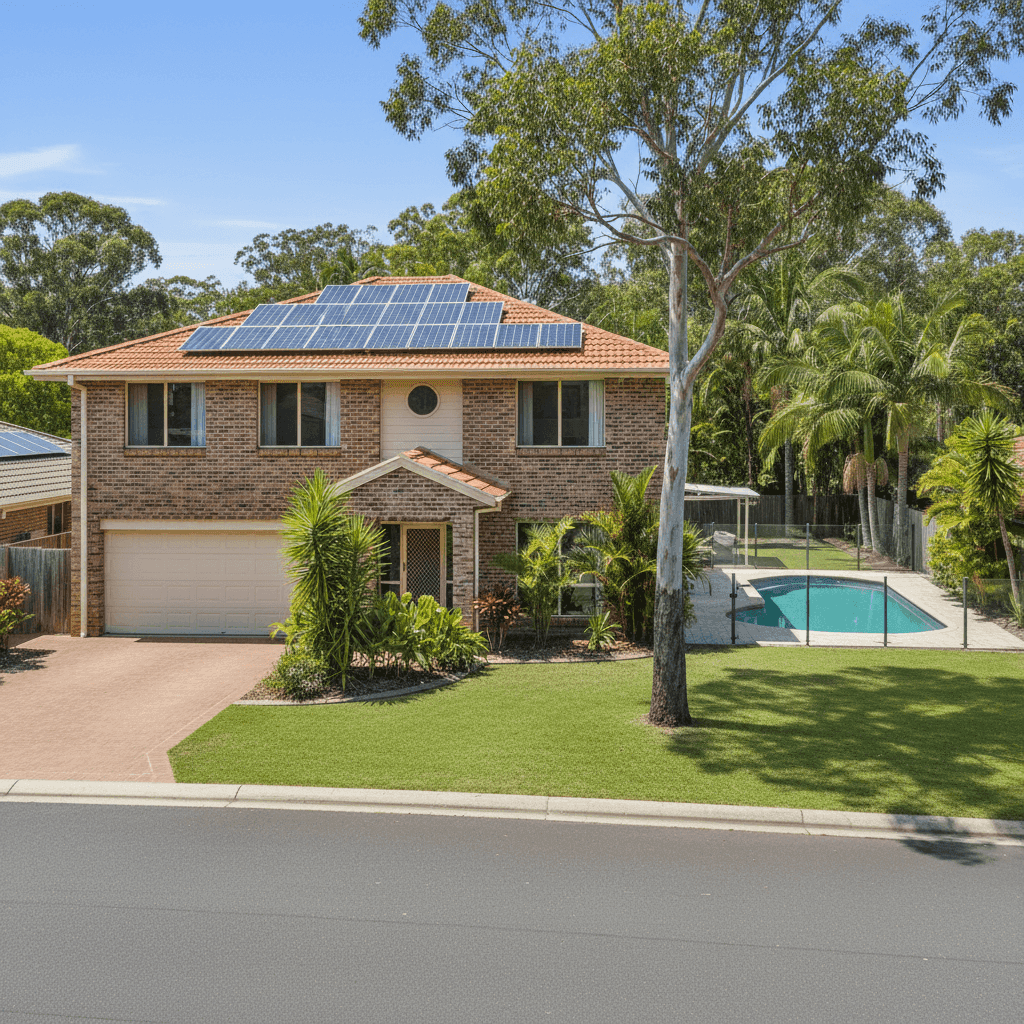
Helensvale is one of the Gold Coast's most sought-after family suburbs — a leafy, well-established community known for its spacious homes, good schools, and easy access to both the M1 and the theme parks. If you own a free standing home here, you're likely paying close attention to the cost of protecting it. This article breaks down a real home and contents insurance quote for a 4-bedroom, 2-bathroom brick veneer home in Helensvale (postcode 4212), and puts the numbers into context using suburb, state, and national benchmarks.
---
Is This Quote Fair?
The quote in question comes in at $3,310 per year (or $310/month) for combined home and contents cover, with a building sum insured of $758,000 and contents valued at $85,000. Both the building and contents excess are set at $1,000.
Our pricing engine has rated this quote as Fair — Around Average, and the data backs that up. Based on 150 quotes collected for Helensvale (4212), the suburb median sits at $4,102 per year. That means this quote is tracking roughly $792 below the local median — a meaningful saving for a property of this size and specification.
To put it in percentile terms: the suburb's 25th percentile is $2,967/yr and the 75th percentile is $5,828/yr. At $3,310, this quote falls comfortably in the lower-middle band of the local market — better than average, but not the cheapest available. For a well-appointed 244 sqm home with a pool, solar panels, and ducted climate control, that's a reasonable outcome.
---
How Helensvale Compares
One of the most striking things about Helensvale's insurance market is the sheer spread between the average and median premiums. The suburb average is $14,169/yr — dramatically higher than the median of $4,102. This kind of gap almost always signals a skewed distribution, where a subset of high-value properties or high-risk profiles are pulling the average upward. For most homeowners, the median is the more relevant benchmark.
Here's how the numbers stack up across different geographies:
| Benchmark | Average | Median |
|---|---|---|
| Helensvale (4212) | $14,169/yr | $4,102/yr |
| Gold Coast LGA | $8,161/yr | — |
| Queensland | $9,129/yr | $3,903/yr |
| National | $5,347/yr | $2,764/yr |
Compared to the Queensland state median of $3,903/yr, this quote is only slightly above — a difference of around $407 annually. Against the national median of $2,764/yr, it's higher, but that's expected: Queensland properties generally attract elevated premiums due to the state's exposure to severe weather events, including floods, storms, and hail.
The Gold Coast LGA average of $8,161/yr further illustrates that Helensvale sits in a relatively moderate risk zone compared to some coastal or flood-prone parts of the region.
---
Property Features That Affect Your Premium
Several characteristics of this property have a direct bearing on what insurers charge. Understanding them helps you assess whether your quote reflects your actual risk profile.
Brick veneer construction with a tiled roof is generally viewed favourably by insurers. Brick veneer offers solid fire and impact resistance, and tiles are considered more durable than Colorbond or corrugated iron in many storm scenarios. This combination typically attracts lower premiums than timber-framed or clad homes.
Slab foundation is standard for Queensland homes built from the mid-20th century onward and presents no particular premium loading in a non-flood-prone area. Helensvale is not classified as a cyclone risk zone, which is a significant factor — properties in cyclone-rated areas of Queensland can attract substantially higher premiums.
The pool adds a modest liability and replacement cost component to the premium. Pools require specific coverage for the structure itself, and some insurers apply a loading for the increased public liability exposure.
Solar panels are increasingly common on Queensland rooftops, but they do add to the insured building value and can be a target for storm or hail damage claims. It's worth confirming with your insurer that panels are explicitly covered under your policy — not all standard building policies include them by default.
Ducted climate control is another high-value fixture that contributes to the building sum insured. At $758,000, the building cover for a 244 sqm home built in 1985 is substantial, reflecting the cost of modern rebuilding standards, materials, and labour — not the market value of the property.
Standard fittings quality keeps the premium from being loaded for luxury finishes, which is appropriate for a home of this era and specification.
---
Tips for Homeowners in Helensvale
1. Review your sum insured regularly Building costs have risen sharply across South East Queensland in recent years. If your home was last valued several years ago, your $758,000 sum insured may no longer reflect the true cost of rebuilding. Underinsurance is one of the most common — and costly — mistakes homeowners make. Use a building cost calculator or speak to a quantity surveyor every few years.
2. Confirm solar panel and pool coverage Don't assume these features are automatically included. Ask your insurer specifically whether solar panels are covered for storm, hail, and accidental damage, and check whether your pool structure and associated equipment (pumps, filters, heating) are listed under your building policy.
3. Shop the market at renewal time A "Fair" rating means this quote is competitive, but the market changes. Insurers reprice risk regularly, and loyalty doesn't always pay. Set a reminder to compare quotes at least 30 days before your renewal date — you may find a materially better deal without sacrificing cover quality.
4. Consider your excess carefully Both the building and contents excess are set at $1,000. Opting for a higher excess (say, $2,000) can reduce your annual premium, which makes sense if you have the financial buffer to absorb a larger out-of-pocket cost in the event of a claim. Conversely, a lower excess may be worth the extra premium cost if your cash flow is tight.
---
Compare Your Home Insurance Quote Today
Whether you're renewing an existing policy or shopping for the first time, it pays to see what the market has to offer. CoverClub aggregates real quote data from across Australia so you can benchmark your premium against your neighbours and make a genuinely informed decision. Get a home insurance quote now and see how your property stacks up.