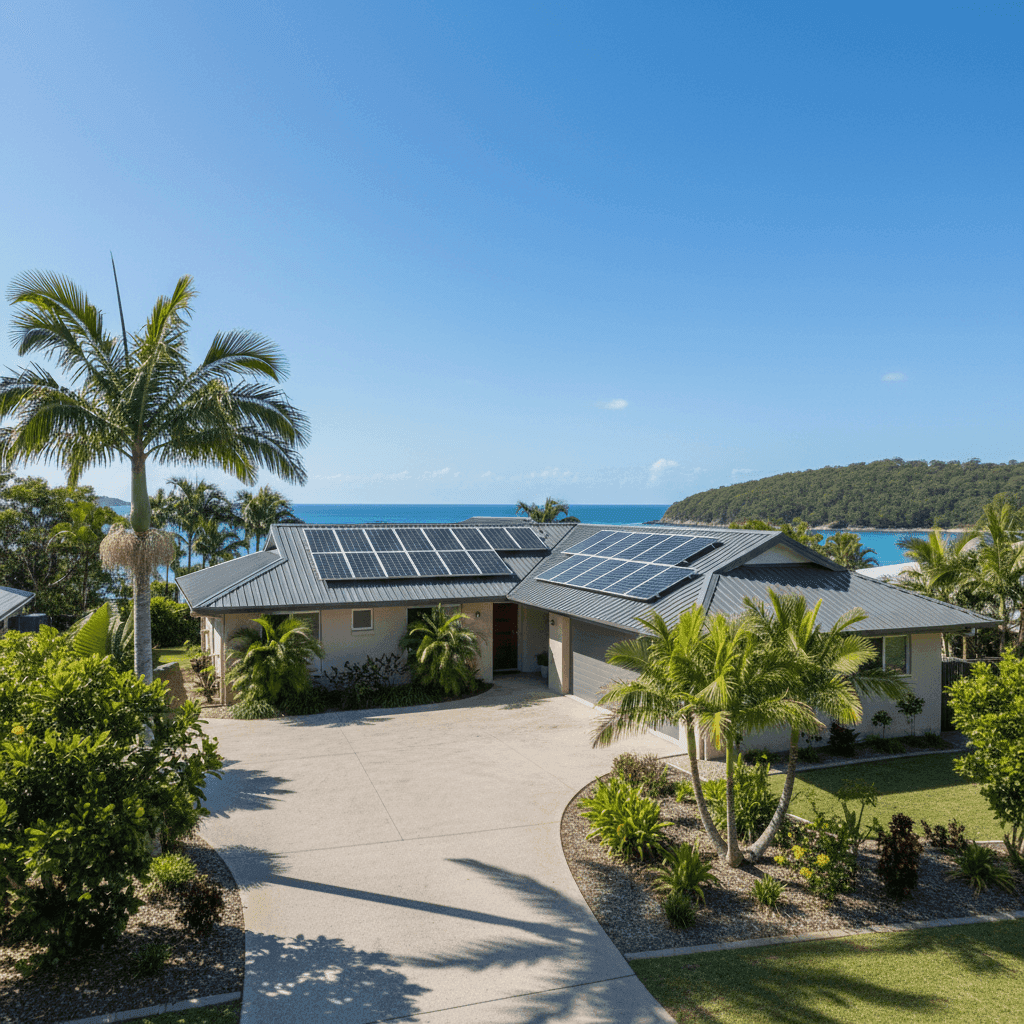
Hideaway Bay is a quiet coastal locality tucked within the Mackay region of Queensland — and like much of tropical North Queensland, it comes with a unique set of insurance considerations. This article breaks down a real building insurance quote for a four-bedroom, three-bathroom free-standing home in Hideaway Bay (postcode 4800), comparing it against local, state, and national benchmarks to help you understand what you're paying and why.
---
Is This Quote Fair?
The quote in question sits at $3,572 per year (or $342 per month) for building-only cover on a home insured for $691,000, with a $1,000 building excess. Our price rating for this quote is FAIR — Around Average.
That assessment holds up well under scrutiny. Based on 14 quotes sampled for Hideaway Bay, the suburb average premium is $4,923 per year and the median sits at $5,160. This quote lands below both figures, placing it closer to the 25th percentile of local premiums ($3,466/yr) than the median — meaning it's priced more competitively than most homes in the area are achieving.
In other words, while "fair" might sound like damning with faint praise, this quote is actually sitting in the better half of what Hideaway Bay homeowners are currently paying. It's not the cheapest quote available in the suburb, but it's meaningfully below average.
---
How Hideaway Bay Compares
To put this quote in broader context, here's how Hideaway Bay stacks up against Queensland and national benchmarks:
| Benchmark | Average Premium | Median Premium |
|---|---|---|
| Hideaway Bay (suburb) | $4,923/yr | $5,160/yr |
| Mackay LGA | $8,458/yr | — |
| Queensland (state) | $9,129/yr | $3,903/yr |
| National | $5,347/yr | $2,764/yr |
A few things stand out here. The Queensland state average of $9,129 is extraordinarily high — driven by cyclone-prone regions like Far North Queensland where premiums can be eye-watering. However, the state median of $3,903 tells a more nuanced story: most Queensland homeowners pay less than the average suggests, because a relatively small number of very high-risk properties skew the mean significantly upward.
Hideaway Bay's suburb average of $4,923 is above the Queensland median but well below the state average — consistent with a coastal area that carries genuine cyclone risk but isn't in the most extreme exposure zones. Compared to the national average of $5,347, this suburb sits slightly below, and the quote itself ($3,572) is comfortably under the national benchmark too.
The Mackay LGA average of $8,458 is notably high, which likely reflects a mix of high-value coastal properties and elevated natural hazard risk across the broader region. The fact that this particular quote comes in well under the LGA average is a positive sign.
---
Property Features That Affect Your Premium
Several characteristics of this property influence how insurers price the risk — some favourably, some less so.
Cyclone Risk Area
This is the single biggest premium driver for any property in this part of Queensland. Hideaway Bay falls within a designated cyclone risk zone, which means insurers apply significantly higher loadings to account for the potential cost of wind and storm damage. This factor alone can double or triple premiums compared to equivalent homes in southern states.
Concrete External Walls
Concrete construction is generally viewed favourably by insurers. It's more resistant to fire, wind, and impact damage than timber-framed homes, which can translate to lower premiums. In a cyclone-prone area, this is a particularly meaningful advantage.
Steel / Colorbond Roof
Colorbond steel roofing performs well in high-wind environments and is a common choice in cyclone-affected regions. Insurers tend to regard it as a durable, low-maintenance roofing material, which can positively influence the premium calculation.
Slab Foundation
A concrete slab foundation is a stable, well-regarded base type that presents minimal risk of subsidence or movement — another modest positive from an underwriting perspective.
Solar Panels
The property has solar panels installed. While these add value and are generally covered under building insurance, they do represent an additional asset that contributes to the sum insured. Some insurers also factor in the cost of reinstating solar systems after storm or hail damage, which can add a small loading to the premium.
Timber / Laminate Flooring
Timber and laminate floors are attractive but can be more susceptible to water damage than tiled alternatives. In a region prone to heavy rainfall and flooding, this is worth keeping in mind — particularly if the policy includes flood cover.
Sum Insured: $691,000
At 153 square metres, this translates to roughly $4,516 per square metre — a figure that sits within a reasonable range for a well-appointed home in a regional coastal Queensland location. Ensuring your sum insured accurately reflects full rebuild costs (including demolition, professional fees, and current material costs) is critical to avoiding underinsurance.
---
Tips for Homeowners in Hideaway Bay
1. Review Your Sum Insured Annually
Construction costs in regional Queensland have risen sharply in recent years. A sum insured that was adequate two or three years ago may no longer cover a full rebuild today. Use a building cost calculator or speak with a quantity surveyor to validate your figure each year.
2. Ask About Cyclone Excess Clauses
Many insurers apply a separate, higher excess for cyclone-related claims — sometimes expressed as a percentage of the sum insured rather than a flat dollar amount. Make sure you understand what your policy's cyclone excess is before you need to make a claim.
3. Confirm Solar Panel Coverage
Check whether your solar system is explicitly listed as covered under your building policy, and for how much. Some policies include solar panels automatically; others require you to specify them or add an endorsement. Given the cost of replacing a solar system, this is worth confirming in writing.
4. Compare Quotes Before Renewal
The 14-quote sample for Hideaway Bay shows a wide spread — from around $3,466 at the 25th percentile to $5,724 at the 75th percentile. That's a difference of over $2,200 per year for broadly similar cover. Shopping around at renewal time is one of the most effective ways to avoid paying more than you need to.
---
Ready to Compare?
Whether you're renewing an existing policy or insuring a new property, it pays to see what the market is offering. Get a home insurance quote at CoverClub and compare your options side by side — it only takes a few minutes and could save you hundreds each year.