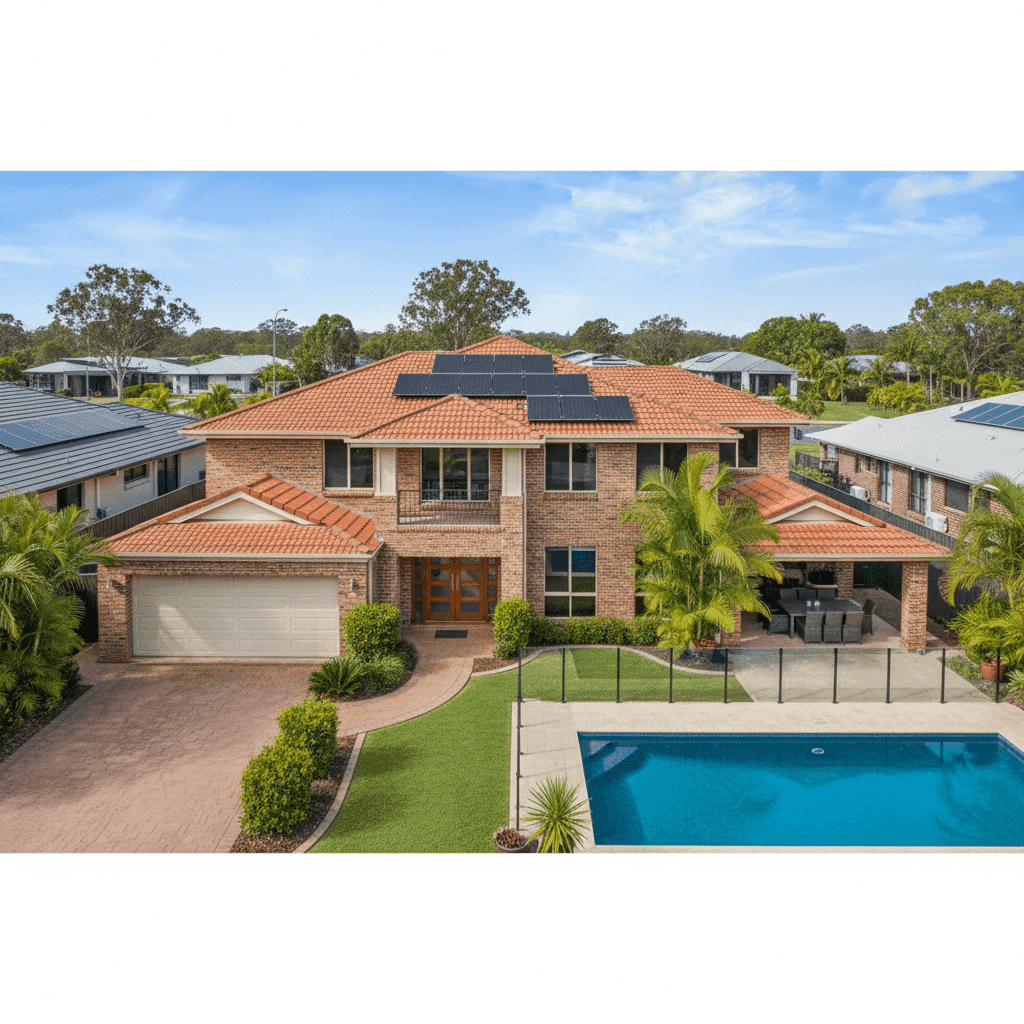
Hope Island, nestled within the Gold Coast's prestigious canal and waterway network, is home to some of Queensland's most desirable residential properties. For owners of a large, free standing home in this postcode, understanding what drives your insurance premium — and whether you're paying a fair price — is essential. This article breaks down a real home and contents insurance quote for a five-bedroom property in Hope Island QLD 4212, comparing it against local, state, and national benchmarks to help you make an informed decision.
---
Is This Quote Fair?
The quote in question comes in at $4,652 per year (or $439/month) for combined home and contents cover, with a building sum insured of $1,780,000 and contents valued at $153,000. Both the building and contents excess are set at $2,000.
Our price rating for this quote is FAIR — Around Average, and the data backs that up. When stacked against the Hope Island suburb median of $5,486/yr, this quote actually sits below the midpoint for the area — a positive sign. It also falls comfortably within the interquartile range for the suburb, which runs from $3,628/yr at the 25th percentile up to $8,631/yr at the 75th percentile.
In other words, while this isn't the cheapest quote available in the postcode, it's well within the normal range for a property of this size, quality, and location. Homeowners paying anywhere between $3,600 and $8,600 annually in Hope Island are in broadly typical territory — this quote sits closer to the lower half of that band, which is a reasonable outcome for a 315 sqm home with above-average fittings, a pool, solar panels, and ducted climate control.
---
How Hope Island Compares
Hope Island is not a cheap suburb to insure, and the numbers make that clear. The suburb average premium sits at a striking $30,600/yr — dramatically higher than the median of $5,486/yr. This wide gap between average and median is a telltale sign that a small number of very high-value properties (think waterfront estates and luxury builds) are pulling the average upward significantly. For most homeowners, the median is the more meaningful reference point.
Zooming out to the state level, the Queensland average premium is $9,129/yr, with a median of $3,903/yr. The Gold Coast LGA average sits at $8,161/yr — reflecting the region's elevated rebuild costs, storm exposure, and higher-than-average property values. At $4,652/yr, this quote is below both the QLD and Gold Coast LGA averages, which is encouraging.
Nationally, the average home and contents premium is $5,347/yr, with a median of $2,764/yr. This quote is slightly below the national average but above the national median — consistent with a larger, well-appointed property in a sought-after coastal suburb.
| Benchmark | Premium |
|---|---|
| This Quote | $4,652/yr |
| Hope Island Median | $5,486/yr |
| Hope Island Average | $30,600/yr |
| QLD Average | $9,129/yr |
| Gold Coast LGA Average | $8,161/yr |
| National Average | $5,347/yr |
| National Median | $2,764/yr |
---
Property Features That Affect Your Premium
Several characteristics of this property have a meaningful influence on what insurers charge:
Size and value. At 315 sqm with a building sum insured of $1,780,000, this is a large, high-value home. Rebuild costs are a primary driver of building insurance premiums, and a property of this scale naturally attracts higher cover costs than a standard three-bedroom home.
Construction quality. Brick veneer external walls and a tiled roof are generally viewed favourably by insurers. These materials are considered durable and relatively resistant to fire and storm damage compared to weatherboard or Colorbond alternatives, which can help moderate your premium.
Slab foundation. A concrete slab foundation is standard for Queensland homes built in the 2000s and is generally treated as a neutral-to-positive factor by underwriters — there's no elevated subfloor to worry about and less exposure to flooding in many scenarios.
Timber and laminate flooring. While aesthetically appealing, timber and laminate floors can be more susceptible to water damage than tiles, which may be factored into contents and building assessments.
Above-average fittings. Kitchens, bathrooms, and fixtures rated above average push up the cost to rebuild or repair, which is reflected in both the sum insured and the premium. This property has four bathrooms, further adding to that complexity.
Pool, solar panels, and ducted climate control. Each of these adds to the insurable value of the property and introduces additional risk vectors — pools can be a liability consideration, solar panels require specialist repair or replacement, and ducted systems are expensive to restore after storm or fire damage. Together, they contribute meaningfully to the overall premium.
No cyclone risk. Hope Island falls outside designated cyclone risk zones, which is a notable premium advantage compared to properties in Far North Queensland. This helps keep the quote more competitive than it might otherwise be for a coastal Queensland property.
---
Tips for Homeowners in Hope Island
1. Review your sum insured regularly. With construction costs rising sharply across Queensland, it's worth reassessing your building sum insured each year. Underinsurance is a significant risk — if your $1,780,000 sum insured no longer reflects the true cost to rebuild, you could be left short after a major claim. Use an independent building cost calculator or consult a quantity surveyor to validate your figure.
2. Compare quotes before renewal. Insurers don't always reward loyalty. Premiums can vary significantly between providers for the same property, and the Hope Island data — with a spread from roughly $3,600 to $8,600/yr for comparable homes — confirms there's real money to be saved by shopping around. Get a fresh quote at CoverClub to see how your current premium stacks up.
3. Consider your excess strategically. This quote carries a $2,000 excess on both building and contents. Opting for a higher voluntary excess can reduce your annual premium, which makes sense if you have the financial buffer to cover a larger out-of-pocket cost in the event of a claim. Conversely, if cash flow is a concern, a lower excess may be worth the slightly higher premium.
4. Check your contents cover reflects reality. A $153,000 contents value is reasonable for a well-furnished five-bedroom home, but it's easy for this figure to drift out of date. High-value items like jewellery, artwork, electronics, and outdoor furniture should be inventoried periodically. Don't forget items associated with solar systems or pool equipment that may sit in a grey area between building and contents cover — clarify this with your insurer.
---
Ready to Compare?
Whether you're renewing your policy or insuring a new property in Hope Island, comparing quotes is the single most effective way to ensure you're not overpaying. CoverClub makes it easy to see how your premium measures up against real data from your suburb, your state, and across Australia. Start your comparison at CoverClub and find out if you're getting a fair deal.