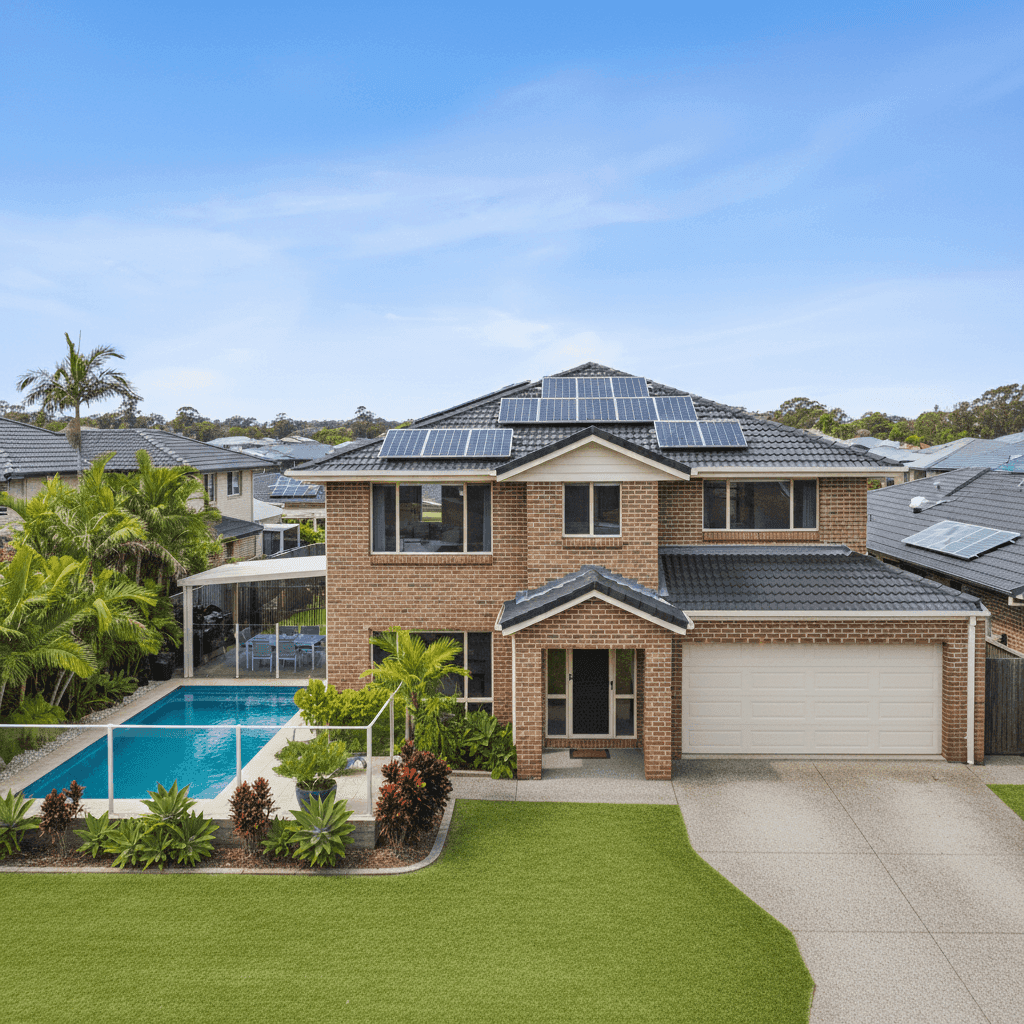
Hope Island, nestled in the northern Gold Coast corridor of Queensland, is one of the state's most sought-after addresses — known for its canal-front streets, golf courses, and modern residential estates. For homeowners in this postcode, understanding what you're paying for home insurance — and whether you're getting a fair deal — is just as important as the property itself.
This article breaks down a real home and contents insurance quote for a four-bedroom, free-standing home in Hope Island QLD 4212, and puts the numbers in context against suburb, state, and national benchmarks.
---
Is This Quote Fair?
The annual premium for this property came in at $3,588 per year (or $348/month), covering both building (insured at $771,000) and contents ($100,000), each with a $1,000 excess.
Our pricing model rates this quote as CHEAP — below average for the area. That's a meaningful finding, given that Hope Island sits within the Gold Coast Local Government Area, where premiums can vary enormously depending on flood zones, proximity to waterways, and individual insurer risk models.
To put it plainly: at $3,588/yr, this homeowner is paying less than the suburb's 25th percentile of $3,628/yr — meaning fewer than one in four comparable properties in the area are quoted at a lower price. That's a strong result by any measure.
For further context, the suburb median sits at $5,486/yr, meaning this quote comes in roughly 35% below what a typical Hope Island homeowner pays. The suburb average, at $30,600/yr, is dramatically higher — a figure skewed by a small number of very high-risk or high-value properties that pull the mean upward. The median is generally the more reliable benchmark for day-to-day comparisons.
---
How Hope Island Compares
Understanding your premium means looking beyond your street. Here's how Hope Island stacks up across multiple levels:
| Benchmark | Annual Premium |
|---|---|
| This Quote | $3,588 |
| Hope Island 25th Percentile | $3,628 |
| Hope Island Median | $5,486 |
| Hope Island Average | $30,600 |
| Hope Island 75th Percentile | $8,631 |
| Gold Coast LGA Average | $8,161 |
| QLD State Median | $3,903 |
| QLD State Average | $9,129 |
| National Median | $2,764 |
| National Average | $5,347 |
You can explore the full breakdown for this postcode at the Hope Island suburb insurance stats page, or compare it against Queensland-wide data and national insurance benchmarks.
A few things stand out in this comparison:
- Hope Island's average ($30,600) is nearly six times the national average ($5,347). This reflects the suburb's exposure to canal and waterway flooding risk, which can make some properties extremely expensive to insure — even if yours isn't one of them.
- This quote beats the QLD state median ($3,903), which is notable given that Hope Island is generally considered a higher-risk suburb than much of regional Queensland.
- Nationally, the median is $2,764 — so this quote is above the national median, but that's entirely expected for a Gold Coast property with a pool, solar panels, and a $771,000 building sum insured.
The takeaway: this is a genuinely competitive quote for the location.
---
Property Features That Affect Your Premium
Several characteristics of this property directly influence how insurers price the risk. Here's what matters most:
Construction & Materials
The home was built in 2009 with brick veneer external walls, a tiled roof, and a concrete slab foundation. This is a reassuring combination for insurers. Brick veneer is durable and fire-resistant, tiled roofs have a long lifespan and perform well in most weather events, and slab foundations are standard and structurally sound. Homes built post-2000 also benefit from more stringent building codes, which reduces the likelihood of structural claims.
Flooring
Tile flooring throughout the home is another premium-friendly feature. Tiles are resistant to water damage, don't warp or stain easily, and are straightforward to replace — all of which reduce the expected cost of claims.
Pool, Solar & Climate Control
The property includes a swimming pool, solar panels, and ducted climate control — three features that add both value and complexity to a policy. Pools increase liability exposure and can be costly to repair or replace. Solar panels represent a significant asset (typically insured under the building sum) and can be damaged by hail or storm events. Ducted climate control systems are expensive to service and replace. Each of these features nudges premiums upward, so achieving a sub-$3,600 result with all three present is a solid outcome.
No Cyclone Risk
Despite being in Queensland, this property is not classified as a cyclone risk area. This is significant — cyclone premiums in northern QLD can be eye-watering. Hope Island's Gold Coast location places it outside the most vulnerable cyclone corridors, which keeps the risk profile more manageable.
Body Corporate / Strata
It's worth noting that this property has a body corporate or strata arrangement. In many cases, the body corporate holds a separate building insurance policy for common areas and the building structure. Homeowners in this situation should confirm exactly what the body corporate policy covers versus what their individual policy needs to address — particularly for internal fixtures, contents, and liability.
---
Tips for Homeowners in Hope Island
Whether you're renewing your policy or shopping around for the first time, here are four practical steps to help you get the best value:
- Check your flood and water damage inclusions carefully. Hope Island's canal-side geography means water ingress and flooding are genuine risks for some properties. Read your Product Disclosure Statement (PDS) closely to understand whether storm surge, riverine flooding, or stormwater overflow are covered — and to what extent.
- Review your building sum insured annually. With construction costs rising across Queensland, the cost to rebuild your home may have increased significantly since you last set your sum insured. Underinsurance is one of the most common — and costly — mistakes homeowners make. A licensed quantity surveyor or your insurer's calculator can help you set an accurate figure.
- Confirm what your body corporate policy covers. If your property falls under a strata or body corporate arrangement, request a copy of the body corporate's insurance certificate of currency. This will clarify what's already covered so you can avoid paying twice — or leaving gaps.
- Compare quotes before your renewal date. Insurers don't always reward loyalty with better pricing. Spending 10 minutes comparing quotes before your renewal can reveal meaningful savings. Get a quote at CoverClub to see what the market looks like for your specific property.
---
Find the Right Cover for Your Home
Whether this quote matches your situation or you're simply trying to understand what fair pricing looks like in Hope Island, having the right data makes all the difference. CoverClub aggregates real insurance quote data to help Australian homeowners make more informed decisions — without the guesswork.
Compare home insurance quotes for your property at CoverClub and see how your premium stacks up against your neighbours, your state, and the rest of the country.