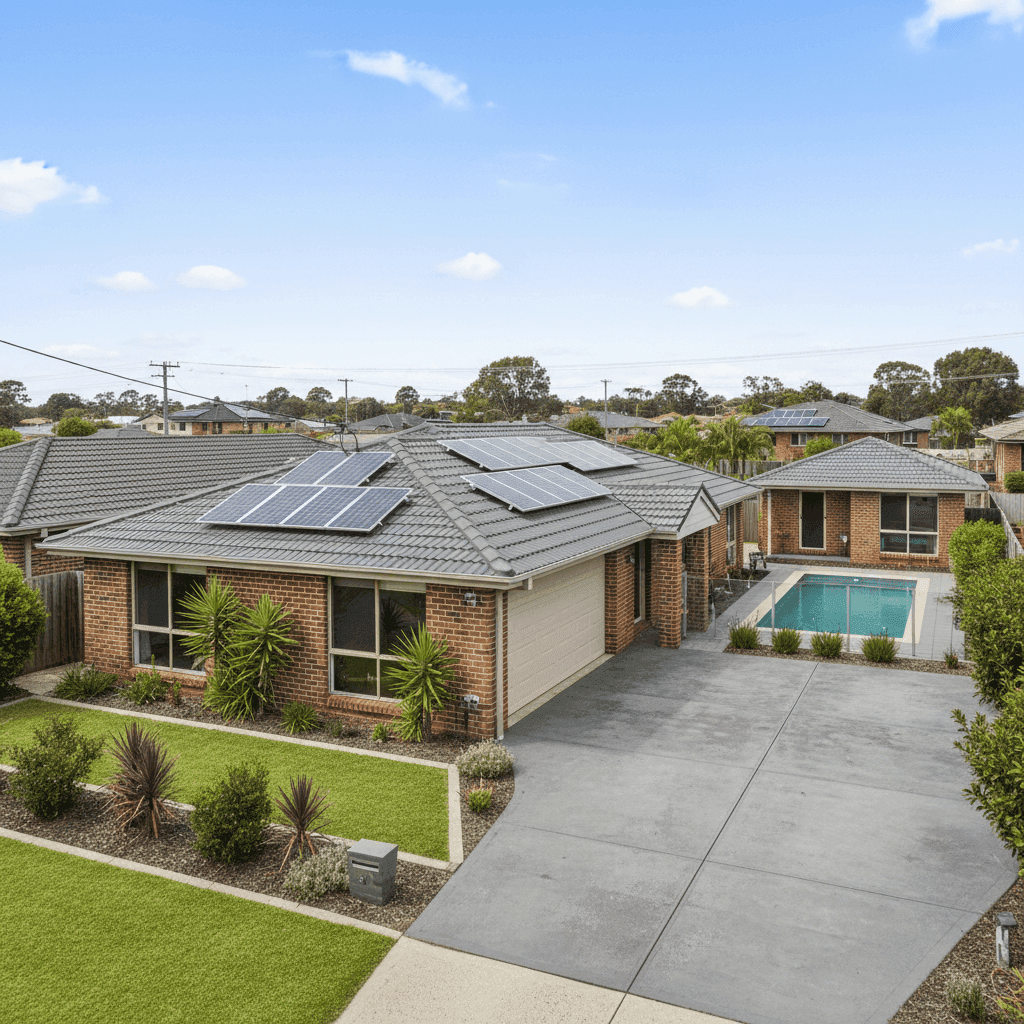
If you own a free standing home in Hoppers Crossing, VIC 3029, you're probably curious whether your home insurance premium is competitive — or whether you're quietly overpaying. This analysis breaks down a real quote for a four-bedroom, three-bathroom brick veneer home in the suburb, comparing it against local, state, and national benchmarks so you can make a more informed decision.
---
Is This Quote Fair?
The quote in question comes in at $1,803 per year (or $173/month) for combined home and contents cover, with a building sum insured of $819,000 and $50,000 in contents cover. Both the building and contents excess are set at $1,000.
Our price rating for this quote is FAIR — Around Average, which is a reasonable outcome for a property of this size and specification. It sits comfortably above the suburb's 25th percentile ($1,052/yr) and below the 75th percentile ($1,894/yr), placing it squarely in the middle of the range for comparable properties in the area.
In plain terms: this isn't a bargain, but it's not an outlier either. Given the property's features — including a pool, solar panels, ducted climate control, and a granny flat — a premium near the top of the mid-range is broadly expected. Each of these additions increases the insurer's exposure, which naturally flows through to the price.
---
How Hoppers Crossing Compares
Understanding where your premium sits relative to broader benchmarks is key to evaluating value. Here's how this quote stacks up:
| Benchmark | Premium |
|---|---|
| This Quote | $1,803/yr |
| Hoppers Crossing suburb average | $1,531/yr |
| Hoppers Crossing suburb median | $1,462/yr |
| LGA (Melton) average | $2,509/yr |
| VIC state average | $3,000/yr |
| VIC state median | $2,718/yr |
| National average | $5,347/yr |
| National median | $2,764/yr |
(Based on 132 quotes collected for the [Hoppers Crossing 3029 area](https://coverclub.com.au/stats/VIC/3029/hoppers-crossing).)
A few things stand out here. First, this quote is above the suburb average and median — but that's largely explained by the property's above-average size (214 sqm) and its additional features. A standard four-bedroom home without a pool, granny flat, or solar system would likely land closer to the suburb median.
Second, the quote is well below both the Victorian state average and the national average, which is genuinely encouraging. Across Victoria, the average home insurance premium sits at $3,000/yr — meaning this quote is roughly 40% cheaper than the state norm. Compared to the national average of $5,347/yr, the savings are even more striking, though it's worth noting that national figures are heavily influenced by high-risk areas such as cyclone-prone regions in Queensland and the Northern Territory.
The Melton LGA average of $2,509/yr is also a useful reference point. This quote sits $706 below the LGA average, which suggests Hoppers Crossing itself may attract relatively more competitive pricing within the broader Melton council area — likely due to its established infrastructure and lower exposure to certain natural hazards.
---
Property Features That Affect Your Premium
This particular property has several characteristics worth understanding from an insurance perspective:
Brick veneer construction with a concrete tile roof — This is a solid, low-risk combination in the eyes of most insurers. Brick veneer offers good fire resistance, and concrete roofing is durable and less susceptible to storm damage than corrugated iron or Colorbond in some scenarios. This likely contributes to a more competitive base premium.
Slab foundation — Slab-on-ground construction is standard for the era (built in 1989) and generally considered stable in suburban Melbourne. It's neither a risk factor nor a premium reducer on its own.
Swimming pool — A pool adds to the replacement cost of the property and introduces liability considerations. Insurers typically factor this into the building sum insured, which can nudge premiums upward.
Solar panels — Rooftop solar systems are increasingly common but add meaningful replacement value. Panels, inverters, and associated wiring can cost tens of thousands of dollars to replace, and some insurers treat them as a separate consideration within the building sum insured.
Ducted climate control — Ducted HVAC systems are expensive to repair or replace and are generally captured within the building sum insured. Their presence supports a higher sum insured figure, which flows through to the premium.
Granny flat — A secondary dwelling on the property adds significant replacement cost and complexity. If the granny flat is included in the building sum insured, it's a meaningful contributor to the overall premium. Homeowners should confirm with their insurer exactly what structures are covered.
Building sum insured of $819,000 — For a 214 sqm home with the features listed above — including a pool and granny flat — this figure appears reasonable, though it's always worth having your sum insured independently verified to avoid being underinsured.
---
Tips for Homeowners in Hoppers Crossing
1. Review your sum insured regularly Construction costs have risen sharply in recent years. If your building sum insured hasn't been updated since you first took out the policy, there's a real risk of being underinsured. Use a building cost calculator or speak to a quantity surveyor to ensure your coverage reflects today's rebuild costs.
2. Ask about multi-policy discounts Many insurers offer discounts when you bundle home and contents cover — which this policy already does — but you may also find savings by combining with car insurance or other products. It's worth asking your insurer directly.
3. Consider your excess strategically Both excesses on this policy are set at $1,000. Raising your excess can reduce your annual premium, which may make sense if you have the financial buffer to cover a higher out-of-pocket cost in the event of a claim. Conversely, if cash flow is a concern, keeping a lower excess provides more predictable costs.
4. Compare quotes at renewal time Even if you're happy with your current insurer, the home insurance market is competitive and premiums can vary significantly between providers for identical cover. Running a comparison before your renewal date takes only a few minutes and could save you hundreds of dollars per year.
---
Ready to See What You Could Pay?
Whether you're reviewing an existing policy or shopping for cover for the first time, comparing quotes is the smartest first step. At CoverClub, we make it easy to see what home insurance actually costs for properties like yours — with real data, not guesswork. Get a quote today and find out if there's a better deal waiting for you.