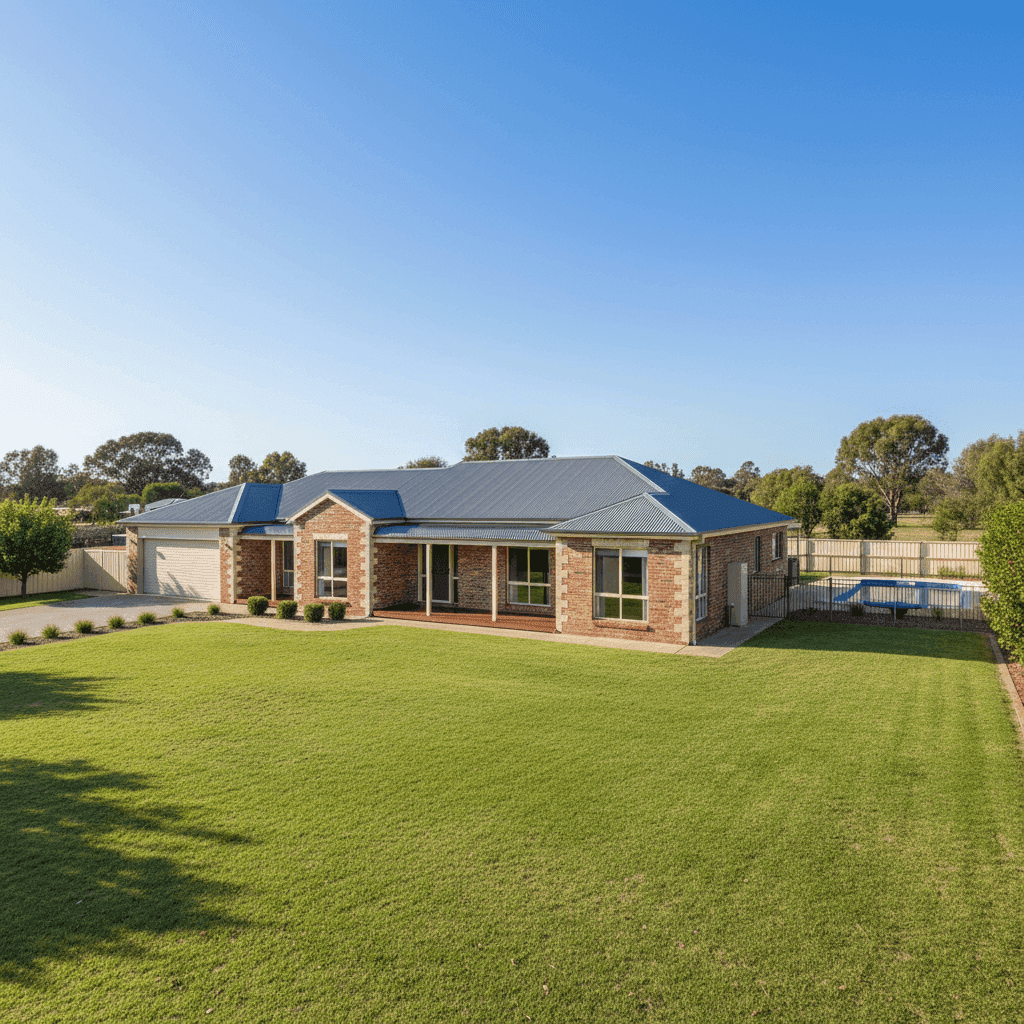
If you own a free standing home in Howlong, NSW 2643, you already know the appeal of this quiet riverside town near the Victorian border. But when it comes to protecting your property, understanding whether you're paying a fair premium — or leaving money on the table — can make a real difference to your household budget. This article breaks down a recent home and contents insurance quote for a five-bedroom, brick veneer home in Howlong, compares it against local, state, and national benchmarks, and offers practical tips to help you get the best value cover.
---
Is This Quote Fair?
The quote in question comes in at $4,268 per year (or $417 per month) for combined home and contents insurance, covering a building sum insured of $870,000 and contents valued at $400,000. Both the building and contents carry a $1,000 excess.
Our price rating for this quote is FAIR — Around Average, and the data backs that up. Sitting comfortably between the suburb's 25th percentile ($3,417/yr) and 75th percentile ($4,901/yr), this premium lands almost squarely in the middle of the market for comparable properties in the area. It's slightly below the suburb median of $4,504/yr, which is a modest but meaningful saving.
In other words, you're not getting a bargain-basement deal, but you're also not being overcharged. For a large five-bedroom home with a pool, ducted climate control, and a building sum insured of $870,000, a premium in this range is broadly reasonable. That said, "fair" doesn't mean "the best available" — there's still meaningful room to shop around, particularly given the spread between the 25th and 75th percentiles in this suburb.
---
How Howlong Compares
To put this quote in proper context, it helps to look at how Howlong stacks up against broader benchmarks. You can explore the full data on the Howlong suburb stats page, the NSW state overview, and national insurance statistics.
| Benchmark | Average Premium | Median Premium |
|---|---|---|
| Howlong (NSW 2643) | $7,789/yr | $4,504/yr |
| NSW State | $9,528/yr | $3,770/yr |
| National | $5,347/yr | $2,764/yr |
A few things stand out here. First, the Howlong suburb average of $7,789/yr is notably higher than the median of $4,504/yr, which tells us the local sample includes some significantly high-cost outliers — likely properties with high rebuild values, flood exposure, or premium cover levels. The quote of $4,268/yr sits well below this average, which is encouraging.
Second, while the NSW state average of $9,528/yr looks alarming, the state median of $3,770/yr paints a more grounded picture. NSW premiums are heavily skewed by high-risk postcodes — coastal flood zones, bushfire-prone areas, and dense urban centres — which drag the average upward. Howlong, as an inland rural town, tends to avoid the most extreme risk categories.
Finally, the national median of $2,764/yr is considerably lower than what's being quoted here, but it's worth remembering that this quote covers a large property (139 sqm, five bedrooms, three bathrooms) with a substantial sum insured. Comparing a property of this size and value to the national median — which includes small apartments and modest dwellings — isn't entirely apples-to-apples.
---
Property Features That Affect Your Premium
Several characteristics of this property directly influence what insurers charge. Understanding these factors can help you have more informed conversations when reviewing or negotiating your policy.
Brick Veneer Construction Brick veneer walls are generally viewed favourably by insurers. They offer solid fire resistance and structural durability compared to timber or weatherboard homes, which can translate to more competitive premiums.
Steel / Colorbond Roof A Colorbond steel roof is another plus from an insurance perspective. It's highly durable, resistant to ember attack, and less prone to hail damage than terracotta or concrete tiles. Insurers tend to price this construction type more competitively.
Concrete Slab Foundation Slab foundations are standard in modern builds and are generally considered low-risk. There's no underfloor cavity for moisture build-up or pest ingress, which reduces certain claim risks.
Swimming Pool The presence of a pool adds to the overall replacement cost of the property and introduces some liability considerations. This is likely contributing modestly to the premium compared to an equivalent home without one.
Ducted Climate Control Ducted systems are a significant fixed asset. Their replacement cost is built into the building sum insured and can influence the premium, particularly if the system is integrated throughout a larger home.
Building Size and Age At 139 sqm and built in 2000, this is a well-established home. Properties from this era are generally well-regarded by insurers — modern enough to meet building codes but not so old as to raise concerns about ageing infrastructure. The 2000 construction date also means the home predates some of the more stringent cyclone-resistance standards required in northern Australia, though cyclone risk is not applicable here.
Sum Insured A building sum insured of $870,000 is on the higher end for a regional NSW property of this size, but it reflects the full cost of rebuilding — not the market value. Getting this figure right is critical: underinsuring can leave you significantly out of pocket after a major claim, while overinsuring means paying unnecessarily high premiums.
---
Tips for Homeowners in Howlong
1. Review Your Sum Insured Annually Construction costs have risen sharply in regional NSW over recent years. It's worth using a building cost calculator each year to ensure your $870,000 sum insured still reflects realistic rebuild costs. An underinsured home can result in a proportional payout — meaning you absorb a share of any loss yourself.
2. Compare Quotes Before Renewal The gap between the 25th percentile ($3,417/yr) and 75th percentile ($4,901/yr) in Howlong represents a potential saving of over $1,400 per year for broadly similar cover. Loyalty to a single insurer rarely pays off — it's worth getting at least two or three competing quotes before your renewal date.
3. Consider Your Excess Strategically Both the building and contents excess on this policy sit at $1,000. Opting for a higher voluntary excess — say $2,500 — can meaningfully reduce your annual premium. If you're unlikely to make small claims (and most homeowners aren't), a higher excess is often a smart trade-off.
4. Protect Your Pool and Outbuildings If you have a pool fence, shed, or other structures on the property, confirm they're explicitly covered under your policy. Some policies limit or exclude outbuildings unless specified, and pool equipment can be expensive to replace.
---
Ready to Compare?
A "fair" rating is a solid starting point, but it's not the finish line. Whether you're renewing soon or just curious about what else is out there, comparing quotes takes only a few minutes and could save you hundreds of dollars a year. Get a home insurance quote at CoverClub and see how your current premium stacks up against the broader market.