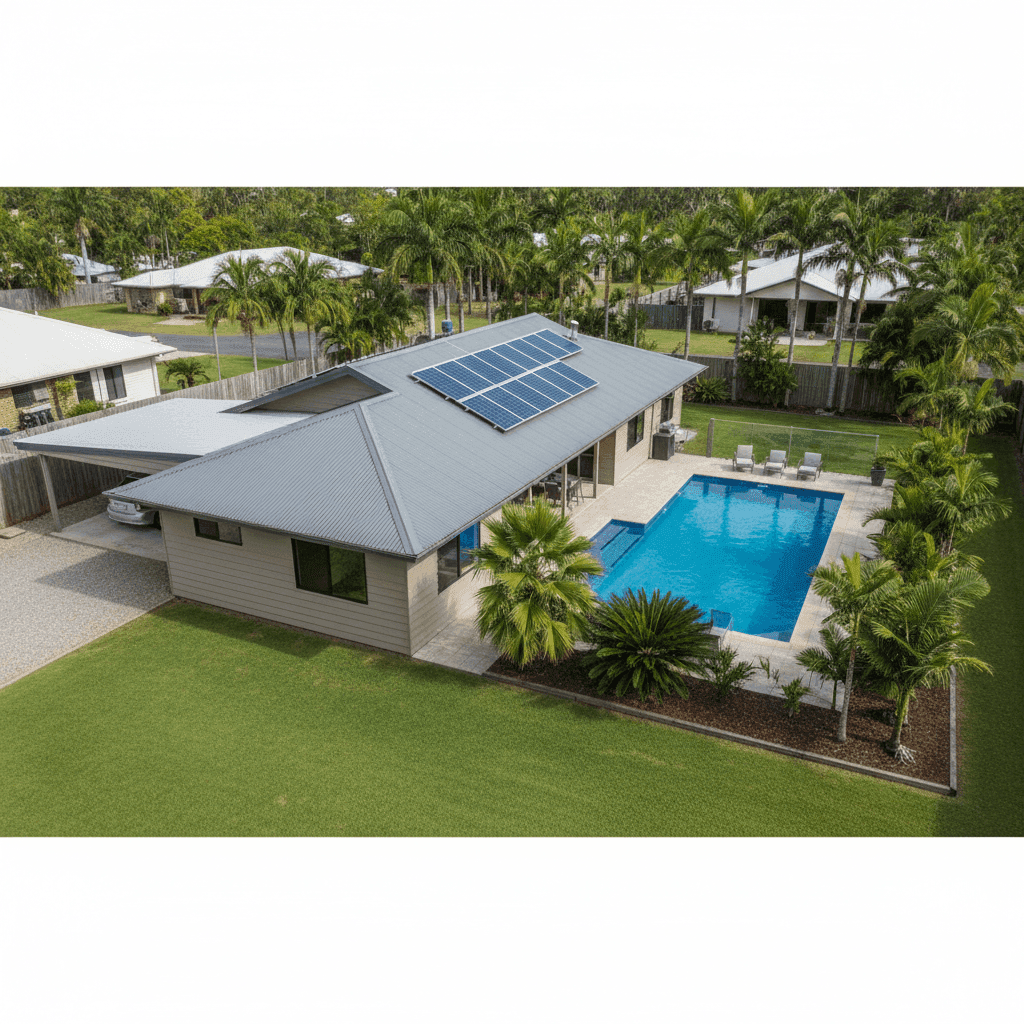
If you own a free standing home in Humpty Doo, NT 0836, you already know that insuring a property in the Northern Territory comes with its own set of considerations — from the tropical climate to cyclone season. This article breaks down a real building insurance quote for a five-bedroom, two-bathroom weatherboard home in the area, and puts the numbers into context so you can make a more informed decision about your cover.
---
Is This Quote Fair?
The quote in question comes in at $4,066 per year (or $383 per month) for building-only cover, with a $1,000 building excess and a sum insured of $1,490,000. Our price rating for this quote is FAIR — Around Average.
That rating reflects where this premium sits relative to similar properties in the suburb. At $4,066 annually, it sits above the Humpty Doo suburb average of $3,733/yr and meaningfully above the suburb median of $3,160/yr — but it's well within the upper quartile range, with the 75th percentile sitting at $5,124/yr. In other words, roughly a quarter of comparable quotes in the area cost even more than this one.
A "fair" rating doesn't mean you can't do better — it means the quote is competitive enough that you're not being significantly overcharged, but there's still room to shop around and potentially save.
---
How Humpty Doo Compares
To understand whether this premium makes sense, it helps to zoom out and look at the broader picture.
| Benchmark | Average Premium | Median Premium |
|---|---|---|
| Humpty Doo (suburb) | $3,733/yr | $3,160/yr |
| Northern Territory | $3,709/yr | $3,580/yr |
| National | $2,965/yr | $2,716/yr |
| Litchfield LGA | $3,734/yr | — |
A few things stand out here. First, premiums in Humpty Doo closely mirror both the NT state average and the Litchfield LGA average — all hovering around the $3,700–$3,730 mark. This consistency suggests that local risk factors are fairly uniform across the region, and that insurers are pricing NT properties similarly regardless of whether you're looking at suburb, LGA, or state level.
Second, the gap between NT and national averages is substantial. The national average sits at $2,965/yr — roughly $770 less than what Humpty Doo homeowners typically pay. That difference isn't arbitrary; it reflects the elevated risk profile of properties in the Top End, particularly around cyclone exposure and the cost of building materials and labour in remote areas.
The quote of $4,066/yr sits about 9% above the suburb average and 28% above the suburb median. That's a meaningful gap, but given the specific features of this property — which we'll explore below — it's not surprising.
---
Property Features That Affect Your Premium
Several characteristics of this property have a direct bearing on what insurers charge. Understanding them helps explain why this quote lands where it does.
Cyclone risk area This is arguably the single biggest factor. Humpty Doo falls within a designated cyclone risk zone, and insurers price that risk accordingly. Cyclone-rated cover typically involves higher premiums and, in many policies, a separate cyclone excess. Homeowners in this area should always confirm that their policy explicitly covers cyclone damage — not all policies are equal on this front.
Weatherboard wood construction Timber-framed, weatherboard homes are generally considered higher risk than brick or concrete construction, particularly in cyclone-prone regions. Wood can be more vulnerable to wind damage and moisture ingress, which insurers factor into their calculations.
Steel/Colorbond roof On the upside, a Colorbond steel roof is a positive for insurers in cyclone zones. When properly installed and maintained to the relevant Australian Standards, steel roofing can perform well in high-wind events — potentially moderating the premium impact of the weatherboard walls.
Slab foundation A concrete slab foundation is generally viewed favourably by insurers. It's stable, resistant to termite entry through the subfloor, and less susceptible to movement in wet-dry climate cycles — all relevant in the NT.
Swimming pool A pool adds to the replacement cost of the property and introduces some liability considerations, both of which contribute to a higher sum insured and, in turn, a higher premium.
Solar panels Solar panels are increasingly common across Australia, but they do add to the insured value of a home. It's worth confirming with your insurer that your panels are explicitly covered under your building policy, as some policies treat them as an optional add-on.
Large building size (277 sqm) At 277 square metres, this is a sizeable home. The sum insured of $1,490,000 reflects both the size and the elevated cost of construction and labour in regional NT. Getting the sum insured right is critical — underinsurance is a real risk, particularly in areas where rebuild costs are higher than the national average.
---
Tips for Homeowners in Humpty Doo
1. Review your cyclone cover carefully Don't assume all building policies offer the same cyclone protection. Check whether your policy has a separate cyclone excess (often a percentage of the sum insured rather than a flat dollar amount), and make sure the definition of "cyclone damage" in your policy document is broad enough to cover wind, rain ingress, and storm surge where relevant.
2. Get your sum insured right With construction costs elevated across regional NT, underinsurance is a genuine concern. The $1,490,000 sum insured on this property reflects the true cost of rebuilding a large home in this area. Use a building cost calculator or speak with a local builder to validate your figure — and revisit it annually, as costs can shift significantly year to year.
3. Ask about discounts for cyclone-resilient upgrades Some insurers offer premium discounts for homes that meet higher wind-resistance standards — things like cyclone-rated roofing fixings, reinforced garage doors, and shutters on windows. If you've made any of these improvements, it's worth asking your insurer whether they're reflected in your premium.
4. Compare quotes before renewal The suburb data here is based on 33 quotes — a meaningful sample that shows a wide spread between the 25th percentile ($2,718/yr) and the 75th ($5,124/yr). That's a $2,400+ gap, which means shopping around can genuinely pay off. Don't let your policy auto-renew without checking what else is available.
---
Compare Home Insurance Quotes in Humpty Doo
Whether you're reviewing an existing policy or looking for cover on a new property, comparing quotes is the most reliable way to know you're getting value. At CoverClub, we make it easy to see how your premium stacks up against real data from your suburb and across the country. Get a quote today and find out where you stand.