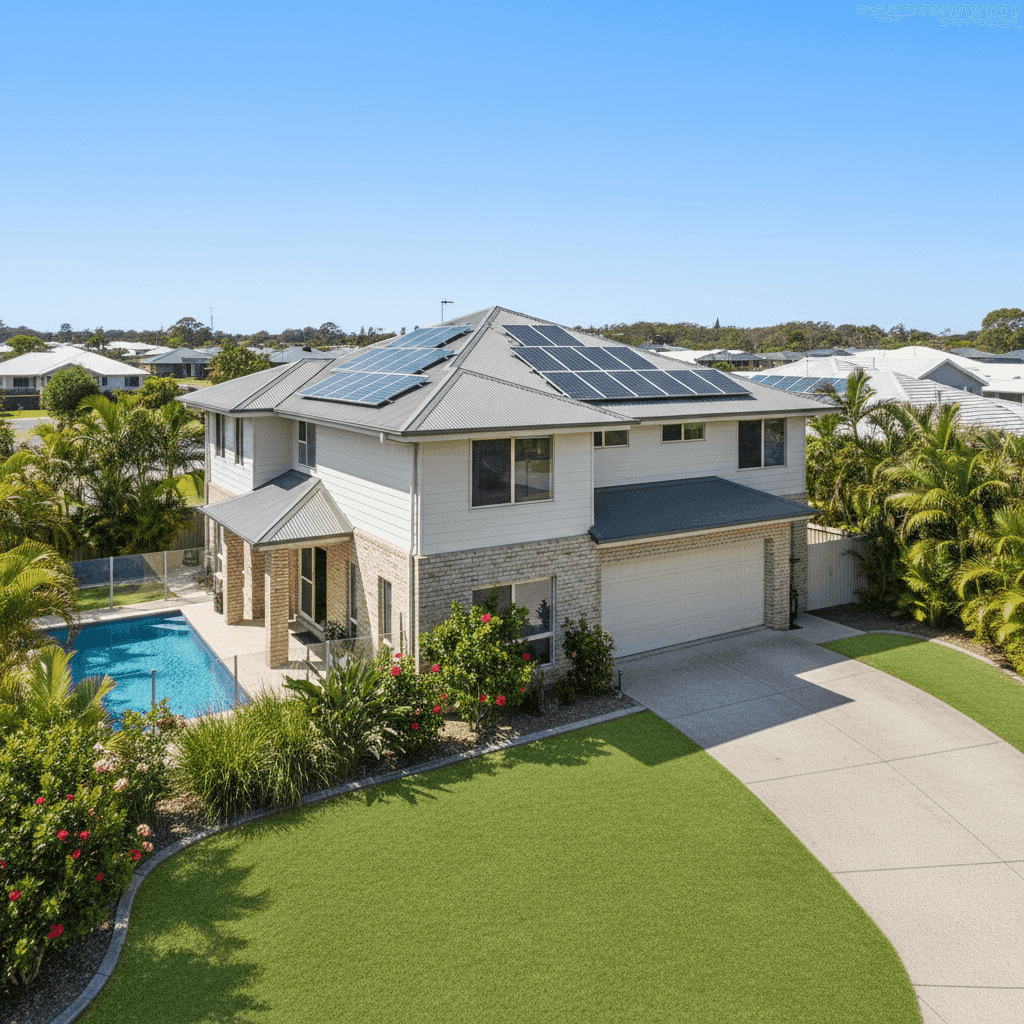
Jacobs Well is a quiet coastal community nestled on the southern shores of Moreton Bay in Queensland's Gold Coast region. Known for its relaxed waterway lifestyle and proximity to both Brisbane and the Gold Coast, it's an increasingly popular location for families seeking space and serenity. For owners of a free standing home in this suburb, understanding what drives your home insurance premium — and whether you're getting a fair deal — is an important part of protecting one of your biggest assets.
This article breaks down a recent Home and Contents insurance quote for a four-bedroom, three-bathroom free standing home in Jacobs Well (QLD 4208), and puts the numbers into context against local, state, and national benchmarks.
---
Is This Quote Fair?
The quoted annual premium of $4,078 per year (or $384 per month) has been rated Fair — Around Average for this property and location. This is an encouraging result, sitting comfortably below both the suburb average and the state average, while landing just above the suburb's 25th percentile of $3,752 per year.
In practical terms, this means the quote is neither a standout bargain nor cause for concern. It reflects a premium that is broadly in line with what similar properties in the area attract, without venturing into the elevated territory that many Jacobs Well homeowners face. Given the property's size, features, and the relatively high-risk insurance environment across Queensland, a "Fair" rating here is genuinely a reasonable outcome.
The building is insured for $864,000 with $100,000 in contents cover, and both the building and contents excess are set at $1,000 — a standard configuration that balances out-of-pocket exposure with premium affordability.
---
How Jacobs Well Compares
The pricing landscape in Jacobs Well is notably wide, which reflects the diverse mix of properties in the suburb — from modest homes to larger waterfront or lifestyle properties. Here's how this quote stacks up:
| Benchmark | Premium |
|---|---|
| This Quote | $4,078/yr |
| Suburb 25th Percentile | $3,752/yr |
| Suburb Median | $5,144/yr |
| Suburb 75th Percentile | $10,869/yr |
| Suburb Average | $20,858/yr |
| LGA (Gold Coast) Average | $8,161/yr |
| QLD State Average | $9,129/yr |
| QLD State Median | $3,903/yr |
| National Average | $5,347/yr |
| National Median | $2,764/yr |
A few things stand out from this data. First, the suburb average of $20,858 is dramatically higher than the median of $5,144 — a clear sign that a small number of very high-value or high-risk properties are pulling the average upward. The median is almost always a more reliable indicator of what a "typical" homeowner in the area pays, and against that benchmark, this quote looks competitive.
Second, Queensland as a state carries significantly higher insurance costs than the national average — the QLD state average of $9,129 is nearly double the national average of $5,347. This reflects the elevated risks associated with Queensland's climate, including flooding, storms, and hail events. Jacobs Well, while not classified as a cyclone risk area, still sits within a broader Queensland risk environment.
You can explore more detailed pricing data for this suburb at the Jacobs Well insurance stats page, or compare across the state on the Queensland home insurance stats page. For a broader perspective, the national home insurance statistics provide useful context on how Australian premiums vary by region.
---
Property Features That Affect Your Premium
Several characteristics of this property have a meaningful influence on its insurance premium — both positively and negatively.
Double Brick Construction Double brick external walls are generally viewed favourably by insurers. They offer strong structural integrity, good resistance to wind and impact damage, and tend to perform well in storm events. This construction type can contribute to a more competitive premium compared to lightweight or timber-framed alternatives.
Steel / Colorbond Roof Colorbond steel roofing is a popular choice in Queensland for good reason — it's durable, low-maintenance, and handles heat and rain well. Insurers typically rate steel roofing positively, as it is less prone to storm damage than some other materials and has a long serviceable life.
Concrete Slab Foundation A slab-on-ground foundation is a stable and well-regarded base type for insurers. It reduces exposure to certain risks such as subfloor flooding or pest damage that can affect raised timber foundations.
Swimming Pool The presence of a pool adds to the replacement cost of the property and introduces some additional liability considerations, both of which can nudge premiums upward. Pool fencing compliance and maintenance are also relevant factors insurers may consider.
Solar Panels Solar panels are an increasingly common feature on Queensland homes, but they do add to the insured value of the building. Ensuring your sum insured accounts for the replacement cost of your solar system is important — underinsurance is a real risk if panels aren't factored in properly.
Ducted Climate Control Ducted air conditioning is a significant built-in feature that contributes to the overall building replacement value. As with solar panels, it's worth confirming your sum insured adequately reflects the cost of replacing this system in the event of a total loss.
Building Size: 235 sqm At 235 square metres, this is a generously sized home. The $864,000 sum insured translates to approximately $3,677 per square metre — a figure that sits within a reasonable range for a well-appointed Queensland home with quality inclusions, though homeowners should periodically review this against current construction costs, which have risen significantly in recent years.
---
Tips for Homeowners in Jacobs Well
1. Review Your Sum Insured Regularly Construction costs in Queensland have climbed considerably since 2020. A home built in 2015 with a sum insured set some years ago may no longer reflect the true cost to rebuild. Use an independent building cost calculator or speak with a quantity surveyor to validate your insured amount — underinsurance can leave you seriously out of pocket after a major claim.
2. Check That Your Solar and Pool Are Properly Covered Both solar panels and swimming pools are sometimes excluded or limited under standard home insurance policies unless specifically declared. Confirm with your insurer that these features are included in your cover and that the sum insured accounts for their full replacement value.
3. Consider the Value of a Higher Excess With both building and contents excesses currently set at $1,000, there may be room to increase these in exchange for a lower annual premium. If you have a solid emergency fund and are unlikely to make small claims, a higher excess can be a cost-effective strategy.
4. Compare Quotes at Renewal Time A "Fair" rating is a good starting point, but the insurance market is competitive and premiums can shift significantly from year to year. Making time to compare quotes before your renewal date — rather than simply accepting the rollover — is one of the most effective ways to avoid paying more than you need to.
---
Ready to Compare?
Whether you're reviewing an existing policy or shopping for cover for the first time, comparing quotes is the smartest way to make sure you're getting genuine value. Get a home insurance quote at CoverClub and see how different providers price your property — it only takes a few minutes and could save you hundreds of dollars a year.