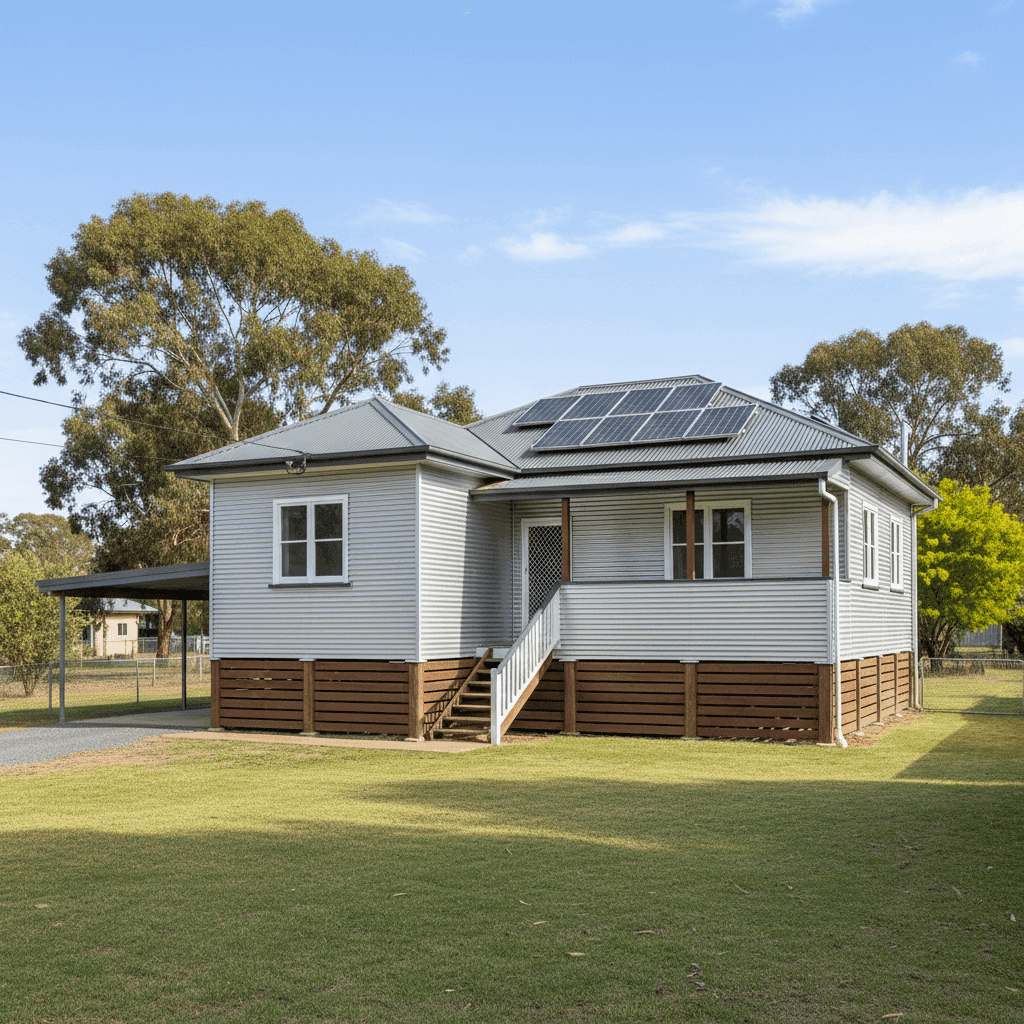
Home insurance costs in regional New South Wales can vary dramatically depending on where you live, what your home is built from, and how insurers assess local risk. This article breaks down a real home and contents insurance quote for a two-bedroom free standing home in Kandos, NSW 2848 — a small town in the Lithgow Local Government Area, nestled in the Central Tablelands west of the Blue Mountains. We'll examine whether the quoted premium represents good value, how it stacks up against local and national benchmarks, and what property features are likely influencing the price.
---
Is This Quote Fair?
The annual premium for this property came in at $1,059 per year (or roughly $98 per month), covering both building (sum insured: $314,000) and contents ($50,000). Our pricing model rates this quote as CHEAP — below average for the area.
To put that in perspective: the suburb average for Kandos sits at $2,110 per year, with a median of $2,152. That means this quote is approximately 50% below what most Kandos homeowners are paying for comparable cover. Even the cheapest quartile of quotes in the suburb starts at $1,924 — so at $1,059, this premium is well below the 25th percentile.
For a homeowner looking to protect a modest two-bedroom property, this is a genuinely competitive result. That said, it's worth noting the excess structure: a $4,000 building excess and $2,000 contents excess are on the higher end, and these higher excesses are likely a key reason the premium is so low. Before celebrating the price, make sure you're comfortable covering those out-of-pocket costs in the event of a claim.
---
How Kandos Compares
Kandos is an affordable suburb to insure relative to broader benchmarks — and this quote reinforces that.
| Benchmark | Average Premium |
|---|---|
| Kandos (suburb) | $2,110 / yr |
| NSW state average | $3,801 / yr |
| National average | $2,965 / yr |
| Lithgow LGA average | $11,842 / yr |
| This quote | $1,059 / yr |
A few things stand out here. First, Kandos is already a relatively affordable suburb to insure — its average of $2,110 is well below both the NSW state average of $3,801 and the national average of $2,965. This suggests the area carries lower-than-average perceived risk from insurers, which is a positive sign for local homeowners.
What's particularly striking is the Lithgow LGA average of $11,842. This figure is heavily skewed by high-risk pockets within the broader LGA — likely areas with significant bushfire exposure or other hazards. Kandos itself appears to be a more benign part of the region from an insurance risk standpoint, which is why its suburb-level average is so much lower than the LGA as a whole.
This quote, at $1,059, sits dramatically below every benchmark — a strong result by any measure.
---
Property Features That Affect Your Premium
Several characteristics of this property likely contribute to its favourable premium outcome.
Aluminium cladding and Colorbond roof Aluminium external walls and steel/Colorbond roofing are both considered durable, low-maintenance materials by insurers. They're resistant to rot, fire, and pest damage, and tend to attract more competitive premiums compared to older materials like weatherboard or fibrous cement sheeting.
Stump foundation and timber/laminate flooring The home sits on stumps and is elevated by at least one metre. While elevated homes can sometimes attract higher premiums in cyclone-prone areas (not applicable here — this property is outside cyclone risk zones), in a temperate inland region like Kandos, elevation can actually be a modest positive. It reduces the risk of underfloor moisture damage and may assist with flood resilience in low-lying areas.
The timber and laminate flooring is standard for homes of this era and construction type. Insurers generally price this similarly to other common flooring types, though it does carry some replacement cost consideration.
Construction year: 1972 At over 50 years old, this home is in the bracket where insurers pay close attention to the age of plumbing, electrical, and roofing systems. However, the Colorbond roof and aluminium cladding suggest the property has been updated over the years — which likely helps keep the premium down compared to an entirely original 1970s build.
Solar panels The presence of solar panels adds a modest layer of complexity to the insured value. Panels are typically covered under building insurance, and their replacement cost should ideally be reflected in the sum insured. At $314,000, the building cover appears reasonable for a 105 sqm home in a regional NSW town, though it's always worth checking that solar systems are explicitly listed in the policy.
No pool, no ducted climate control The absence of a swimming pool and ducted air conditioning simplifies the risk profile and reduces the overall replacement cost — both factors that keep premiums lean.
---
Tips for Homeowners in Kandos
1. Review your sum insured regularly Construction costs have risen sharply across regional NSW in recent years. A building sum insured of $314,000 for a 105 sqm home is worth reviewing annually — use a building cost calculator or speak with a local builder to ensure you're not underinsured. Underinsurance can leave you significantly out of pocket after a major claim.
2. Understand your excess before you commit This policy carries a $4,000 building excess and a $2,000 contents excess. These are higher than typical, and while they've helped reduce the annual premium, they mean you'd be paying a substantial amount before your insurer steps in. If your savings buffer is limited, it may be worth comparing policies with lower excesses — even if the premium is slightly higher.
3. Confirm solar panel coverage If your solar system isn't explicitly listed in your policy schedule, ask your insurer to confirm it's covered under building insurance. Some policies include panels automatically; others require them to be itemised. Given the cost of replacement, this is worth a quick phone call.
4. Shop around at renewal time Insurance loyalty rarely pays off in Australia. Premiums can shift significantly year to year, and the gap between the cheapest and most expensive quotes in Kandos spans hundreds of dollars. Compare quotes at CoverClub before your renewal date to make sure you're still getting a competitive deal.
---
Find Your Best Rate with CoverClub
Whether you're a first-time buyer or a long-time Kandos resident reviewing your existing cover, comparing quotes is the single most effective way to avoid overpaying. CoverClub makes it easy to see what multiple insurers would charge for your specific property — in seconds, with no obligation. Get a home insurance quote today and find out if you're paying more than you need to.