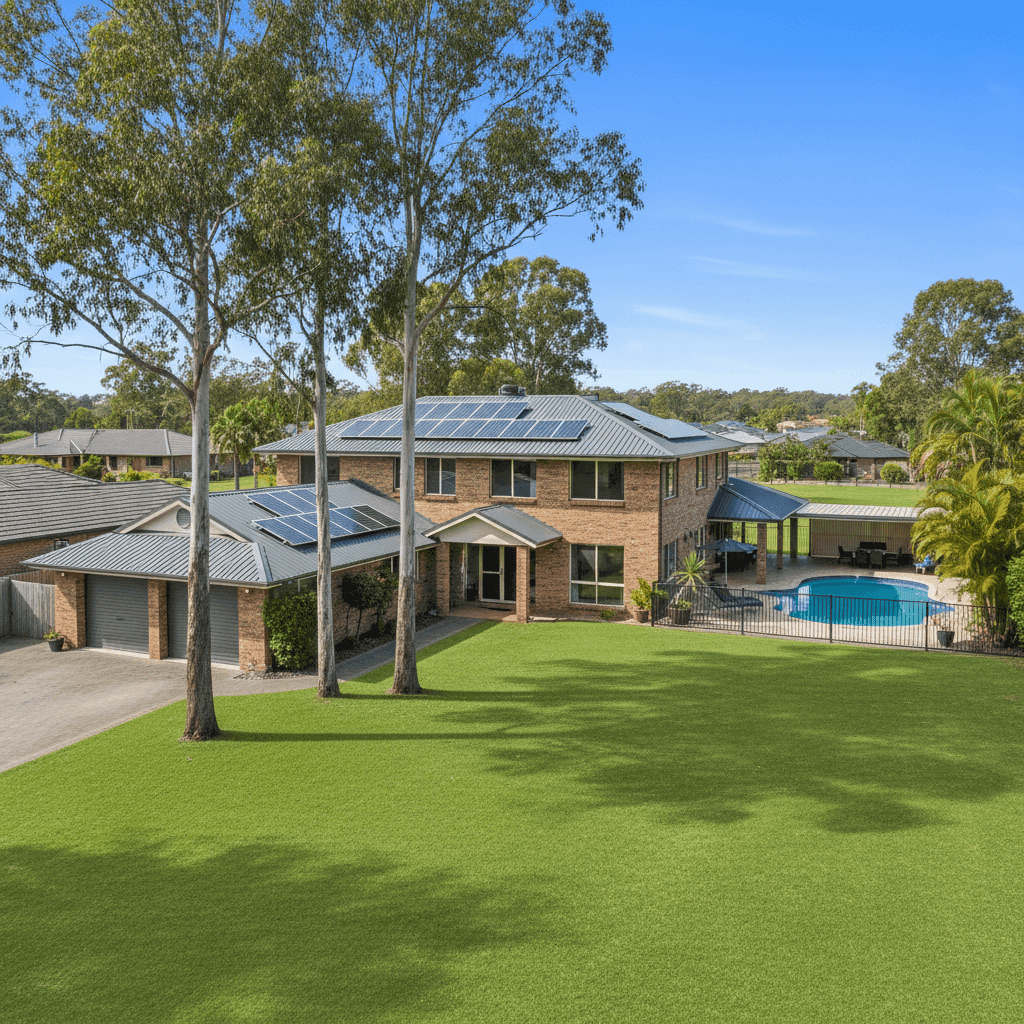
Karana Downs is a quiet, semi-rural suburb on Brisbane's western fringe, sitting within the Ipswich–Brisbane corridor at postcode 4306. It's the kind of area where larger family homes on generous blocks are the norm — and this particular property fits that profile well: a six-bedroom, two-bathroom free-standing home built in 1982, clocking in at 214 sqm of living space. With a pool, solar panels, and ducted climate control, it's a well-appointed family residence. So how does its home and contents insurance quote measure up?
---
Is This Quote Fair?
The quote in question comes in at $3,751 per year (or $353/month) for combined home and contents cover, with a building sum insured of $924,000 and $100,000 in contents cover. Both the building and contents excesses are set at $1,000.
Our price rating for this quote is FAIR — Around Average, and the data backs that up. The suburb median premium for Karana Downs sits at $3,694/year, meaning this quote is just $57 above the midpoint of what others in the area are paying. That's a negligible difference and well within normal variation between insurers.
What's reassuring here is that "fair" doesn't mean "stuck." There's still a meaningful spread of premiums in this suburb — the 25th percentile sits at $2,411/year, which means roughly a quarter of comparable properties are being insured for significantly less. That gap of over $1,300 per year is absolutely worth exploring through comparison shopping.
---
How Karana Downs Compares
To put this quote in proper context, it helps to look at the broader picture. Here's how Karana Downs stacks up against state and national benchmarks:
| Benchmark | Average Premium | Median Premium |
|---|---|---|
| Karana Downs (suburb) | $4,336/yr | $3,694/yr |
| Queensland (state) | $9,129/yr | $3,903/yr |
| Australia (national) | $5,347/yr | $2,764/yr |
A few things stand out immediately. Queensland's average premium of $9,129/year looks alarming at first glance, but the median of $3,903 tells a more nuanced story. The state average is heavily skewed by high-risk areas — think cyclone-prone coastal regions in Far North Queensland, flood-affected river towns, and bushfire corridors — which drag the mean upward significantly. Karana Downs, by contrast, is not classified as a cyclone risk area, which is a meaningful advantage.
The national average of $5,347 is similarly skewed. The national median of $2,764 reflects that many Australian homeowners — particularly in lower-risk urban and suburban areas — pay considerably less than the headline figure suggests.
For Karana Downs specifically, the suburb average of $4,336 is notably lower than both the state and national averages, suggesting the area carries a relatively moderate risk profile overall. This quote, at $3,751, sits below the suburb average and right around the median — a solid position.
You can explore more local data on the Karana Downs insurance stats page, compare it against the full Queensland picture, or see where it lands on the national insurance stats overview.
---
Property Features That Affect Your Premium
Several characteristics of this home will influence how insurers assess and price the risk. Here's what's most relevant:
Age and construction (1982, brick veneer, Colorbond roof, slab foundation) Homes built in the early 1980s are old enough to have some wear on key systems — plumbing, wiring, and roof fixtures — but not so old as to be considered heritage or high-risk by most insurers. Brick veneer is generally viewed favourably: it's durable, fire-resistant, and widely understood by underwriters. A steel/Colorbond roof is similarly well-regarded — it's lightweight, low-maintenance, and performs well in storms. A concrete slab foundation adds structural stability and reduces the risk of subsidence-related claims.
High building sum insured ($924,000) At 214 sqm for a six-bedroom home, the rebuild cost of $924,000 reflects the scale and complexity of the dwelling. Larger homes cost more to insure simply because they cost more to rebuild. It's worth periodically reviewing this figure — underinsurance is a common and costly mistake, particularly as construction costs have risen sharply in recent years.
Pool, solar panels, and ducted climate control These three features all add value to the home but also add to the insurer's exposure. A pool introduces liability considerations (especially with young children or visitors) as well as potential equipment claims. Solar panels increase the replacement cost of the roof structure and can complicate claims if damaged by storms or hail. Ducted climate control is an expensive system to repair or replace, and its inclusion in the contents or building sum insured should be confirmed with your insurer.
Vinyl flooring Vinyl is practical and cost-effective to replace, which works in your favour from a contents and building perspective — it's less expensive to reinstate than hardwood or tile.
---
Tips for Homeowners in Karana Downs
1. Review your building sum insured annually Construction costs in South East Queensland have increased considerably post-pandemic. If your sum insured hasn't been updated in a few years, you may be underinsured without realising it. Use a quantity surveyor or your insurer's rebuild calculator to sense-check the figure.
2. Clarify what's covered for your pool and solar system Not all policies treat pools and solar panels the same way. Some insurers cover solar panels under the building policy; others require a separate endorsement. Similarly, pool equipment (pumps, filters, heating) may or may not be included as standard. Read the Product Disclosure Statement (PDS) carefully or ask your insurer directly.
3. Shop around — the 25th percentile is $2,411 This quote is fair, but "fair" still leaves room to save. With a quarter of Karana Downs properties being insured for under $2,411/year, it's worth getting two or three competing quotes before renewing. The savings potential is real.
4. Consider your excess strategically Both excesses are set at $1,000. Increasing your excess can meaningfully reduce your annual premium — but only makes sense if you have the financial buffer to cover it in the event of a claim. For a home of this value, a $2,000 or $2,500 excess may strike a better balance between premium savings and out-of-pocket risk.
---
Ready to Compare?
Whether you're renewing your current policy or insuring for the first time, comparing quotes is one of the simplest ways to make sure you're not overpaying. CoverClub makes it easy to see real quotes for your specific property and location — no obligation, no hidden fees. Get a home insurance quote today and see how much you could save.