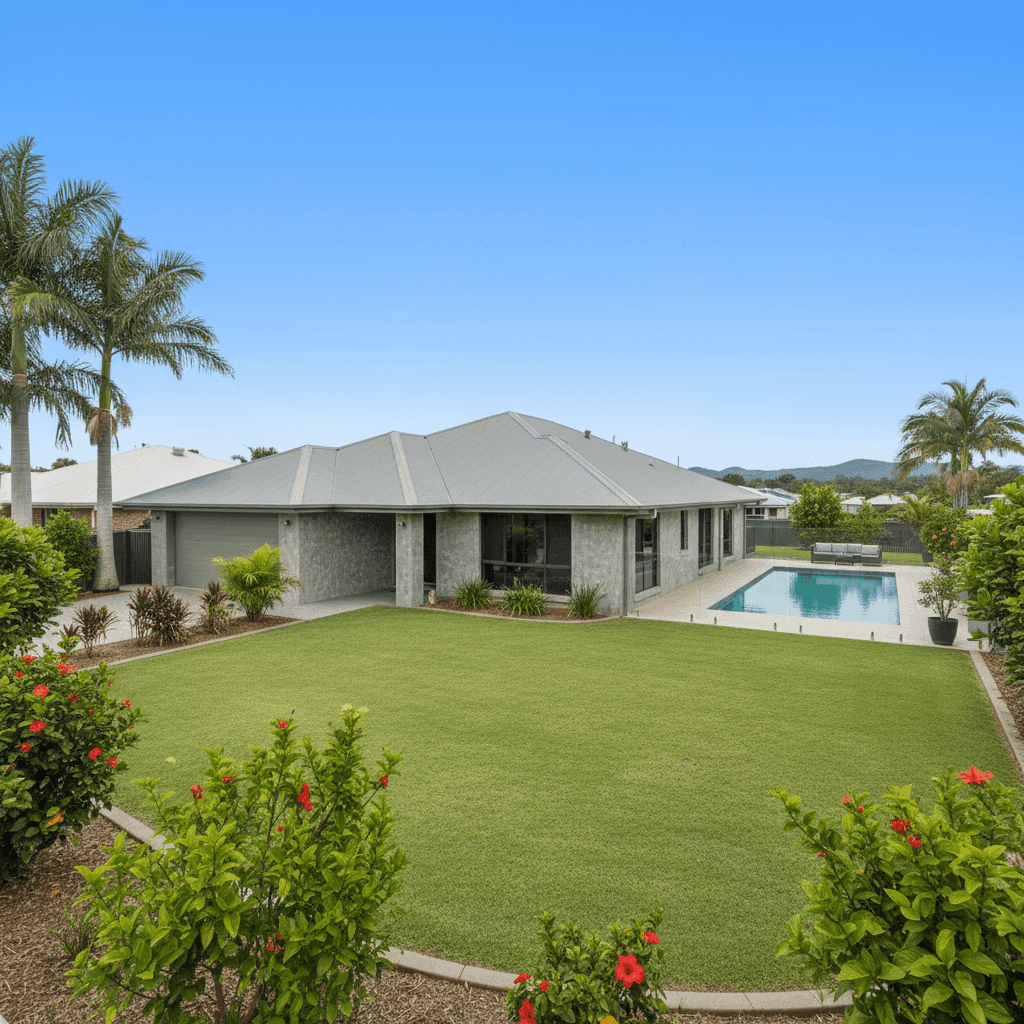
If you own a free standing home in Kelso, QLD 4815, you already know that home insurance in this part of North Queensland isn't a straightforward purchase. Sitting within the greater Townsville region, Kelso properties face a unique set of risk factors — from tropical weather to cyclone exposure — that can make premiums feel like a moving target. This article breaks down a recent building insurance quote for a four-bedroom, two-bathroom home in the suburb, putting the numbers in context so you can make a more informed decision at renewal time.
---
Is This Quote Fair?
The quote in question comes in at $4,237 per year (or roughly $406 per month) for building-only cover on a 214 sqm concrete-walled, Colorbond-roofed home with a sum insured of $773,000. The excess sits at $1,000.
Our pricing engine has rated this quote as FAIR — Around Average, and the data backs that up. Compared to the suburb median of $4,004 per year, this quote is only marginally above the midpoint — a difference of about $233 annually, or less than $20 a month. That's well within the normal range of variation you'd expect given the property's features and location.
It's worth noting that "average" in a cyclone-prone suburb like Kelso still means paying a meaningful premium. But sitting near the median rather than the top of the range is a reasonably good outcome for a property of this size and specification. If this quote were nudging the 75th percentile of $6,007 per year, there'd be a stronger case for shopping around. At $4,237, the homeowner is paying less than roughly half of comparable properties in the area — which is a solid position to be in.
---
How Kelso Compares
To understand whether this quote represents good value, it helps to zoom out and look at the broader pricing landscape.
| Benchmark | Premium |
|---|---|
| This quote | $4,237/yr |
| Kelso (4815) suburb median | $4,004/yr |
| Kelso suburb average | $5,004/yr |
| Kelso 25th percentile | $2,649/yr |
| Kelso 75th percentile | $6,007/yr |
| QLD state average | $9,129/yr |
| QLD state median | $3,903/yr |
| Townsville LGA average | $7,340/yr |
| National average | $5,347/yr |
| National median | $2,764/yr |
A few things stand out here. The QLD state average of $9,129 is extraordinarily high — dragged upward by high-risk coastal and cyclone-prone postcodes across the state. The median of $3,903 tells a more grounded story, and this quote sits just above that figure.
The Townsville LGA average of $7,340 is also notably higher than what this property is quoted at, suggesting the homeowner may have found a competitive insurer or that the property's construction characteristics are working in their favour.
Nationally, this quote is below the average of $5,347 but above the national median of $2,764 — which reflects the reality that insuring a home in a cyclone risk zone will always carry a loading compared to, say, a property in suburban Melbourne or Adelaide.
Based on CoverClub's suburb data for Kelso, the spread between the 25th and 75th percentiles is quite wide ($2,649 to $6,007), which underscores just how much individual property features and insurer appetite can shift the final number.
---
Property Features That Affect Your Premium
Several characteristics of this particular home have a direct bearing on the premium calculated.
Cyclone risk area is arguably the single biggest factor. Kelso falls within a designated cyclone risk zone, and insurers price this in heavily. Cyclone cover typically adds a significant loading to base premiums in North Queensland, and some policies include a separate cyclone excess on top of the standard excess.
Concrete external walls are generally viewed favourably by insurers. Compared to timber or cladding, concrete construction offers stronger resistance to wind and impact damage — both highly relevant in a cyclone-prone region. This likely contributes to a more competitive premium than a comparable timber-framed home would attract.
Steel/Colorbond roofing is a mixed signal. Colorbond is durable and widely used in Queensland, but metal roofing in cyclone areas can be a risk factor depending on how it's secured. A properly installed Colorbond roof to current cyclone standards is generally well-regarded, but older installations may attract scrutiny.
Slab foundation and tile flooring both suggest a solid, low-maintenance construction that is unlikely to attract negative risk adjustments. Slab homes typically perform well in flood and storm scenarios compared to raised timber floors.
The swimming pool adds a small liability component to the risk profile and may marginally increase the premium, though for building-only cover the effect is minimal.
Ducted climate control is a higher-value fitting that would be captured within the sum insured. At $773,000 for a 214 sqm home built in 2007, the sum insured appears appropriately calibrated for the region — replacement costs in North Queensland can be elevated due to labour and materials logistics.
---
Tips for Homeowners in Kelso
1. Check your cyclone excess separately Many policies in cyclone-rated zones apply a separate, higher excess for cyclone-related claims — sometimes 1–2% of the sum insured. On a $773,000 property, that could mean an out-of-pocket cost of $7,730–$15,460 before your insurer pays a cent. Always read the Product Disclosure Statement (PDS) carefully and factor this into your financial planning.
2. Review your sum insured annually Construction costs in regional Queensland have risen sharply in recent years. A sum insured that was accurate in 2023 may no longer reflect what it would actually cost to rebuild your home today. Use a building cost calculator or ask a local builder for a rough estimate to ensure you're not underinsured.
3. Ask about discounts for cyclone-rated upgrades If your roof, windows, or garage door have been upgraded to meet current cyclone standards (such as AS 4055 or AS/NZS 1170.2), let your insurer know. Some insurers offer premium discounts for homes with certified cyclone-resistant features — it's worth a conversation at renewal.
4. Compare quotes before auto-renewing The wide pricing spread in Kelso — from $2,649 at the 25th percentile to $6,007 at the 75th — shows that insurers price this suburb very differently. Auto-renewing with your current insurer without comparing alternatives could mean paying hundreds of dollars more than necessary each year.
---
Compare Your Home Insurance Options with CoverClub
Whether you're reviewing your current policy or insuring a new home in Kelso, comparing quotes is the most effective way to ensure you're getting fair value. Get a home insurance quote through CoverClub to see how your property stacks up and explore options from multiple insurers in one place. It takes just a few minutes and could save you significantly at renewal.