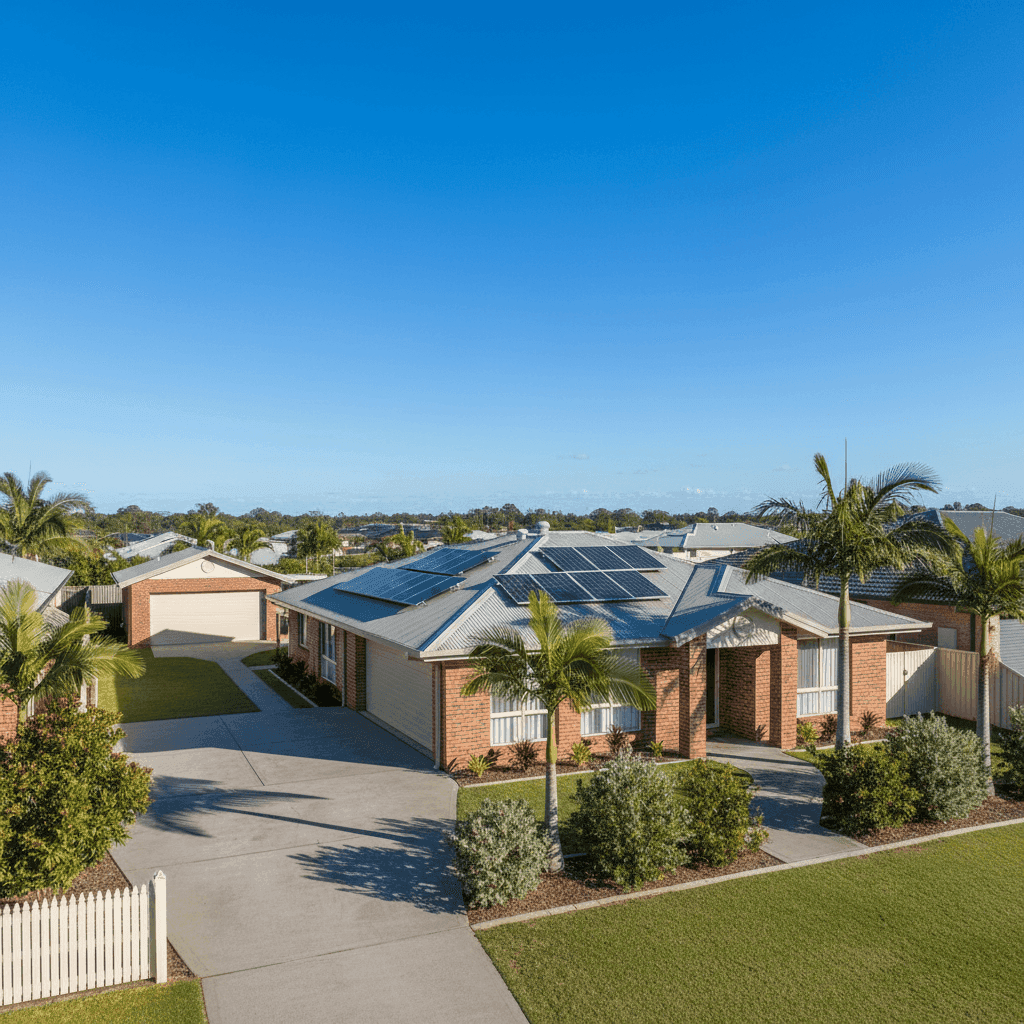
If you own a free standing home in Kelso, QLD 4815, you already know that getting the right building insurance is more than just a formality — it's a critical financial safeguard. Kelso sits within the Townsville local government area, a region well known for its elevated weather risks, including tropical cyclones, heavy rainfall, and storm surge. In this article, we break down a real building insurance quote for a three-bedroom home in the suburb, assess whether the price is competitive, and share practical tips to help local homeowners get the best value from their cover.
---
Is This Quote Fair?
The quote in question is $3,556 per year (or $341 per month) for building-only cover on a 130 sqm free standing home, with a sum insured of $576,000 and a standard $1,000 excess.
Our price rating for this quote is FAIR — Around Average, and the data backs that up.
When compared against other quotes collected for Kelso (QLD 4815), this premium sits comfortably below both the suburb average of $5,004/yr and the suburb median of $4,004/yr. In fact, it falls closer to the 25th percentile benchmark of $2,649/yr than to the upper end of the market, where premiums stretch to $6,007/yr at the 75th percentile.
So while "fair" might sound lukewarm, in the context of Kelso — a cyclone-risk suburb in North Queensland — paying $3,556/yr for solid building cover is actually a reasonably strong outcome. Homeowners paying closer to the suburb average of $5,004/yr are spending over $1,400 more annually for comparable protection.
That said, "fair" also signals there may be room to improve. Depending on your insurer, policy features, and any applicable discounts, it's worth checking whether a lower premium is achievable without sacrificing meaningful cover.
---
How Kelso Compares
To put this quote in broader context, here's how Kelso stacks up against state and national benchmarks:
| Benchmark | Average Premium | Median Premium |
|---|---|---|
| Kelso (QLD 4815) | $5,004/yr | $4,004/yr |
| Queensland (State) | $9,129/yr | $3,903/yr |
| Townsville LGA | $7,340/yr | — |
| National | $5,347/yr | $2,764/yr |
A few things stand out here. First, Queensland's state average premium of $9,129/yr is extraordinarily high — more than double the national average of $5,347/yr. This reflects the outsized impact of cyclone-prone postcodes like Townsville and Cairns dragging the state mean upward. The Queensland median of $3,903/yr is far more representative of what typical homeowners pay, and it aligns closely with what we're seeing in Kelso.
The Townsville LGA average of $7,340/yr is notably higher than the Kelso suburb average of $5,004/yr, suggesting that some pockets within Townsville carry significantly greater risk loading than others. Kelso, while still in a cyclone-risk zone, appears to attract relatively more moderate premiums within the broader LGA.
At $3,556/yr, this quote is well below both the Townsville LGA average and the Queensland state average, while also coming in under the suburb average. Based on a sample of 47 quotes collected for this postcode, that's a meaningful saving relative to what many local homeowners are paying.
---
Property Features That Affect Your Premium
Several characteristics of this property have a direct influence on the premium — some push it higher, others help keep it in check.
Cyclone risk area is the single biggest factor. Kelso falls within a designated cyclone risk zone, which automatically triggers higher premium loading from most insurers. This is non-negotiable for homes in North Queensland and is the primary reason premiums in this region are elevated compared to southern states.
Brick veneer construction is generally viewed favourably by insurers. Compared to weatherboard or fibre cement cladding, brick veneer offers better resistance to wind, fire, and impact — all relevant perils in this area. This likely contributes to a more competitive premium than a timber-clad equivalent would attract.
Steel/Colorbond roof is another positive from an underwriting perspective. Colorbond roofing is durable, low-maintenance, and performs well in high-wind events when properly installed and secured. Many insurers price this more competitively than terracotta or concrete tiles, which can become projectiles in cyclonic conditions.
Slab foundation provides structural stability and reduces the risk of subsidence or flood-related undermining compared to raised timber stumps — a relevant consideration in a region prone to heavy rainfall.
Solar panels add replacement value to the building sum insured and can introduce a small premium uplift, as they represent an additional asset to cover. It's worth confirming with your insurer that your solar system is explicitly included in your building cover.
Ducted climate control similarly adds to the insured value of the home. These systems can be costly to repair or replace after storm or water damage, so ensuring your sum insured adequately reflects their value is important.
Granny flat on the property is a significant factor. A secondary dwelling increases the total insured value of the building and may affect how your policy is structured. Always confirm with your insurer that the granny flat is covered under your building policy — some insurers require it to be declared separately.
---
Tips for Homeowners in Kelso
1. Review your sum insured carefully — and include the granny flat At $576,000 for a 130 sqm home plus granny flat, the sum insured needs to reflect the full cost of rebuilding both structures, not just the main dwelling. Building costs in North Queensland have risen sharply in recent years due to labour shortages and materials inflation. Underinsurance is a serious risk — use a building cost calculator or speak to a quantity surveyor if you're unsure.
2. Confirm your solar panels and ducted systems are explicitly covered These are high-value fixtures that are sometimes excluded or subject to sub-limits under standard building policies. Ask your insurer directly whether your solar panels and ducted air conditioning are covered for storm, cyclone, and electrical damage — and check the applicable excess.
3. Invest in cyclone preparedness to potentially reduce your premium Some insurers offer discounts for homes that meet specific cyclone-resilience standards, such as roof tie-downs, cyclone shutters, or compliance with post-2002 building codes. Given this home was built in 2002, it likely meets modern standards — but it's worth asking your insurer whether any mitigation upgrades could reduce your loading.
4. Compare quotes annually — don't let your policy auto-renew unchecked The insurance market in North Queensland is competitive and pricing can shift significantly year to year. With a suburb average of $5,004/yr and a wide spread between the 25th percentile ($2,649/yr) and 75th percentile ($6,007/yr), there's clearly significant variation in what different insurers charge for similar properties. Shopping around at renewal time is one of the most effective ways to avoid overpaying.
---
Compare Your Home Insurance Quote Today
Whether you're reviewing your current policy or shopping for the first time, CoverClub makes it easy to see how your premium stacks up. Get a home insurance quote at CoverClub and compare your options side by side — so you can make a confident, informed decision about protecting one of your most valuable assets.