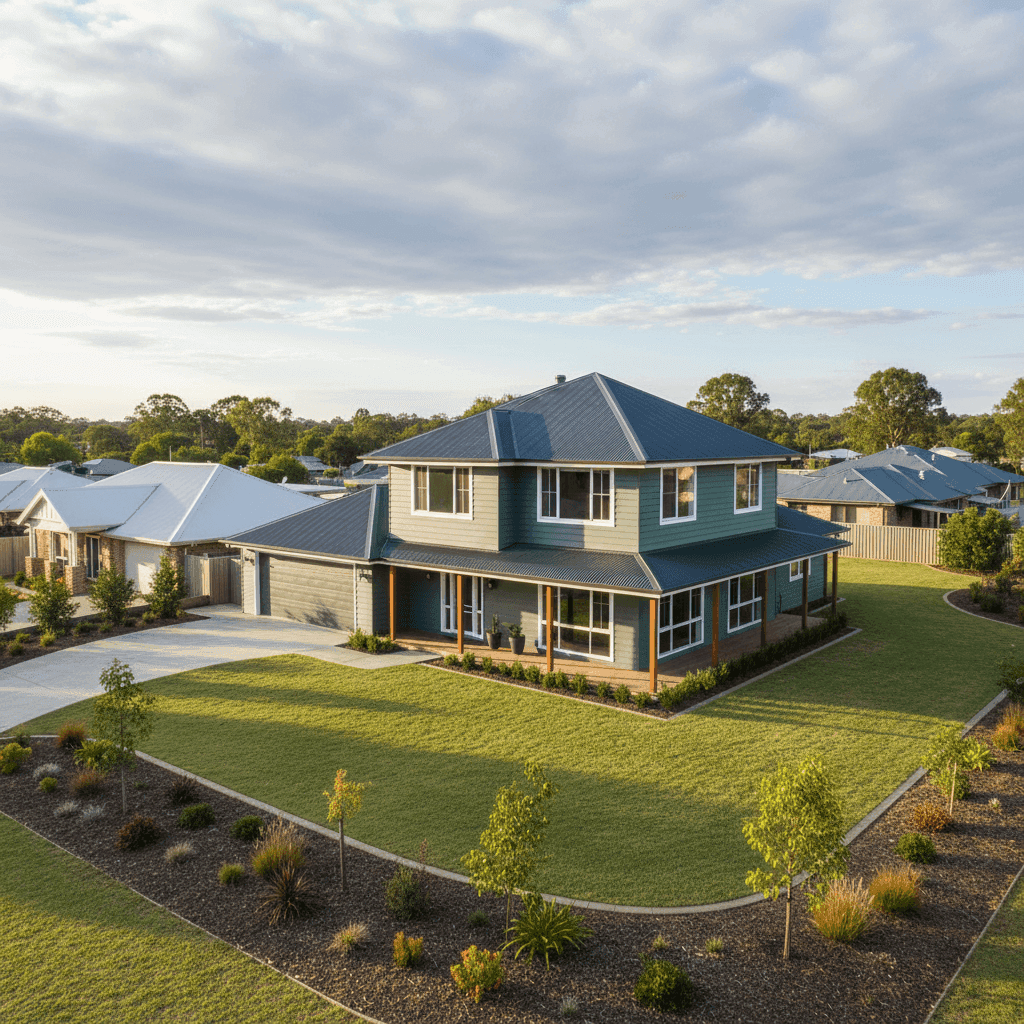
If you own a free standing home in Kingaroy, QLD 4610, you've probably noticed that insurance premiums can vary wildly depending on who you ask — and how you ask. This article breaks down a real home and contents insurance quote for a five-bedroom property in this South Burnett region town, benchmarks it against local, state, and national data, and helps you understand whether you're getting a fair deal or paying too much.
---
Is This Quote Fair?
The quote in question comes to $4,280 per year (or $410/month) for combined home and contents cover, with a building sum insured of $1,079,000 and contents valued at $153,000. Both the building and contents excess sit at $1,000.
Our price rating for this quote is EXPENSIVE — above average for the Kingaroy area.
To put that in perspective: the suburb average premium across 88 quotes in postcode 4610 sits at $2,638 per year, with a median of $2,418. This quote lands well above the 75th percentile of $3,557 — meaning it's pricier than roughly three-quarters of comparable quotes in the same suburb. That's a meaningful gap, and one worth investigating before simply renewing or accepting the figure at face value.
That said, the higher sum insured — particularly the $1,079,000 building cover for a 305 sqm home — is likely a significant driver of the elevated premium. Larger insured values naturally attract higher costs, so it's worth confirming whether your building replacement estimate is accurate and not over-inflated.
---
How Kingaroy Compares
Understanding where Kingaroy sits in the broader insurance landscape helps provide useful context. Here's a quick snapshot:
| Benchmark | Average Premium | Median Premium |
|---|---|---|
| Kingaroy (4610) | $2,638/yr | $2,418/yr |
| South Burnett LGA | $2,940/yr | — |
| Queensland | $9,129/yr | $3,903/yr |
| National | $5,347/yr | $2,764/yr |
A few things stand out here. Queensland's average premium of $9,129 is dramatically higher than its median of $3,903 — a sign that extreme premiums in high-risk coastal and cyclone-prone areas (think Cairns, Townsville, and the Whitsundays) are pulling the state average upward significantly. Kingaroy, sitting inland on the Darling Downs, benefits from not being in a designated cyclone risk zone, which keeps local premiums considerably more grounded.
Compared to the national average of $5,347/yr, this quote is still above the mark, but the national figure is similarly skewed by high-risk postcodes. The Queensland state stats tell a similar story of wide variance. When you zoom in to the Kingaroy suburb-level data, the picture becomes clearer — and this quote is on the expensive side for the local market.
---
Property Features That Affect Your Premium
Several characteristics of this property will be influencing the quote, for better or worse.
Weatherboard timber walls are a known risk factor for insurers. Timber-clad homes are more susceptible to fire spread and can be costlier to repair or replace than brick veneer or double-brick construction. Most insurers price this in, which can push premiums higher compared to masonry alternatives.
Steel/Colorbond roofing is generally viewed favourably. It's durable, low-maintenance, and performs well in storms and hail events — all things insurers appreciate. This likely provides some offsetting benefit to the timber wall risk.
A concrete slab foundation is considered one of the more stable and insurer-friendly foundation types in Queensland. It's resistant to subsidence and pest damage, which reduces the likelihood of structural claims.
Timber and laminate flooring can be a factor in water damage claims — these materials are more vulnerable to moisture than tiles — but it's not typically a major premium driver on its own.
Ducted climate control is a higher-value fixed fitting that adds to the overall replacement cost of the home. With standard fittings quality elsewhere, this system is likely factored into the building sum insured and contributes modestly to the premium.
The absence of a pool and solar panels simplifies the risk profile slightly. Pools add liability exposure, and solar systems (particularly older ones) can introduce fire risk and complicate roof claims. Neither applies here, which is a small but positive factor.
At 305 sqm, this is a generously sized home, and the building sum insured of $1,079,000 reflects that. It's worth periodically reviewing whether your sum insured aligns with current construction costs — over-insuring can mean unnecessarily high premiums, while under-insuring leaves you exposed.
---
Tips for Homeowners in Kingaroy
1. Review your sum insured regularly Construction costs have risen sharply in recent years across Queensland. Use an independent building calculator or speak to a quantity surveyor to ensure your $1,079,000 figure is accurate — not a legacy estimate that's drifted out of touch with reality in either direction.
2. Compare quotes before renewing Loyalty rarely pays in the insurance industry. With this quote sitting above the suburb's 75th percentile, there's a reasonable chance that shopping around could surface a more competitive option. Get a comparison quote at CoverClub to see what else is available for your property.
3. Consider your excess settings Both building and contents excesses are set at $1,000. Opting for a higher voluntary excess — say, $2,500 or $5,000 — can meaningfully reduce your annual premium if you're financially comfortable absorbing a larger out-of-pocket cost in the event of a claim. Just make sure the saving justifies the added exposure.
4. Bundle strategically, but verify the value Many insurers offer discounts for combining home and contents cover under one policy — which this quote already does. However, it's still worth obtaining separate quotes for building-only and contents-only cover to confirm the bundle is actually cheaper than the sum of its parts.
---
Ready to Find a Better Rate?
Whether this quote is right for your situation depends on your specific needs, risk tolerance, and what's included in the policy fine print. But if you're paying above the suburb average and want to know what else is out there, it costs nothing to look.
Compare home insurance quotes for your Kingaroy property at CoverClub — it takes just a few minutes and could save you hundreds of dollars a year.