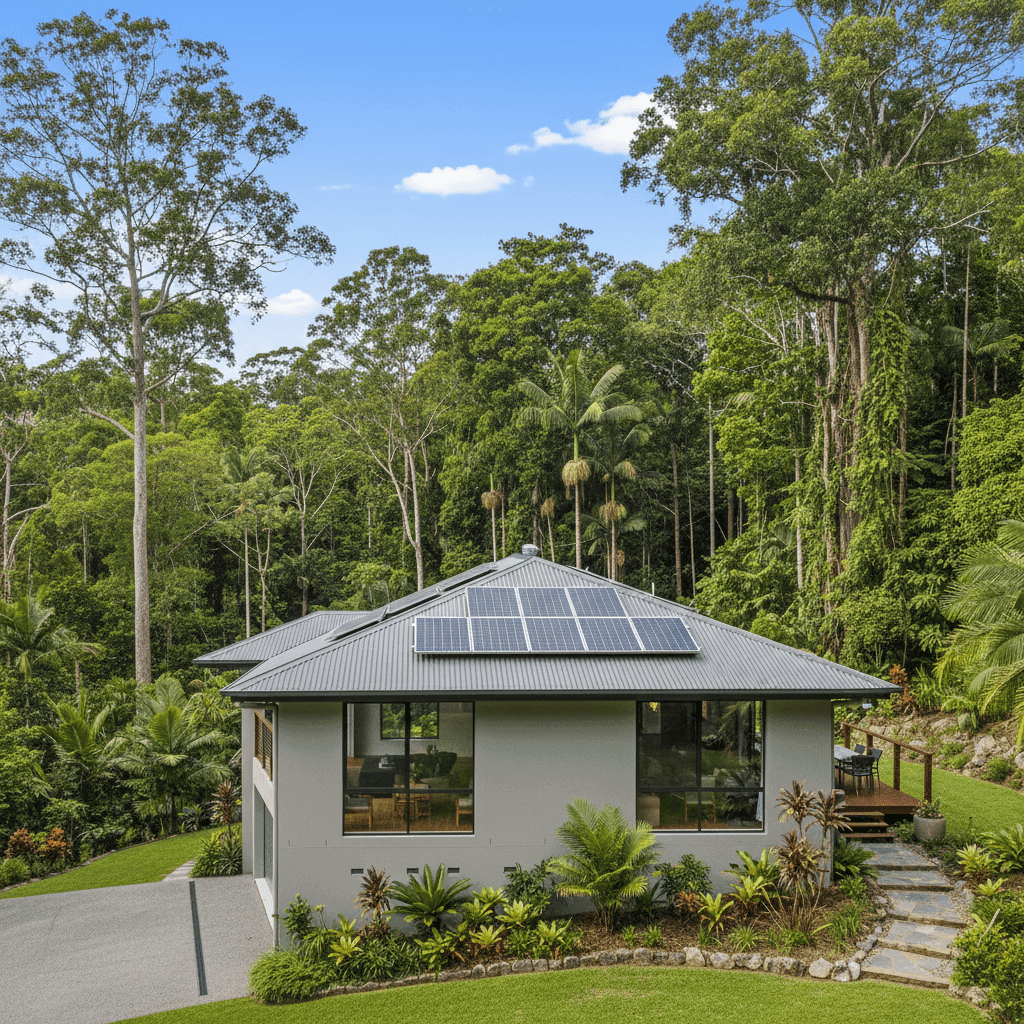
If you own a free standing home in Kuranda, QLD 4881, you already know this stunning rainforest village comes with a unique set of lifestyle benefits — and a unique set of insurance challenges. Nestled in the Wet Tropics just west of Cairns, Kuranda sits squarely in one of Australia's most weather-exposed regions. For homeowners here, understanding what drives your insurance premium isn't just useful — it can save you thousands of dollars a year.
This article breaks down a recent building-only insurance quote for a 3-bedroom, 2-bathroom free standing home in Kuranda, compares it against local, state, and national benchmarks, and offers practical tips to help you get better value on your cover.
---
Is This Quote Fair?
The quote in question comes in at $35,005 per year (or $3,355/month) for building-only cover, with a sum insured of $533,000 and a $1,000 building excess. Our price rating for this quote is EXPENSIVE — Above Average.
To put that in perspective: the suburb average for Kuranda sits at $7,362 per year, with a median of just $4,126. This quote is roughly 4.75 times the suburb median — a significant premium that warrants a closer look.
It's worth noting that averages in cyclone-prone areas can be heavily skewed by high-risk properties, so the median is often a more reliable benchmark. Even against the suburb's 75th percentile of $4,853 per year, this quote stands dramatically higher. That said, several property-specific factors — which we'll explore below — go a long way toward explaining the gap.
---
How Kuranda Compares
To understand just how expensive home insurance can be in this part of Queensland, it helps to zoom out and look at the broader picture.
| Benchmark | Average Premium | Median Premium |
|---|---|---|
| Kuranda (suburb) | $7,362/yr | $4,126/yr |
| Mareeba LGA | $5,551/yr | — |
| Queensland | $9,129/yr | $3,903/yr |
| National | $5,347/yr | $2,764/yr |
You can explore the full Queensland home insurance statistics or compare against national averages to see how your area stacks up.
A few things stand out here. First, Queensland's state average of $9,129 is notably higher than the national average of $5,347 — driven largely by the prevalence of cyclone-risk postcodes across North Queensland, Far North Queensland, and coastal areas. Second, the gap between averages and medians at both the state and national level signals that a relatively small number of very high-risk or high-value properties are pulling the averages upward. This is an important nuance when interpreting where any individual quote lands.
Kuranda's suburb sample of 33 quotes provides a reasonable — if not exhaustive — snapshot of the local market. Based on that data, this quote is clearly an outlier, and the property's specific characteristics are the primary driver.
---
Property Features That Affect Your Premium
Several features of this property combine to push the premium well above typical levels for the suburb. Here's how each one plays a role:
🌀 Cyclone Risk Area
This is the single biggest factor. Kuranda falls within a designated cyclone risk zone, and insurers price this risk heavily. Cyclone cover in Far North Queensland can add thousands of dollars to an annual premium compared with properties in southern states — sometimes representing the majority of the total cost.
🏠 Concrete External Walls
Concrete construction is generally viewed favourably by insurers for its durability and fire resistance. However, in cyclone zones, the overall structural integrity assessment still weighs heavily, and concrete alone doesn't dramatically offset cyclone loading.
🏗️ Steel/Colorbond Roof
Colorbond roofing is common in Queensland and performs reasonably well in high-wind events. Insurers typically view it as a mid-range risk — better than older tile roofs in some respects, but still subject to significant cyclone uplift risk.
☀️ Solar Panels
Solar panels are an increasingly common feature on Australian homes, but they do add to the rebuild cost and can be a point of vulnerability in high-wind events. Their inclusion in the sum insured calculation contributes to the overall building value.
❄️ Ducted Climate Control
Ducted air conditioning systems are expensive to replace and add to the insured value of the building. In a tropical climate like Kuranda's, these systems are near-essential, and their replacement cost is factored into the sum insured.
📐 Sum Insured: $533,000
The sum insured of $533,000 for a 130 sqm home built in 1990 reflects a rebuild cost that accounts for labour, materials, demolition, and professional fees — all of which have risen sharply in recent years. In regional Queensland, building costs can be higher than in metropolitan areas due to supply chain and labour constraints, which inflates the sum insured and, in turn, the premium.
🪵 Timber/Laminate Flooring
Timber and laminate flooring can be susceptible to water and flood damage — a relevant consideration in a high-rainfall area like Kuranda. This may contribute marginally to the overall risk profile.
---
Tips for Homeowners in Kuranda
If your premium is higher than you'd like, there are several practical steps worth exploring:
1. Compare Multiple Insurers
Not all insurers price cyclone risk the same way. Some have more appetite for Far North Queensland properties than others, and the difference in quotes can be substantial. Use CoverClub to compare quotes side by side so you're not leaving money on the table.
2. Review Your Sum Insured Carefully
Over-insuring is a common and costly mistake. Make sure your sum insured reflects the actual rebuild cost of your home — not its market value. A quantity surveyor or your insurer's online calculator can help you arrive at a more accurate figure.
3. Consider a Higher Excess
Opting for a higher voluntary excess (say, $2,500 or $5,000) can meaningfully reduce your annual premium. This strategy works well if you have the financial buffer to cover a larger out-of-pocket cost in the event of a claim.
4. Invest in Cyclone Resilience
Some insurers offer premium discounts for homes that meet higher cyclone-resistance standards. Upgrades such as cyclone shutters, reinforced roof connections, or compliance with updated building codes may reduce your risk rating over time. Check with your insurer about what improvements could qualify you for a discount.
---
Ready to Find a Better Deal?
A premium of $35,005 per year is a significant household expense, and it's worth making sure you're getting the right cover at the most competitive price available. CoverClub makes it easy to compare home insurance quotes from multiple providers in one place — so you can see exactly what the market looks like for your property.
👉 Get a home insurance quote for your Kuranda property and find out if you could be paying less.
You can also explore detailed Kuranda suburb insurance statistics to benchmark your own quote, or browse Queensland-wide data for broader context.