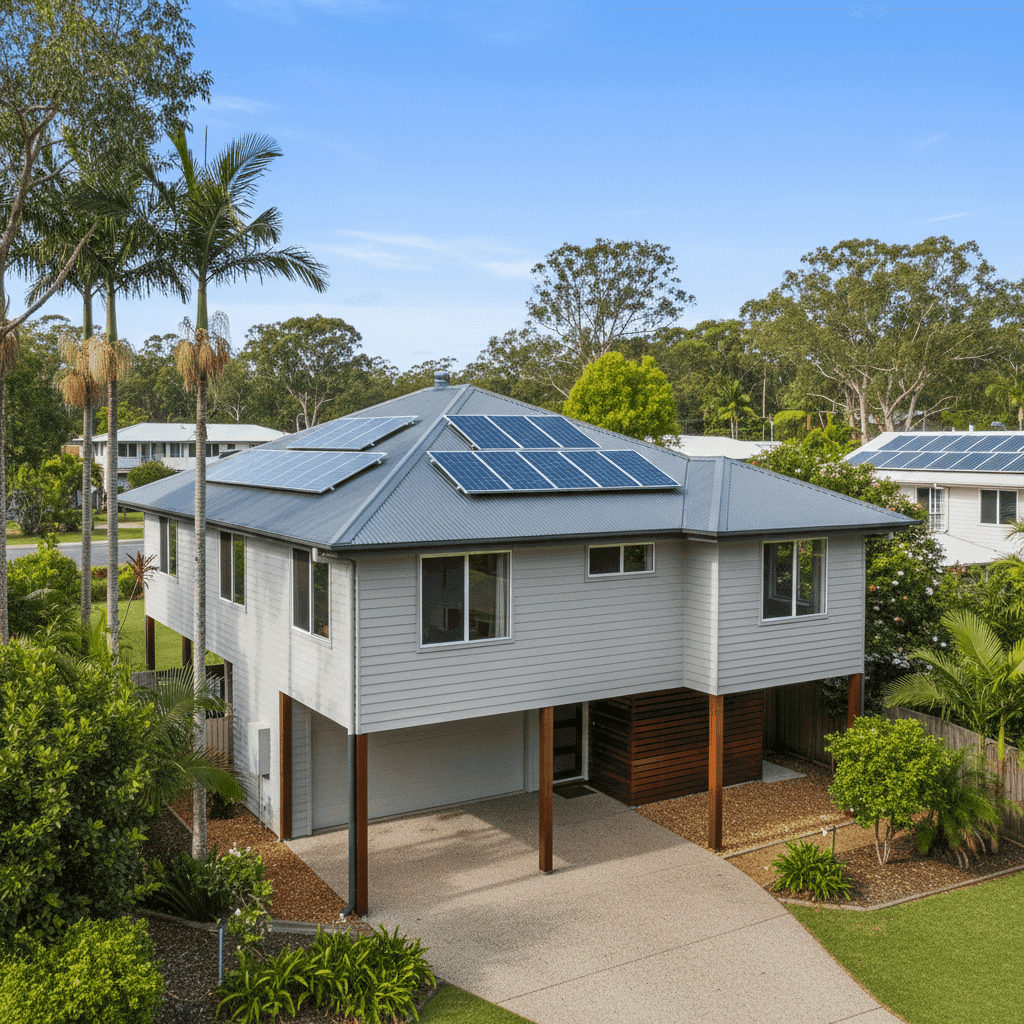
Landsborough is a charming hinterland town sitting at the gateway to the Sunshine Coast, popular with families drawn to its relaxed lifestyle, leafy streets, and relative affordability compared to coastal suburbs. For owners of a free standing home in this postcode, understanding what drives your home insurance premium — and whether you're paying a fair price — can make a meaningful difference to your household budget.
This article breaks down a real home and contents insurance quote for a 3-bedroom, 2-bathroom free standing home in Landsborough QLD 4550, comparing it against local, state, and national benchmarks so you can make a more informed decision.
---
Is This Quote Fair?
The annual premium for this property comes in at $4,171 per year (or $393 per month), covering both building (sum insured: $821,000) and contents ($80,000), each with a $1,000 excess.
Our pricing engine rates this quote as Fair — Around Average, and the data backs that up. The suburb average for Landsborough sits at $3,922 per year, meaning this quote is roughly $249 above the local average — a modest difference of around 6%. Importantly, it falls comfortably within the suburb's interquartile range of $2,956 (25th percentile) to $4,378 (75th percentile), based on 63 quotes analysed in the area.
In plain terms: this isn't a bargain, but it's not an outlier either. The quote reflects the specific characteristics of this property — more on those below — and sits in a range that many Landsborough homeowners would recognise as typical. There's likely room to sharpen the price by comparing insurers, but there's no immediate cause for alarm.
---
How Landsborough Compares
To put this quote in proper context, it helps to zoom out and look at the broader QLD insurance landscape and national averages.
| Benchmark | Average Premium | Median Premium |
|---|---|---|
| Landsborough (4550) | $3,922/yr | $3,569/yr |
| Sunshine Coast LGA | $7,249/yr | — |
| Queensland | $9,129/yr | $3,903/yr |
| National | $5,347/yr | $2,764/yr |
A few things stand out here. The Queensland average of $9,129 per year looks alarming at first glance, but the median of $3,903 tells a more grounded story. The large gap between average and median in QLD is driven by high-risk coastal and far-north Queensland properties — cyclone-prone areas, flood plains, and beachfront homes — pulling the average up significantly.
Landsborough, sitting inland from the Sunshine Coast, benefits from a more moderate risk profile. The suburb's median of $3,569 is actually slightly below the Queensland median, which is a positive sign for homeowners in this area. Compared to the Sunshine Coast LGA average of $7,249, Landsborough looks quite attractive — likely because it avoids the elevated storm surge and coastal flooding risks that push premiums higher in beachside suburbs.
Nationally, the median of $2,764 is lower than Landsborough's, which reflects the fact that many parts of Australia — particularly in southern states — face fewer natural hazard risks than South East Queensland.
---
Property Features That Affect Your Premium
Several characteristics of this particular home have a direct bearing on the premium quoted.
Elevated construction (at least 1 metre): This property is elevated by at least one metre, consistent with the classic Queenslander-style approach to building. Elevation is generally viewed favourably by insurers — it reduces exposure to ground-level flooding and can lower premiums compared to slab-on-ground homes in the same area. This is a meaningful advantage in a region that can experience heavy rainfall events.
Hardiplank/Hardiflex external walls: Fibre cement cladding like Hardiplank is considered a durable, low-maintenance building material. It performs well in terms of fire resistance and is generally regarded positively by underwriters compared to older timber weatherboard or rendered brick alternatives.
Steel/Colorbond roof: Colorbond roofing is a popular choice across Queensland for good reason — it's lightweight, resistant to corrosion, and holds up well in storms. Insurers typically rate it favourably compared to tile roofs, which can be more susceptible to impact damage.
Pole/stump foundation: Combined with the elevated design, a pole foundation is characteristic of homes built to manage Queensland's climate and terrain. While it adds to the character and practicality of the home, insurers factor in the specific construction type when calculating rebuild costs.
Above average fittings quality: Higher-quality internal fittings — think stone benchtops, premium appliances, and quality fixtures — push up the sum insured needed to accurately rebuild the home to the same standard. This is reflected in the $821,000 building sum insured, which is appropriate for a well-appointed 153 sqm home built in 2014.
Solar panels: The presence of solar panels adds to the replacement value of the home and is factored into the building sum insured. Some insurers explicitly cover solar panels under building cover, so it's worth confirming this is the case with your policy documents.
Ducted climate control: Like solar, ducted air conditioning is a fixed installation that forms part of the building sum insured. It's a common feature in Queensland homes and adds meaningfully to rebuild costs.
---
Tips for Homeowners in Landsborough
1. Make sure your sum insured keeps pace with construction costs Building costs have risen sharply across Australia in recent years. A 153 sqm home with above-average fittings built in 2014 should be regularly reassessed — ideally annually — to ensure the $821,000 sum insured still reflects what it would actually cost to rebuild today. Underinsurance is one of the most common and costly mistakes homeowners make.
2. Review your contents cover separately $80,000 in contents cover is a starting point, but it's easy to underestimate the cumulative value of furniture, electronics, appliances, clothing, and personal items. Walk through each room and take stock — many homeowners find their contents are worth considerably more than they initially estimated.
3. Compare quotes before renewal Insurers don't always reward loyalty. Even if your current premium feels reasonable, it's worth running a comparison at renewal time. Premiums can vary significantly between providers for the same property and cover level. Get a quote at CoverClub to see how your current price stacks up.
4. Check your policy's flood and storm cover While Landsborough is not classified as a cyclone risk area, the Sunshine Coast hinterland can experience significant rainfall and localised flooding. Confirm that your policy includes flood cover — not just storm damage — as these are sometimes treated as separate events with different conditions.
---
Ready to Find a Better Deal?
Whether you're renewing soon or just curious about what else is out there, CoverClub makes it easy to compare home and contents insurance quotes for properties in Landsborough and across Australia. Our data-driven tools help you understand what's fair for your specific property — not just a generic estimate.
Compare home insurance quotes at CoverClub and see if you can do better than average.