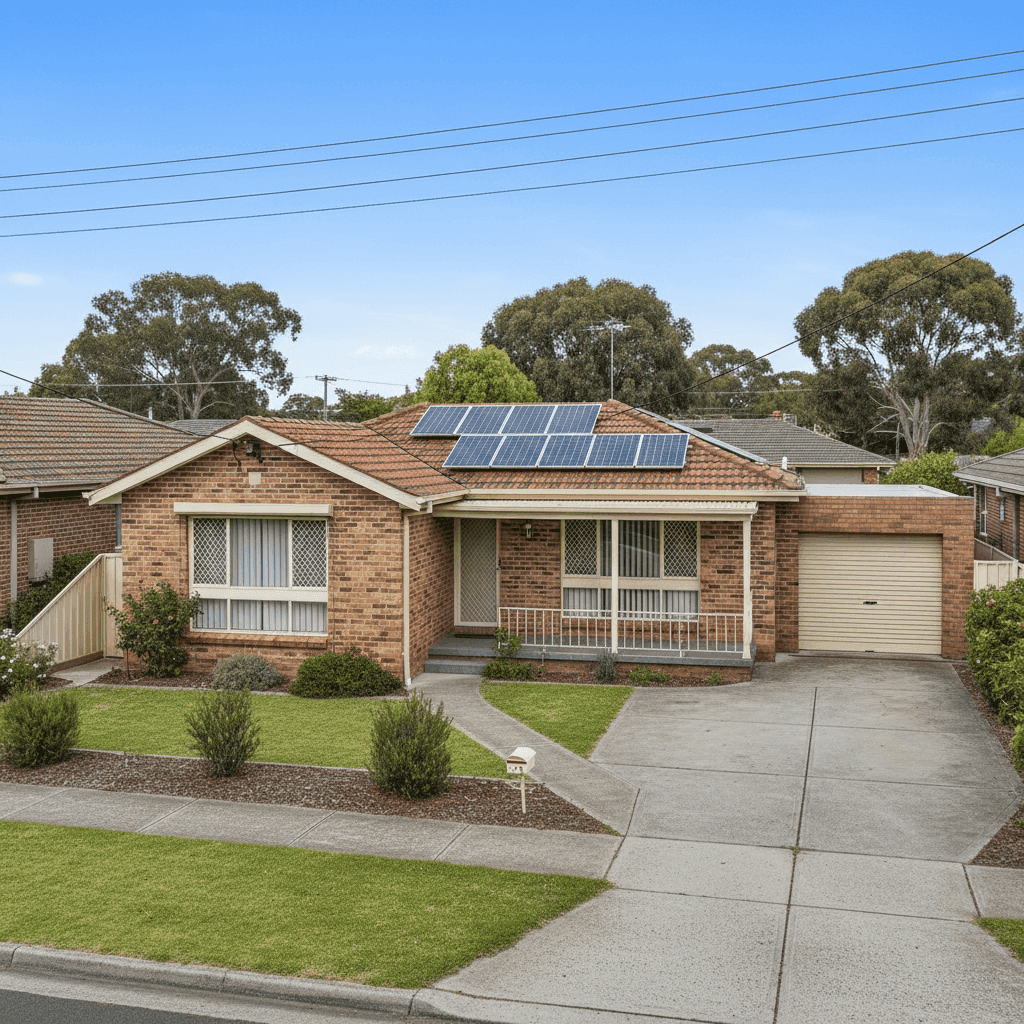
If you own a free standing home in Lara, VIC 3212, you're likely aware that getting the right home insurance at a fair price takes a little research. Lara is a growing suburb on the Bellarine Peninsula fringe, sitting between Geelong and Melbourne — a location that brings its own mix of risk factors and lifestyle appeal. This article breaks down a real home and contents insurance quote for a three-bedroom, two-bathroom brick veneer home in the area, and puts it in context against local, state, and national benchmarks to help you decide whether you're getting value for money.
---
Is This Quote Fair?
The quote in question comes in at $1,444 per year (or $138/month) for combined home and contents cover, with a $550,000 building sum insured and $30,000 in contents. The building excess and contents excess are both set at $1,000.
Our price rating for this quote is FAIR — Around Average, and the data backs that up. Based on 122 quotes collected for Lara (3212), the suburb average sits at $1,455/year and the median at $1,343/year. At $1,444, this quote lands just below the suburb average and slightly above the median — right in the middle of the pack.
To put it another way: roughly half of Lara homeowners are paying less than $1,343/year, and half are paying more. This quote sits comfortably in the second quartile, meaning it's not a standout bargain, but it's also far from the most expensive option on the market. The 75th percentile for the suburb is $1,765/year, so there's meaningful room above this quote before you'd be considered to be overpaying.
---
How Lara Compares
One of the most striking things about this quote is how well Lara stacks up against broader benchmarks.
| Benchmark | Average Premium | Median Premium |
|---|---|---|
| Lara (3212) | $1,455/yr | $1,343/yr |
| Greater Geelong LGA | $1,754/yr | — |
| Victoria | $3,000/yr | $2,718/yr |
| National | $5,347/yr | $2,764/yr |
Compared to the Victorian state average of $3,000/year, Lara homeowners are paying significantly less — roughly half the state average. Even within the Greater Geelong LGA, which averages $1,754/year, Lara comes in well below the local government area benchmark.
Zooming out further, the national average of $5,347/year is heavily influenced by high-risk regions in Queensland and Western Australia — areas prone to cyclones, flooding, and bushfires. Lara's position in coastal Victoria, outside designated cyclone risk zones, helps keep premiums comparatively modest. At $1,444/year, this quote is less than 27% of the national average — a figure that underscores just how relatively affordable home insurance can be in this part of the country.
---
Property Features That Affect Your Premium
Several characteristics of this particular property play a role in shaping the premium. Here's what's most relevant:
Brick veneer construction and tiled roof Brick veneer walls combined with a tiled roof is one of the more insurer-friendly combinations you'll find in Australian suburban housing. Both materials offer solid fire resistance and durability, which typically translates to lower premiums compared to timber-framed or steel-clad homes. Insurers generally view this construction type as lower risk, and that's reflected in the competitive pricing seen here.
Slab foundation A concrete slab foundation is common in homes built from the 1970s onward and is generally considered stable. That said, homes on slabs in Victoria can be susceptible to subsidence in areas with reactive clay soils — something worth keeping in mind if your area has experienced prolonged dry spells followed by heavy rain.
Built in 1982 At over 40 years old, this home sits in a bracket where some insurers apply age-related loading to premiums, particularly around plumbing, electrical, and roofing systems. However, the impact appears to be modest here, likely because the construction materials (brick veneer and tiles) remain in sound condition and the building sum insured of $550,000 is reasonable for a 139 sqm home in the area.
Solar panels The presence of solar panels adds a small degree of complexity to a home insurance policy. Panels are typically covered under the building component of a policy, but it's worth confirming with your insurer that your system — including inverters and mounting hardware — is explicitly included. Some policies have sublimits or exclusions for solar equipment, so reading the Product Disclosure Statement (PDS) carefully is essential.
Ducted climate control Ducted heating and cooling systems are a valued inclusion in Victorian homes and are generally covered under building insurance. Like solar, it's worth verifying that the full system (including ductwork and the external unit) is covered under your policy's building definition.
No pool The absence of a swimming pool removes one common source of premium loading and liability exposure — a minor but notable factor that keeps costs down.
---
Tips for Homeowners in Lara
1. Review your building sum insured regularly Construction costs have risen sharply in recent years across Victoria. A sum insured of $550,000 for a 139 sqm home seems reasonable today, but it's worth reassessing annually. Underinsurance is one of the most common and costly mistakes homeowners make — if your rebuild cost exceeds your sum insured, you'll be out of pocket for the difference.
2. Confirm solar panel coverage in your PDS With solar panels on the roof, don't assume they're automatically covered in full. Ask your insurer directly: Are the panels, inverter, and mounting hardware covered? Is there a sublimit? What happens if a panel is damaged during a storm or by a falling branch? Getting clarity upfront avoids nasty surprises at claim time.
3. Consider increasing your excess to reduce your premium Both the building and contents excess on this policy are set at $1,000. If you have a financial buffer and are unlikely to make small claims, raising your excess — say, to $2,000 — can meaningfully reduce your annual premium. Just make sure the saving justifies the increased out-of-pocket cost if you do need to claim.
4. Don't set and forget your contents sum insured $30,000 in contents cover is on the lower end for a three-bedroom, two-bathroom home. Take a few minutes to mentally walk through each room and estimate the replacement value of your belongings — furniture, appliances, clothing, electronics, and more. Many homeowners discover they're significantly underinsured on contents when they actually sit down and do the maths.
---
Compare Your Options at CoverClub
Whether this quote is the right one for you depends on your individual circumstances, risk appetite, and what's covered in the fine print. The best way to know if you're getting a competitive deal is to compare. At CoverClub, you can quickly see how quotes for your property stack up against real data from your suburb and beyond — helping you make a more informed decision without the guesswork. Take two minutes to enter your address and see what's available for your home.