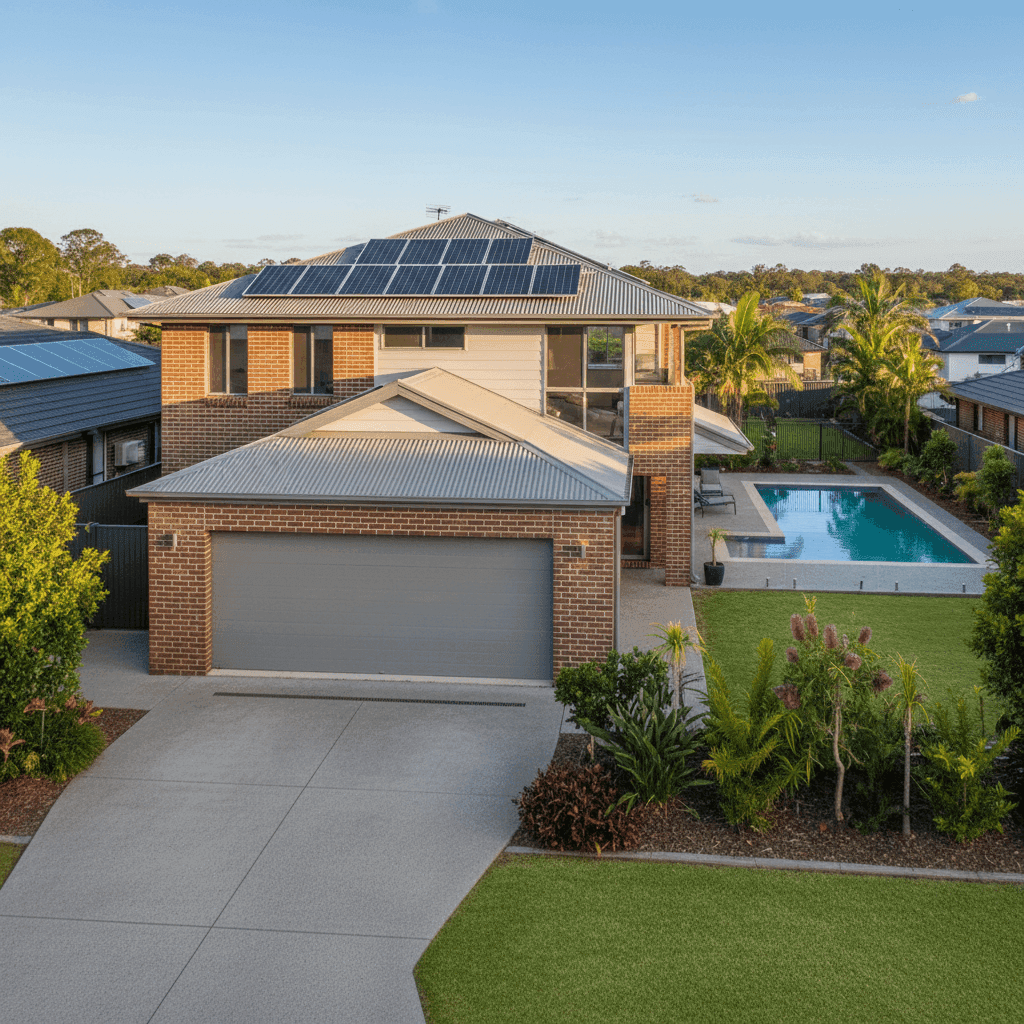
Little Mountain, nestled in Queensland's Sunshine Coast region, is a well-established suburban pocket known for its family-friendly streets and proximity to the Caloundra coast. For owners of a four-bedroom, brick veneer free standing home in this postcode, understanding what you should be paying for home and contents insurance is just as important as choosing the right cover. This article breaks down a real quote of $4,820 per year (or $455/month) for a property in Little Mountain QLD 4551, and puts it into context against local, state, and national benchmarks.
---
Is This Quote Fair?
The short answer: this quote is rated Expensive — above average for the area.
At $4,820 annually, this premium sits notably higher than what most Little Mountain homeowners are paying. Based on suburb-level data for Little Mountain (4551), the suburb average premium is $2,945/yr, with a median of $2,648/yr. That means this quote is roughly 64% above the suburb average and nearly double the median — a significant gap worth investigating before simply accepting the figure.
To be fair, the sum insured here is substantial: $950,000 for the building and $190,000 for contents. Higher insured values naturally push premiums upward, and a 244 sqm home with a pool, solar panels, and ducted climate control does carry more replacement cost than a smaller, more modest property. Still, even accounting for those factors, the premium warrants a closer look and — ideally — a comparison across multiple insurers.
---
How Little Mountain Compares
Putting this quote in a broader context reveals some interesting patterns:
| Benchmark | Premium |
|---|---|
| This Quote | $4,820/yr |
| Little Mountain suburb average | $2,945/yr |
| Little Mountain suburb median | $2,648/yr |
| Little Mountain 25th percentile | $2,103/yr |
| Little Mountain 75th percentile | $3,356/yr |
| Sunshine Coast LGA average | $7,249/yr |
| QLD state average | $9,129/yr |
| QLD state median | $3,903/yr |
| National average | $5,347/yr |
| National median | $2,764/yr |
A few things stand out here. First, Queensland's state average of $9,129/yr is extraordinarily high — largely driven by cyclone-prone northern Queensland postcodes where premiums can be eye-watering. The QLD state insurance data reflects this skew heavily. Little Mountain, by contrast, is not classified as a cyclone risk area, which is a meaningful advantage and helps explain why local premiums are far more moderate than the state average might suggest.
Second, when compared to the national picture, this quote of $4,820 is actually below the national average of $5,347 — though it's well above the national median of $2,764. The national average, like Queensland's, is pulled upward by high-risk coastal and tropical regions.
The Sunshine Coast LGA average of $7,249/yr also sits well above this quote, again reflecting the influence of higher-risk coastal and hinterland properties within the broader council area.
Bottom line: While this quote isn't alarming in a state or national context, it is on the expensive side for Little Mountain specifically, and there's a reasonable chance a comparable policy could be found for less.
---
Property Features That Affect Your Premium
Several characteristics of this property have a direct bearing on the premium calculated:
- Brick veneer construction: Generally viewed favourably by insurers for its durability and fire resistance. This typically helps moderate premiums compared to timber-framed or lightweight cladding exteriors.
- Steel/Colorbond roof: A solid, low-maintenance roofing material that insurers tend to rate well. It's resistant to fire and performs reliably in storms — a plus in Queensland's storm season.
- Slab foundation: Concrete slab foundations are standard in Queensland and carry no particular premium penalty. They're stable and well-understood by underwriters.
- Timber/laminate flooring: These floor types can be more susceptible to water damage than tiles, which may contribute slightly to contents and building risk assessments.
- Swimming pool: Pools add replacement value to the building sum insured and introduce some liability considerations. They're a common feature in South East Queensland but do nudge premiums upward.
- Solar panels: An increasingly common addition, but one that adds to the insured value of the building. Panels can be damaged in hailstorms or high winds, and their replacement cost is meaningful.
- Ducted climate control: Another high-value fixture that increases the building's replacement cost estimate. Ducted systems are expensive to repair or replace, which is reflected in the premium.
- Construction year (1990): A home built in 1990 is now over three decades old. Older properties can attract slightly higher premiums due to ageing infrastructure — plumbing, wiring, and roofing materials that may be closer to end-of-life.
- No cyclone risk: This is a significant premium mitigator for Little Mountain. Cyclone cover adds enormously to premiums across northern QLD, so being outside the designated cyclone zone is a genuine financial advantage.
---
Tips for Homeowners in Little Mountain
1. Shop around — seriously. With this quote sitting 64% above the suburb average, comparing policies from multiple insurers is the single most impactful thing you can do. Premiums for the same property can vary by hundreds — sometimes thousands — of dollars between providers. Use a comparison tool like CoverClub to benchmark your options quickly.
2. Review your sum insured carefully. A building sum insured of $950,000 is substantial for a 244 sqm home in Little Mountain. Make sure this figure reflects the rebuild cost (not the market value) of your home. Overinsuring inflates your premium unnecessarily, while underinsuring leaves you exposed. Consider getting a building valuation or using an online rebuild cost calculator to check the figure.
3. Consider your excess settings. Both the building and contents excess on this policy are set at $500 — a relatively low figure. Opting for a higher voluntary excess (say, $1,000 or $2,500) can meaningfully reduce your annual premium. If you have a solid emergency fund and are unlikely to make small claims, a higher excess is often a smart trade-off.
4. Bundle strategically, but verify the savings. Many insurers offer discounts for bundling building and contents cover under one policy, as is the case here. However, it's worth checking whether separate policies from different providers might actually work out cheaper — bundling isn't always the best deal, particularly if one insurer is more competitive on building cover and another on contents.
---
Compare Your Home Insurance Options
Whether you're reviewing an existing policy or shopping for the first time, CoverClub makes it easy to see what homeowners across Little Mountain and the broader Sunshine Coast are actually paying. Get a home insurance quote today and find out if you could be paying less for the same level of protection. With suburb-level data drawn from real quotes, you'll have the context you need to make a confident decision.
---