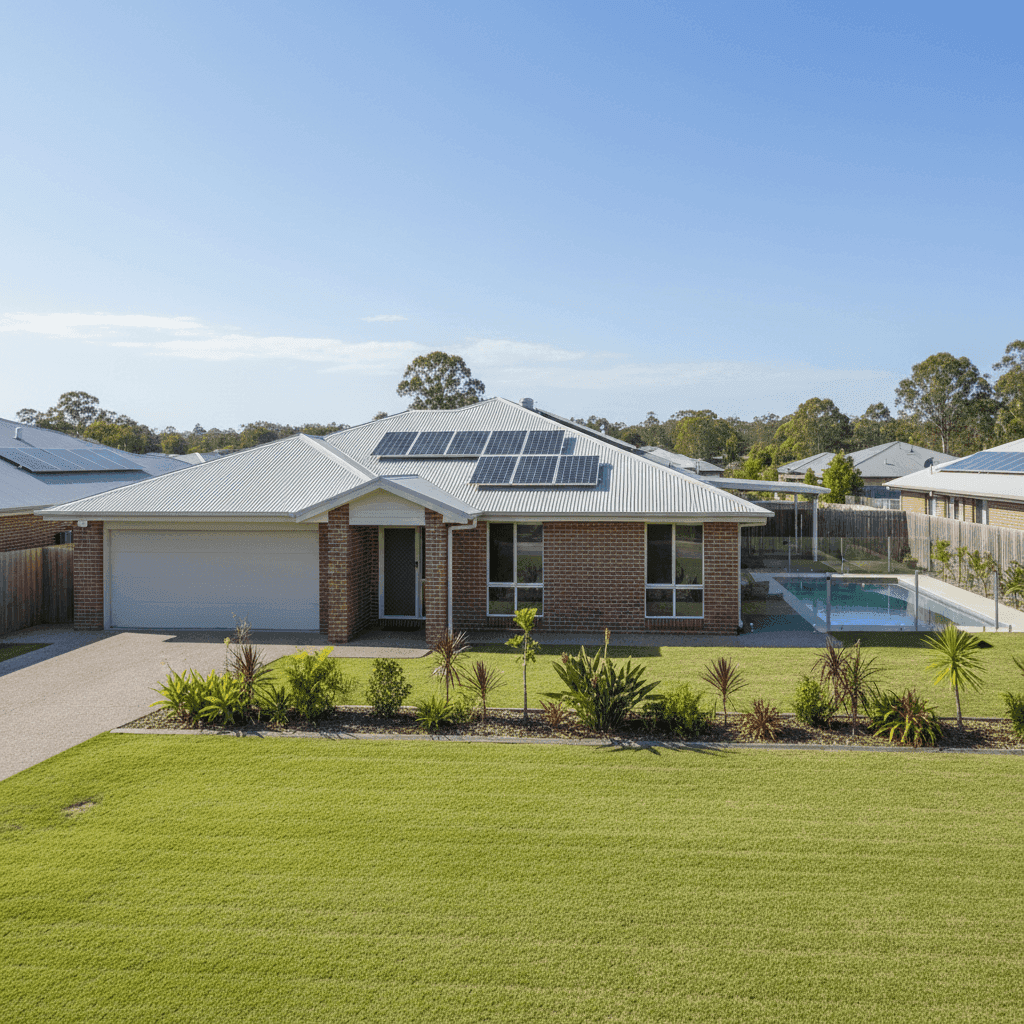
Logan Village is a quiet, semi-rural suburb tucked into the southern reaches of South East Queensland, sitting within the Logan City local government area near the Gold Coast border. It's the kind of place where larger blocks, established homes, and a relaxed lifestyle attract families looking to escape the density of the city — but that doesn't mean home insurance is something you can afford to overlook. This article breaks down a real building insurance quote for a three-bedroom, two-bathroom free-standing home in Logan Village (postcode 4207), and puts it in context against local, state, and national benchmarks.
---
Is This Quote Fair?
The quoted annual premium for this property is $3,107 per year (or roughly $291 per month), covering the building only with a $738,000 sum insured and a $1,000 excess.
Our price rating for this quote is FAIR — Around Average, and the data backs that up. The suburb average premium sits at $3,320/yr, meaning this quote comes in about $213 below the local average — a modest but meaningful saving. It also falls comfortably within the interquartile range for the suburb: the 25th percentile is $2,476/yr and the 75th percentile is $3,497/yr, placing this quote solidly in the middle of what Logan Village homeowners are typically paying.
So while you're not snagging a bargain-basement deal, you're also not being overcharged. For a brick veneer home built in 1996 with a pool and solar panels, this is a reasonable outcome.
---
How Logan Village Compares
To really understand whether $3,107 is competitive, it helps to zoom out and look at the broader picture. You can explore the full data on the Logan Village suburb stats page, the QLD state stats page, and the national stats page.
| Benchmark | Average Premium | Median Premium |
|---|---|---|
| Logan Village (suburb) | $3,320/yr | $3,066/yr |
| Queensland (state) | $9,129/yr | $3,903/yr |
| Australia (national) | $5,347/yr | $2,764/yr |
| Gold Coast LGA | $8,161/yr | — |
A few things stand out here. Queensland's state average of $9,129/yr is dramatically higher than the suburb average — a figure heavily skewed by high-risk coastal and cyclone-prone areas in Far North Queensland. The median of $3,903/yr is a more useful comparison point, and this quote sits below that too, which is encouraging.
At the national level, the average of $5,347/yr is similarly distorted by extreme-risk regions. The national median of $2,764/yr is actually below this quote, though it's worth noting that Logan Village's own median ($3,066/yr) is very close — suggesting the local market has its own risk profile that pushes premiums slightly higher than the national middle ground.
The Gold Coast LGA average of $8,161/yr is particularly striking. Logan Village, while geographically close to the Gold Coast, appears to attract considerably lower premiums — likely because it sits further inland, away from storm surge zones and high-density coastal exposure.
---
Property Features That Affect Your Premium
Several characteristics of this property have a direct bearing on what insurers charge. Here's how the key features stack up:
Brick Veneer Walls & Colorbond Roof This is a solid combination from an insurer's perspective. Brick veneer is considered a durable, fire-resistant construction material, and Colorbond steel roofing is well-regarded for its resilience against wind and rain. Together, they typically attract more competitive premiums than, say, weatherboard or fibre cement cladding with a tiled roof.
Slab Foundation A concrete slab is one of the more straightforward foundation types for insurers to assess. It avoids the complexities of subfloor spaces (common in older Queenslander-style homes) and is generally associated with lower risk of subsidence or pest-related structural damage.
Timber & Laminate Flooring While aesthetically popular, timber and laminate floors can be more susceptible to water damage than tiles. This is a factor some insurers weigh when assessing internal finishing risks, particularly in areas that experience heavy rainfall events.
Swimming Pool Pools add to the replacement cost of a property, which is reflected in the sum insured. They also introduce liability considerations. At $738,000 insured, the pool's rebuild value is likely factored into that figure, so it's important to ensure your sum insured genuinely covers full reinstatement — pool and all.
Solar Panels Solar systems are increasingly common in QLD, and most insurers now include them under building cover as a fixed structure. However, it's worth confirming with your insurer that your panels and inverter are explicitly covered, including damage from storm or hail — both of which are relevant risks in South East Queensland.
1996 Construction A home built in the mid-90s sits in a reasonable middle ground — old enough to have some character, but built under modern enough standards to avoid the more significant risks associated with pre-1980s construction. Wiring, plumbing, and roofing from this era are generally still serviceable, though worth monitoring as the property ages.
---
Tips for Homeowners in Logan Village
1. Review your sum insured annually Construction costs have risen sharply across Australia in recent years. A sum insured that was accurate two or three years ago may now be insufficient to fully rebuild your home. Use a building cost calculator or speak with a quantity surveyor to check your figure is still realistic — underinsurance is one of the most common and costly mistakes homeowners make.
2. Confirm solar panel coverage explicitly Don't assume your solar system is automatically covered. Ask your insurer to confirm in writing that panels, inverters, and mounting hardware are included under the building policy, and check whether storm and hail damage is covered without additional exclusions.
3. Shop around — even if your current quote seems fair A "fair" rating means you're around the market average, but that doesn't mean you couldn't do better. Premiums vary significantly between insurers for the same property. Comparing quotes through CoverClub takes only a few minutes and could reveal a meaningfully cheaper option with equivalent or better cover.
4. Consider your excess strategically This policy carries a $1,000 excess. Opting for a higher excess (say, $2,000) can reduce your annual premium — sometimes by a few hundred dollars. If you're unlikely to make small claims and have the financial buffer to cover a larger excess in an emergency, this trade-off can make good financial sense.
---
Ready to Compare?
Whether you're renewing your current policy or shopping around for the first time, CoverClub makes it easy to see what home insurance actually costs for properties like yours in Logan Village. Get a quote today and find out if you could be paying less — without sacrificing the cover you need.