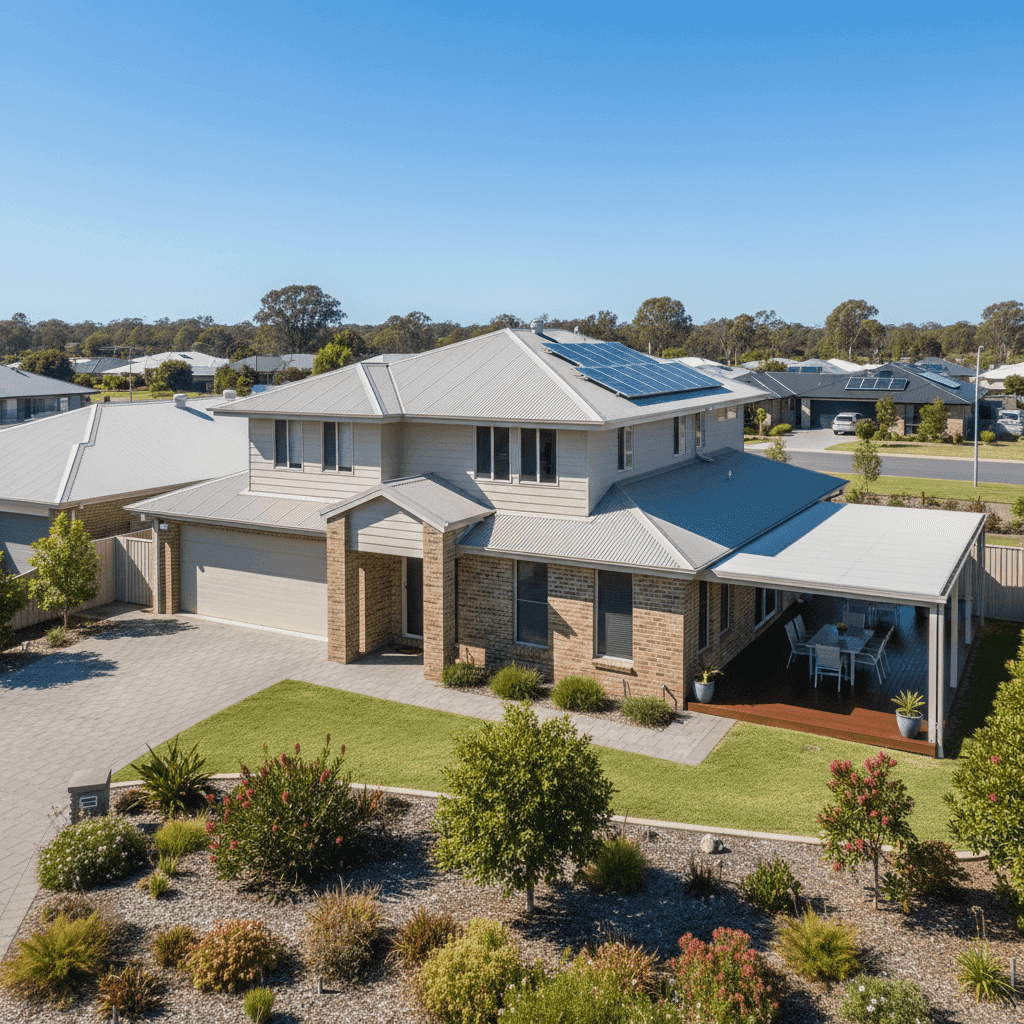
Logan Village is a quiet, semi-rural suburb tucked into the southern reaches of South East Queensland, sitting within the Logan City local government area. It's the kind of place where larger family homes on generous blocks are the norm — and a five-bedroom, free-standing double brick home fits right in. If you own a property like this, understanding what drives your home insurance premium is just as important as having the right cover in place.
This article breaks down a real home and contents insurance quote for a property of this type in Logan Village (postcode 4207), rated as expensive relative to the local market. We'll unpack what the numbers mean, how they stack up against suburb, state, and national benchmarks, and what you can do to make sure you're getting value for money.
---
Is This Quote Fair?
The annual premium on this quote comes in at $3,846 per year (or $362/month) for combined home and contents cover, with a building sum insured of $732,000 and contents valued at $95,000. Both the building and contents excess are set at $1,000.
Our pricing data rates this quote as Expensive — Above Average for the Logan Village area. That's a meaningful signal worth paying attention to.
To put it in context: the suburb average for Logan Village sits at $3,320/yr and the median is $3,066/yr. This quote is roughly 16% above the suburb average and about 25% above the median. It also nudges above the suburb's 75th percentile of $3,497/yr, meaning fewer than one in four comparable quotes in the area cost this much.
That said, "expensive" doesn't automatically mean "wrong." A higher premium can reflect legitimate risk factors tied to the specific property — its size, age, construction, inclusions, and the level of cover selected. The key is knowing whether those factors justify the price, or whether there's room to negotiate or shop around.
---
How Logan Village Compares
One of the more reassuring aspects of this quote is how it sits relative to broader Queensland and national benchmarks. You can explore the full Logan Village insurance statistics, Queensland state data, and national comparisons on CoverClub.
Here's how the numbers line up:
| Benchmark | Annual Premium |
|---|---|
| This Quote | $3,846 |
| Logan Village Suburb Average | $3,320 |
| Logan Village Suburb Median | $3,066 |
| QLD State Average | $9,129 |
| QLD State Median | $3,903 |
| National Average | $5,347 |
| National Median | $2,764 |
| Gold Coast LGA Average | $8,161 |
The Queensland state average of $9,129/yr is strikingly high — driven significantly by cyclone-prone coastal and far-north Queensland properties, which attract enormous premiums. Logan Village is not in a cyclone risk zone, which is a genuine financial advantage for homeowners here.
Compared to the QLD state median of $3,903/yr, this quote is actually slightly below — a positive sign. And against the Gold Coast LGA average of $8,161/yr (which encompasses a wide range of high-risk coastal and flood-prone properties), this quote looks quite reasonable.
Nationally, the average of $5,347/yr reflects the wide variation across Australia's diverse climate and geography. A quote of $3,846 for a well-built, five-bedroom home in a non-cyclone area is broadly in line with what you'd expect at a national level.
The takeaway: while this quote is on the higher end locally, it's not out of step with Queensland and national norms for a property of this size and specification.
---
Property Features That Affect Your Premium
Several characteristics of this property have a direct bearing on how insurers price the risk. Here's what stands out:
Double Brick Construction Double brick walls are generally viewed favourably by insurers — they're durable, fire-resistant, and structurally robust. This can work in your favour when it comes to building replacement costs, though the higher cost to rebuild brick structures can also push up the sum insured.
Steel/Colorbond Roof Colorbond roofing is a popular choice in Queensland and is well-regarded by insurers for its durability and resistance to wind and hail. It's a positive factor in risk assessment.
Solar Panels This property has solar panels, which are increasingly common across Queensland. Insurers typically cover solar panels as part of the building, but it's worth confirming they're explicitly included in your policy and that the sum insured accounts for their replacement value.
Ducted Climate Control Ducted air conditioning is a significant fixed installation that adds to the replacement cost of the building. Ensuring your building sum insured reflects this is important — underinsurance is a common and costly mistake.
Age and Size Built in 1985, this home is around 40 years old. Older properties can attract slightly higher premiums due to the potential for aging infrastructure (plumbing, wiring, etc.), though double brick construction ages particularly well. At 205 sqm across five bedrooms, this is a substantial home — and the $732,000 building sum insured reflects a realistic rebuild cost for a property of this size and quality in South East Queensland.
Above-Average Fittings The above-average fittings quality noted for this property — think quality cabinetry, fixtures, and finishes — contributes to a higher rebuild cost and, in turn, a higher premium. It's one of the clearest reasons this quote sits above the suburb median.
Slab Foundation and Tile Flooring A concrete slab foundation is standard and reliable for Queensland homes. Tiled flooring throughout is practical in the Queensland climate and unlikely to significantly impact premium calculations.
---
Tips for Homeowners in Logan Village
1. Review Your Sum Insured Annually Construction costs have risen sharply in recent years. A building sum insured that was accurate two years ago may now leave you underinsured. Use a building cost calculator or ask your insurer to review whether $732,000 still reflects current rebuild costs for a 205 sqm double brick home in South East Queensland.
2. Confirm Solar Panels Are Covered Not all policies automatically include solar panel systems in the building cover. Check your Product Disclosure Statement (PDS) to confirm your panels and inverter are covered, and that the sum insured accounts for their full replacement value.
3. Shop Around — Even If You're Happy With Your Insurer Being rated as "above average" in price is a prompt to compare. The suburb's 25th percentile sits at $2,476/yr — meaning some comparable properties in Logan Village are insured for significantly less. Loyalty doesn't always pay in insurance. Getting a second or third quote costs nothing.
4. Consider Your Excess Level Both the building and contents excess on this policy are set at $1,000. Opting for a higher excess (say, $2,000) can meaningfully reduce your annual premium. If you have a healthy emergency fund and rarely make small claims, a higher excess can be a smart trade-off.
---
Compare Your Home Insurance on CoverClub
Whether you're reviewing an existing policy or shopping for cover on a new property, CoverClub makes it easy to see how your premium stacks up against real quotes from across your suburb, state, and nationally. Get a quote today and find out if you're paying a fair price — or if there's a better deal waiting for you.