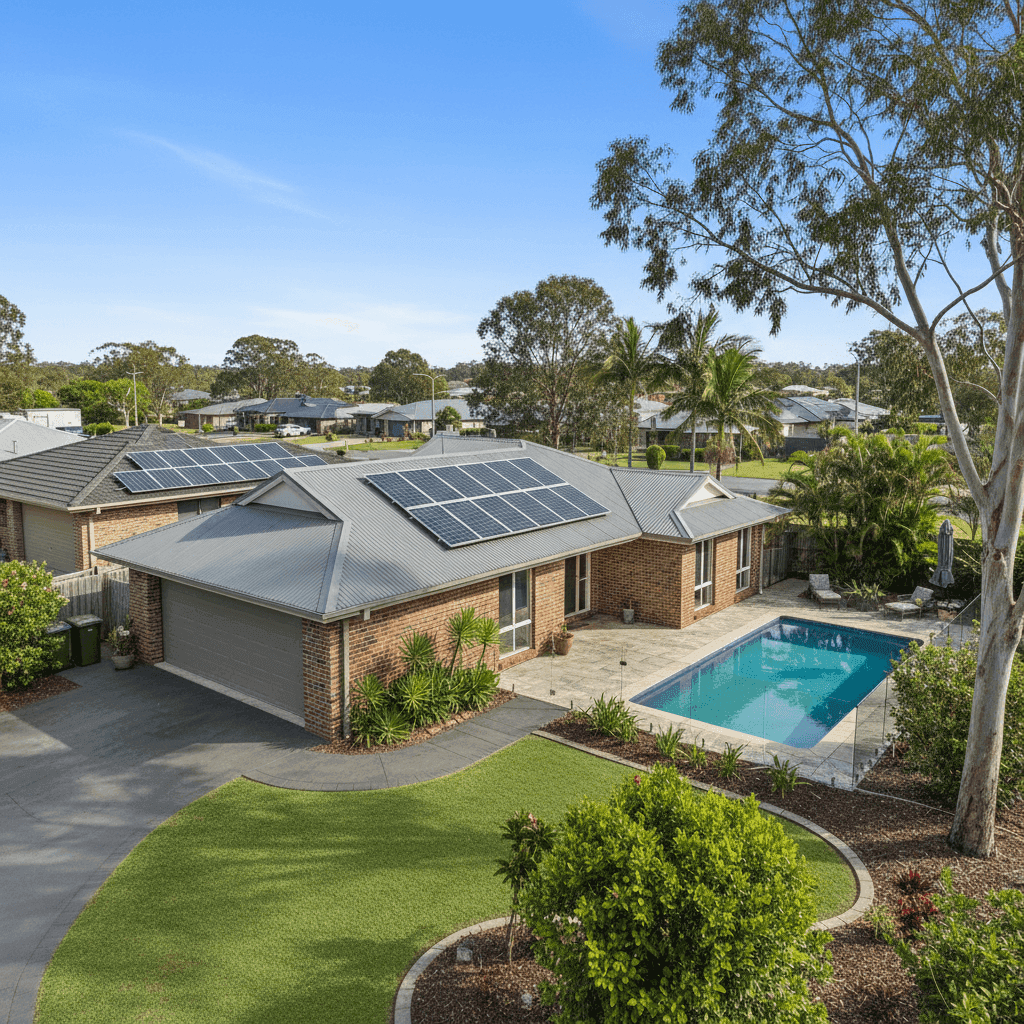
Logan Village is a quiet, semi-rural suburb sitting on the southern fringe of Greater Brisbane, just inside the 4207 postcode. Known for its spacious blocks, leafy streets, and relaxed lifestyle, it attracts families looking for room to breathe without straying too far from the Gold Coast or Brisbane CBDs. For owners of larger free standing homes in this area, getting the right home and contents insurance — and understanding whether you're paying a fair price — is an important part of protecting a significant asset.
This article breaks down a recent home and contents insurance quote for an 8-bedroom free standing home in Logan Village, examines how it stacks up against local, state, and national benchmarks, and offers practical tips for homeowners looking to manage their premiums.
---
Is This Quote Fair?
The quote in question comes in at $4,371 per year (or $412/month), covering a building sum insured of $1,046,000 and contents valued at $50,000, with a $1,000 excess on both building and contents.
Our price rating for this quote is Expensive — above average for the area.
To put that in context: the suburb average for Logan Village (4207) sits at $3,320/year, with a median of $3,066/year across 43 quotes in our dataset. This quote lands roughly $1,051 above the suburb average — that's a 32% premium over what most comparable properties in the area are paying.
It's worth noting that the suburb's 75th percentile is $3,497/year, meaning this quote sits well above even the more expensive end of the local range. That said, this is an unusually large property — 8 bedrooms and 277 sqm — which naturally pushes the building sum insured higher than a typical Logan Village home. A $1,046,000 building cover is substantial and will be a significant driver of the total premium.
---
How Logan Village Compares
Understanding your quote in isolation only tells part of the story. Here's how Logan Village sits within the broader insurance landscape:
| Benchmark | Average Premium | Median Premium |
|---|---|---|
| Logan Village (4207) | $3,320/yr | $3,066/yr |
| Queensland | $9,129/yr | $3,903/yr |
| National | $5,347/yr | $2,764/yr |
A few things stand out here. Queensland's average premium of $9,129/year is dramatically higher than the median of $3,903/year — a sign that the state's average is being pulled upward by high-risk coastal and cyclone-prone areas in Far North Queensland. Logan Village, sitting outside designated cyclone risk zones, benefits from considerably lower premiums than many other parts of the state.
Compared to the Queensland state average, this quote is well below the $9,129 mark — which is reassuring. Against the national average of $5,347/year, it also comes in lower. However, when measured against the more relevant local benchmarks — the suburb median and average — it is on the higher side, largely attributable to the property's size and the corresponding building sum insured.
The LGA (Gold Coast) average of $8,161/year also provides useful context: Logan Village homeowners are generally paying significantly less than many Gold Coast properties, likely reflecting the area's lower flood and storm surge exposure compared to coastal suburbs.
---
Property Features That Affect Your Premium
Several characteristics of this property have a direct bearing on its insurance cost:
Size and Sum Insured At 277 sqm with 8 bedrooms, this is a large home by any measure. The $1,046,000 building sum insured reflects the cost to rebuild a property of this scale, and insurers price accordingly. Larger homes cost more to rebuild, which means higher premiums — it's one of the most straightforward drivers of cost.
Double Brick Construction Double brick external walls are generally viewed favourably by insurers. Brick is resilient against fire, wind, and general wear, and tends to attract lower premiums compared to timber-framed or clad homes. This construction type is a positive factor working in the homeowner's favour.
Steel/Colorbond Roof Colorbond roofing is durable, low-maintenance, and performs well in Australian weather conditions. Insurers typically regard steel roofing positively, as it is resistant to fire and less prone to storm damage than some alternatives like terracotta tiles.
Slab Foundation and Tiled Flooring A concrete slab foundation is standard for Queensland homes built in the 1990s and is generally considered stable and low-risk. Tiled flooring is similarly straightforward from an insurance perspective — it's durable and easy to replace.
Swimming Pool Pools add value to a property but also introduce additional liability considerations. Some insurers factor pool-related risks into their pricing, particularly for legal liability cover. It's worth confirming your policy includes adequate liability protection.
Solar Panels Solar panels are increasingly common on Queensland homes and are generally covered under building insurance. However, it's important to check that your sum insured accounts for the replacement cost of the panels, as they can represent a significant value — particularly on a larger roof.
Ducted Climate Control Ducted air conditioning systems are considered a fixed building fixture and should be included in your building sum insured. Given the size of this home, a full ducted system could represent tens of thousands of dollars in replacement value, so ensuring it's adequately covered is essential.
---
Tips for Homeowners in Logan Village
1. Review Your Building Sum Insured Carefully With a large home like this, underinsurance is a real risk. The $1,046,000 sum insured needs to reflect the true cost of rebuilding — not just the market value of the property. Factor in the cost of demolition, site clearance, and rebuilding to current standards. If you haven't had a professional valuation recently, it may be worth organising one.
2. Compare Quotes Across Multiple Insurers This quote is rated as expensive relative to the suburb. Even for a large property, a 32% premium above the local average is worth scrutinising. Different insurers assess risk differently, and shopping around — particularly through a comparison platform — can surface meaningfully cheaper options with equivalent cover.
3. Consider Increasing Your Excess Both the building and contents excess are set at $1,000. Opting for a higher excess (say, $2,000 or $2,500) can reduce your annual premium noticeably. If you have a solid emergency fund and are unlikely to make small claims, a higher excess is often a smart trade-off.
4. Check What's Covered for Your Pool and Solar Make sure your policy explicitly covers your swimming pool structure and solar panel system under the building section. Some standard policies have exclusions or sub-limits for these items. It's also worth reviewing your liability cover in relation to the pool — particularly if you have visitors or young children in the household.
---
Compare Your Home Insurance with CoverClub
Whether you're renewing an existing policy or shopping around for the first time, it pays to know where your quote stands. CoverClub helps Australian homeowners benchmark their premiums against real data from their suburb, state, and across the country.
If you own a home in Logan Village or anywhere else in Queensland, get a home insurance quote through CoverClub and see how your premium compares — you might be surprised at what you could save.