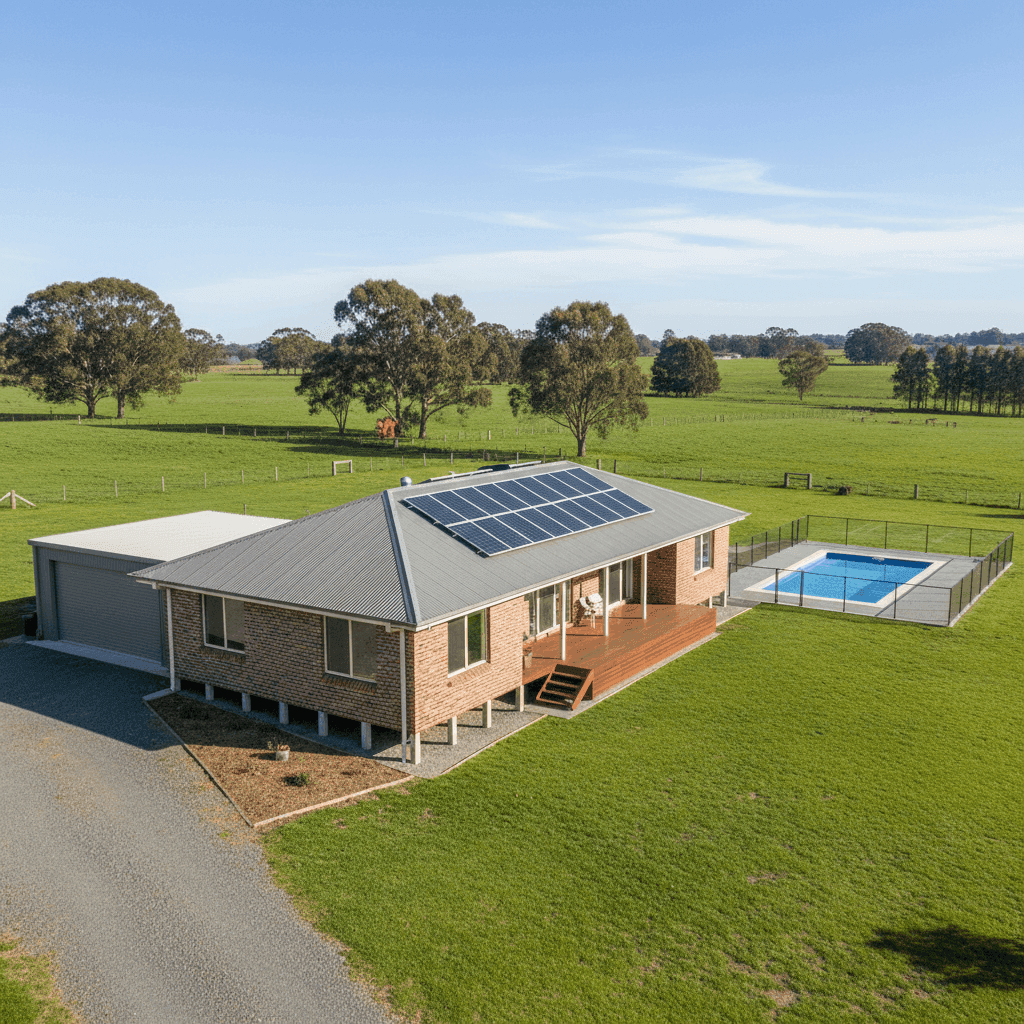
If you own a four-bedroom free standing home in Longford, VIC 3851, you're likely no stranger to the unique mix of lifestyle and risk that comes with living in regional Gippsland. Nestled in the Wellington local government area, Longford is a quiet township surrounded by farmland and waterways — a beautiful place to call home, but one that insurers assess carefully. This article breaks down a recent home and contents insurance quote for a property in this suburb, examines whether the price stacks up, and shares practical tips to help you make smarter insurance decisions.
---
Is This Quote Fair?
The quote in question comes in at $3,692 per year (or $383/month) for combined home and contents cover, with a building sum insured of $1,512,000 and contents valued at $244,000. The building excess is $2,500 and the contents excess is $500.
Our price rating for this quote is Expensive — above average for the Longford area.
To put that in context: the suburb average premium sits at just $2,177/year, and the median is $2,161/year. This quote is roughly 70% higher than what most Longford homeowners are paying. Even when you account for the 75th percentile of local quotes — $2,356/year — this premium still comes in significantly above the pack.
That said, it's important to understand why this quote is elevated before assuming the insurer is overcharging. Several property-specific features are likely pushing the premium upward, and we'll unpack those shortly.
---
How Longford Compares
Understanding your premium in isolation doesn't tell the whole story. Here's how Longford sits relative to broader benchmarks:
| Benchmark | Average Premium | Median Premium |
|---|---|---|
| Longford (suburb) | $2,177/yr | $2,161/yr |
| Victoria (state) | $3,000/yr | $2,718/yr |
| Wellington LGA | $4,409/yr | — |
| National | $5,347/yr | $2,764/yr |
A few things stand out here. First, Longford's suburb average is well below the Victorian state average of $3,000/year — suggesting that, generally speaking, this is a relatively affordable area to insure. However, the Wellington LGA average of $4,409/year tells a different story at the local government level, likely reflecting the diverse risk profiles across the broader region, including flood-prone and bushfire-affected areas.
The national average of $5,347/year is skewed heavily by high-risk postcodes — particularly in Queensland and northern Australia — which is why the national median of $2,764/year is a more useful comparison point. Against that median, this quote at $3,692/year is still on the higher side.
You can explore more local data on the Longford suburb stats page, compare it against Victoria-wide insurance trends, or see how it stacks up against national home insurance averages.
> Note: The suburb sample size here is 19 quotes, which is a relatively small dataset. Averages can shift meaningfully as more data comes in, so treat these figures as a useful guide rather than a definitive benchmark.
---
Property Features That Affect Your Premium
This isn't a standard entry-level home, and the premium reflects that. Let's look at the features most likely influencing the cost:
High Sum Insured
A building sum insured of $1,512,000 is substantial — well above what many comparable regional homes are insured for. This figure should reflect the full cost to rebuild the property from scratch (not its market value), and for a 214 sqm home with top-of-the-range fittings, a high rebuild cost is entirely plausible. Insurers price directly against this figure, so it's one of the biggest levers on your premium.
Top-of-the-Range Fittings
High-end finishes — think stone benchtops, premium cabinetry, designer fixtures — are more expensive to replace and repair. Insurers factor in fittings quality when calculating both the likelihood and cost of claims, which pushes the premium higher than it would be for a standard-finish home.
Swimming Pool
A pool adds liability risk and increases the cost of property claims (damage to pool equipment, fencing, and surrounds). Most insurers load the premium accordingly.
Solar Panels
Solar systems are increasingly common, but they add to the insurable value of the property and can be costly to repair or replace after storm or hail damage — a real consideration in regional Victoria.
Stump Foundation & Elevated Construction
The home is built on stumps and elevated by less than one metre. While this isn't classified as a full Queenslander-style elevation, it does introduce some additional considerations around subfloor access, pest risk, and potential flood exposure — all of which insurers weigh up.
Timber/Laminate Flooring
Timber and laminate floors can be more susceptible to water damage than tiles, and they're often more expensive to replace. This can influence the contents and building components of a claim.
Brick Veneer Walls & Colorbond Roof
On the positive side, brick veneer is a well-regarded construction type that insurers generally view favourably for fire and storm resilience. A steel Colorbond roof is similarly durable and widely used across regional Victoria — neither of these features should be adding significant cost to your premium.
---
Tips for Homeowners in Longford
1. Double-Check Your Sum Insured
A building sum insured of $1,512,000 is significant. Make sure this figure is based on an up-to-date building cost estimate — not just a rough guess or last year's figure carried over. Overinsuring drives up your premium unnecessarily, while underinsuring leaves you exposed at claim time. Tools like the Cordell Sum Sure calculator can help you arrive at a defensible figure.
2. Review Your Contents Estimate Carefully
$244,000 in contents cover is meaningful. Walk through your home room by room and itemise high-value items — electronics, jewellery, artwork, appliances, and furniture. You may find you're over- or under-estimating. Getting this right ensures you're not paying for cover you don't need.
3. Consider Your Excess Settings
This policy carries a $2,500 building excess. Opting for a higher excess is one of the most direct ways to reduce your annual premium — but make sure you could comfortably cover that amount out of pocket if you needed to make a claim. Some insurers also offer discounts for bundling home and contents, which this policy already does.
4. Compare Quotes Annually
Insurance markets shift, and loyalty doesn't always pay. Given that this quote is above average for Longford, it's well worth shopping around at renewal time. Even a modest saving of $500–$800 per year compounds significantly over time.
---
Ready to Compare?
Whether you're reviewing your current policy or shopping for the first time, CoverClub makes it easy to see what you could be paying. Get a home insurance quote today and compare your options in minutes — no jargon, no pressure, just clear pricing so you can make a confident decision.