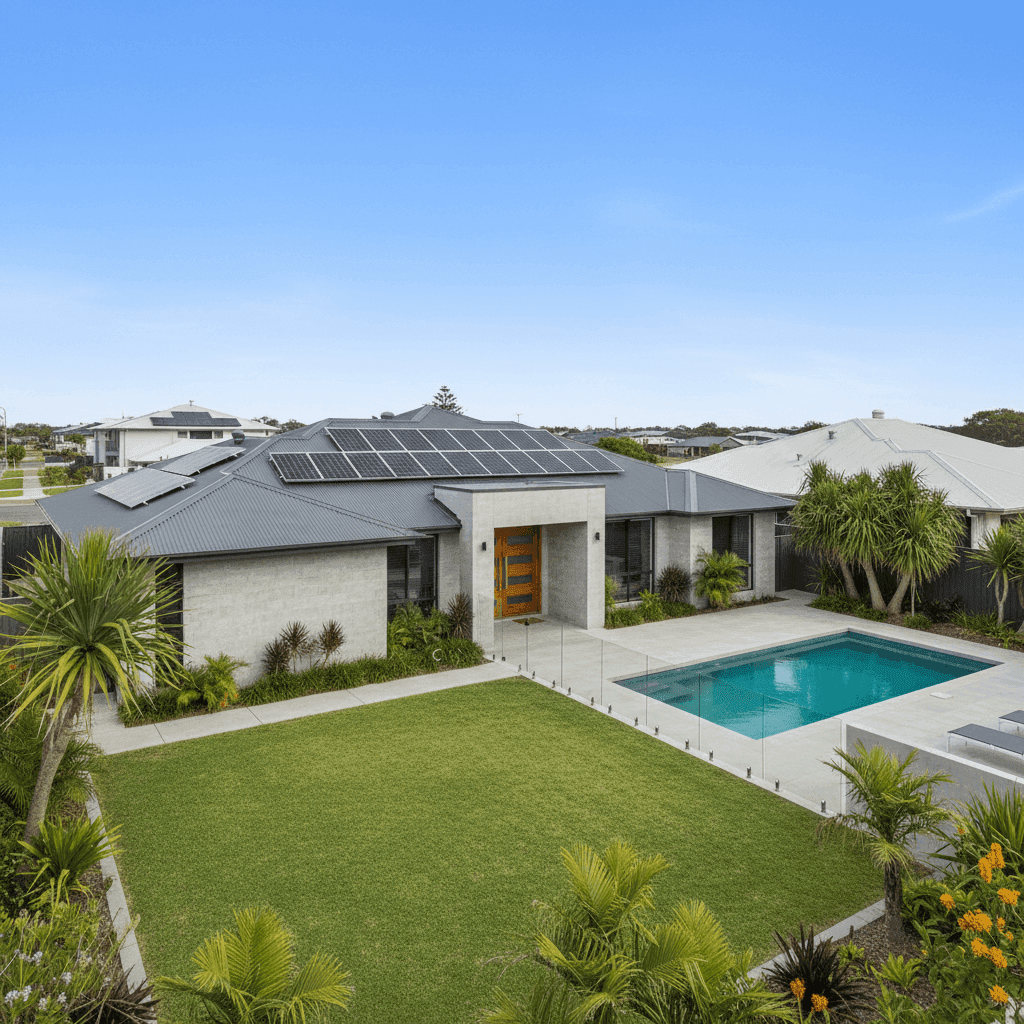
Marcoola is a coastal suburb on Queensland's Sunshine Coast, sitting just back from the beach and offering the kind of relaxed lifestyle that draws families and sea-changers alike. It's also a suburb where home insurance premiums deserve careful attention — coastal proximity, Queensland's weather patterns, and the value of larger homes all play a role in what you'll pay. This article breaks down a real home and contents insurance quote for a five-bedroom, free-standing home in Marcoola (postcode 4564), and puts it in context against local, state, and national benchmarks.
---
Is This Quote Fair?
The quote in question comes in at $4,612 per year (or $454 per month) for combined home and contents cover, with a building sum insured of $1,454,000 and contents valued at $200,000. The building excess is $3,000 and the contents excess $600.
Our price rating for this quote is FAIR — Around Average, and the data backs that up. At $4,612 per year, this premium sits comfortably below both the suburb average of $4,785 and the suburb median of $5,027 for Marcoola. It's also just above the Queensland state average of $4,547, meaning the policyholder is paying roughly in line with what most Queensland homeowners face for comparable cover.
For a property of this size and value — 315 sqm, five bedrooms, four bathrooms, above-average fittings, a pool, solar panels, and ducted climate control — a "fair" rating is genuinely a reasonable outcome. Larger, well-appointed homes naturally attract higher premiums, and this quote reflects that reality without straying into overpriced territory.
---
How Marcoola Compares
Understanding where your premium sits relative to the broader market is one of the most useful things you can do as a homeowner. Here's how this quote stacks up:
| Benchmark | Premium |
|---|---|
| This Quote | $4,612 / yr |
| Marcoola Suburb Average | $4,785 / yr |
| Marcoola Suburb Median | $5,027 / yr |
| Marcoola 25th Percentile | $3,470 / yr |
| Marcoola 75th Percentile | $6,072 / yr |
| QLD State Average | $4,547 / yr |
| QLD State Median | $3,931 / yr |
| National Average | $2,965 / yr |
| National Median | $2,716 / yr |
| Sunshine Coast LGA Average | $7,249 / yr |
A few things stand out here. First, Marcoola premiums are notably higher than the national average — roughly 60% above the national median of $2,716. This is not unusual for coastal Queensland, where insurers factor in flood risk, storm surge exposure, and the general severity of weather events in the region.
Second, and perhaps surprisingly, this quote sits well below the Sunshine Coast LGA average of $7,249 per year. The LGA figure is pulled upward by higher-risk and higher-value properties across the broader Sunshine Coast area, so Marcoola's suburb-level figures offer a more precise comparison for local homeowners.
You can explore Marcoola-specific insurance statistics, Queensland-wide premium data, and national home insurance benchmarks on the CoverClub stats pages.
---
Property Features That Affect Your Premium
Every home is different, and insurers price risk based on a combination of factors. For this particular property, several features are worth highlighting:
Concrete external walls are generally viewed favourably by insurers. Concrete construction offers strong resistance to fire, impact, and wind — all relevant considerations in coastal Queensland. Compared to timber-framed homes, concrete-walled properties often attract lower premiums or at least don't carry the same loading.
Steel/Colorbond roofing is another positive. Colorbond is widely used across Queensland precisely because it handles heat, wind, and rain well. It's durable, relatively low-maintenance, and considered a lower-risk roofing material by most insurers compared to older tile roofs or heritage materials.
Slab foundation with tile flooring is a practical, resilient combination. Slab-on-ground construction is standard for modern Queensland homes and is generally straightforward for insurers to assess. Tiled flooring holds up well in humid coastal environments and doesn't carry the same water-damage risk as carpet or timber in wet conditions.
Above-average fittings do push the sum insured higher — and rightly so. High-quality fixtures, appliances, and finishes cost more to repair or replace, which is reflected in both the building sum insured and the premium. The $1,454,000 building cover figure is substantial, but for a 315 sqm home with premium fittings built in 2011, it's a realistic rebuild estimate.
The pool, solar panels, and ducted climate control each add incremental value to the property and contribute modestly to the overall premium. Solar panels in particular are worth checking on your policy — some insurers cover them as part of the building, others require specific endorsement.
No cyclone risk designation is a meaningful factor for this property. While Marcoola sits on the Sunshine Coast and is exposed to severe storms and heavy rainfall, it falls outside the formal cyclone risk zone that applies to areas further north. This keeps the premium lower than it would be for equivalent properties in, say, Cairns or Townsville.
---
Tips for Homeowners in Marcoola
1. Review your building sum insured regularly. Construction costs have risen significantly in recent years. A rebuild estimate that was accurate in 2021 may be materially understated today. Use a building cost calculator or speak with a quantity surveyor to make sure your sum insured keeps pace with current labour and materials costs.
2. Check how your solar panels are covered. With solar panels now a standard feature on many Queensland homes, it's worth confirming whether your policy covers them under the building section, and whether damage from storms or electrical faults is included. Don't assume — read the Product Disclosure Statement (PDS) carefully.
3. Consider your excess strategy. This quote carries a $3,000 building excess. A higher excess typically lowers your annual premium, but it means more out-of-pocket cost when you do make a claim. Think about what you could comfortably absorb in a claim scenario and set your excess accordingly.
4. Compare quotes at renewal, not just when you first take out a policy. Insurance markets shift, and loyalty doesn't always pay. Running a comparison at renewal — even if you're happy with your current insurer — takes only a few minutes and could reveal meaningful savings or better cover terms.
---
Compare Your Home Insurance Quote
Whether you're a first-time buyer in Marcoola or a long-term homeowner reviewing your cover, comparing quotes is the single most effective step you can take. CoverClub makes it easy to see what insurers are offering for your specific property — get a home insurance quote today and find out if you're paying a fair price.