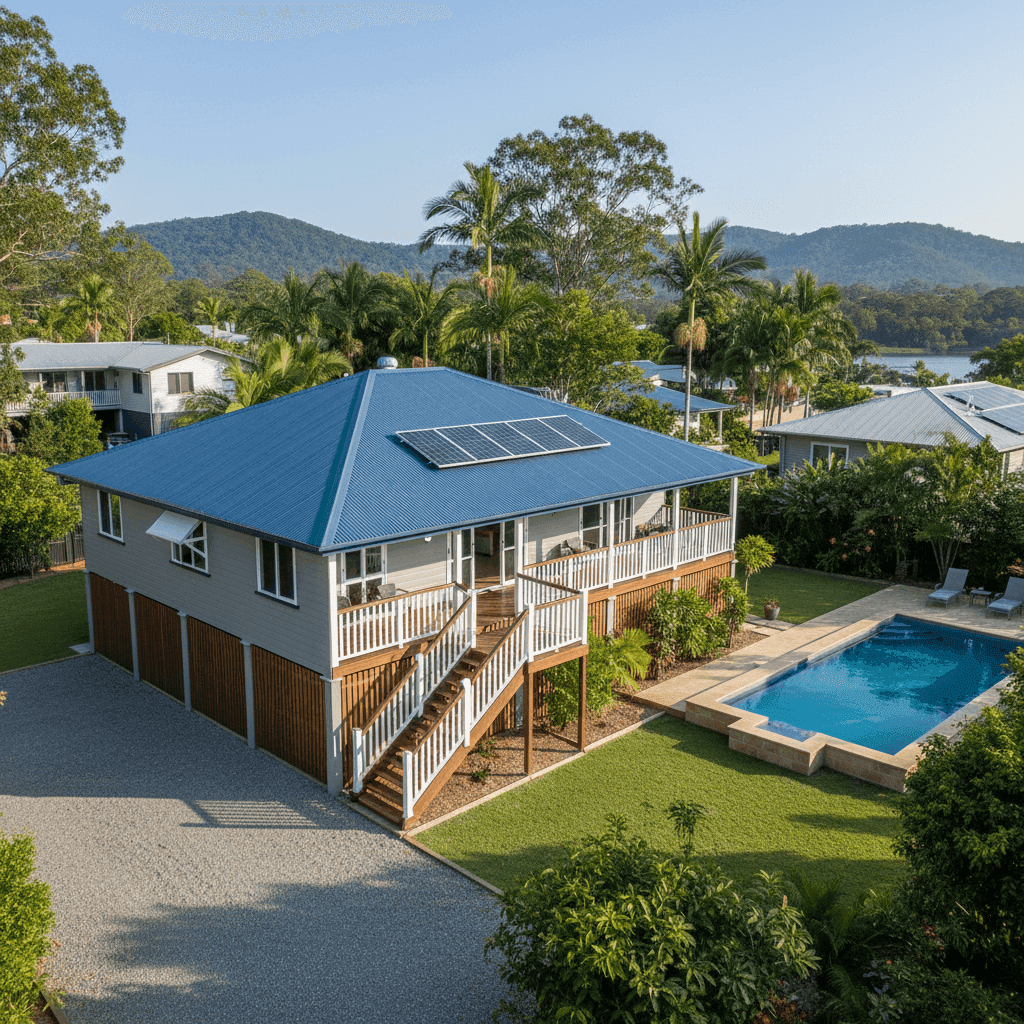
Maroochy River is one of the Sunshine Coast's most picturesque pockets — a relaxed, semi-rural suburb where acreage properties and riverside homes sit alongside modern family residences. It's a desirable place to live, but like much of South-East Queensland, home insurance here comes with some notable price tags. This article breaks down a recent home and contents insurance quote for a five-bedroom free-standing home in Maroochy River (postcode 4561), helping you understand what's driving the cost and whether the premium stacks up.
---
Is This Quote Fair?
The quote in question sits at $6,562 per year (or $629/month) for combined home and contents cover, with a building sum insured of $2,636,000 and contents valued at $294,000. Both the building and contents excess are set at $5,000.
Our price rating for this quote is Expensive — Above Average.
To put that in context: the suburb average for Maroochy River is $4,955/yr, and the suburb median sits at $4,233/yr. This quote lands well above both figures — roughly 32% above the suburb average and 55% above the median. It also exceeds the suburb's 75th percentile of $5,654/yr, meaning it's pricier than at least three-quarters of comparable quotes in the area.
That said, "expensive" doesn't automatically mean "wrong." A high sum insured — $2,636,000 for the building alone — is a significant driver of premium cost. Larger, higher-value homes naturally attract higher premiums, and this property's features (more on those below) add further complexity to the risk profile. The key question is whether you're getting appropriate cover at a competitive rate, or whether there's room to shop around.
---
How Maroochy River Compares
Understanding where your premium sits relative to broader benchmarks is essential for making an informed decision. Here's how the numbers stack up:
| Benchmark | Premium |
|---|---|
| This Quote | $6,562/yr |
| Suburb Average (Maroochy River) | $4,955/yr |
| Suburb Median | $4,233/yr |
| Suburb 25th Percentile | $3,109/yr |
| Suburb 75th Percentile | $5,654/yr |
| LGA Average (Sunshine Coast) | $7,249/yr |
| QLD State Average | $9,129/yr |
| QLD State Median | $3,903/yr |
| National Average | $5,347/yr |
| National Median | $2,764/yr |
(Based on 33 quotes collected for the Maroochy River suburb. See full [Maroochy River insurance stats](https://coverclub.com.au/stats/QLD/4561/maroochy-river), [QLD state data](https://coverclub.com.au/stats/QLD), and [national benchmarks](https://coverclub.com.au/stats/national).)
One figure worth noting: the Sunshine Coast LGA average of $7,249/yr is actually higher than this quote — suggesting that across the broader region, many homeowners are paying even more. Queensland's state average of $9,129/yr is also well above this quote, though the state median of $3,903/yr tells a different story. The large gap between QLD's mean and median reflects the influence of high-risk, high-premium properties (think cyclone-prone Far North Queensland) skewing the average upward.
Nationally, this quote sits above both the average ($5,347/yr) and median ($2,764/yr), reinforcing the "above average" rating — though Queensland homeowners broadly pay more than their interstate counterparts due to the state's elevated weather risk profile.
---
Property Features That Affect Your Premium
Several characteristics of this property have a direct bearing on the insurance premium. Understanding them helps explain why the cost is what it is.
Hardiplank/Hardiflex External Walls Fibre cement cladding like Hardiplank is generally considered a favourable material by insurers — it's durable, fire-resistant, and handles Queensland's humidity well. This likely has a neutral-to-positive effect on the premium compared to, say, weatherboard or lightweight materials.
Steel/Colorbond Roof Colorbond roofing is widely regarded as one of the better choices for Australian conditions. It performs well in high winds, resists corrosion, and is low-maintenance. Insurers typically view it favourably, which may help moderate the premium.
Stump Foundation (Elevated Less Than 1m) The property sits on stumps and is elevated by less than one metre. In flood-prone or low-lying areas of Queensland, elevation can significantly affect flood risk assessments. Being on stumps — even at a modest height — does provide some buffer, though insurers will still assess the property's proximity to waterways and flood mapping data for the Maroochy River area specifically.
Timber/Laminate Flooring Timber and laminate floors can be costly to repair or replace following water damage or flooding events. This is factored into both the building sum insured and the insurer's risk assessment.
Pool, Solar Panels & Ducted Climate Control Each of these adds to the replacement cost of the property and, in turn, the sum insured. A swimming pool introduces liability considerations, solar panels add to the building value (and can be damaged in storms), and ducted climate control systems are expensive to repair or replace. Collectively, these features push the sum insured — and therefore the premium — upward.
High Building Sum Insured At $2,636,000, the building sum insured is substantial. This is appropriate for a five-bedroom, three-bathroom home with premium features built in 2008, but it's worth periodically reviewing whether this figure remains accurate. Both over-insurance and under-insurance carry risks.
---
Tips for Homeowners in Maroochy River
1. Review your sum insured regularly Construction costs have risen sharply in recent years. Make sure your building sum insured reflects current rebuild costs — not what you paid for the property or what it's worth on the market. An independent quantity surveyor can provide a precise estimate, and some insurers offer free online calculators.
2. Compare quotes before renewing Loyalty doesn't always pay in insurance. Premiums can vary significantly between providers for the same property and level of cover. Use a comparison platform like CoverClub to see multiple quotes side by side before your renewal date.
3. Consider your excess settings This quote carries a $5,000 excess on both building and contents. A higher excess generally reduces your annual premium, but make sure it's an amount you could comfortably cover out of pocket in the event of a claim. If cash flow is a concern, a lower excess with a slightly higher premium might be more practical.
4. Check your flood and water damage inclusions Given the property's proximity to the Maroochy River and its stump foundation, it's worth carefully reading the Product Disclosure Statement (PDS) to understand exactly what's covered under flood, storm surge, and water damage scenarios. Not all policies treat these the same way, and exclusions can catch homeowners off guard at claim time.
---
Ready to Compare?
Whether you're reviewing an existing policy or shopping for cover on a new property, getting multiple quotes is the smartest move you can make. Head to CoverClub to compare home and contents insurance options for your Maroochy River property — it takes just a few minutes and could save you hundreds of dollars a year.