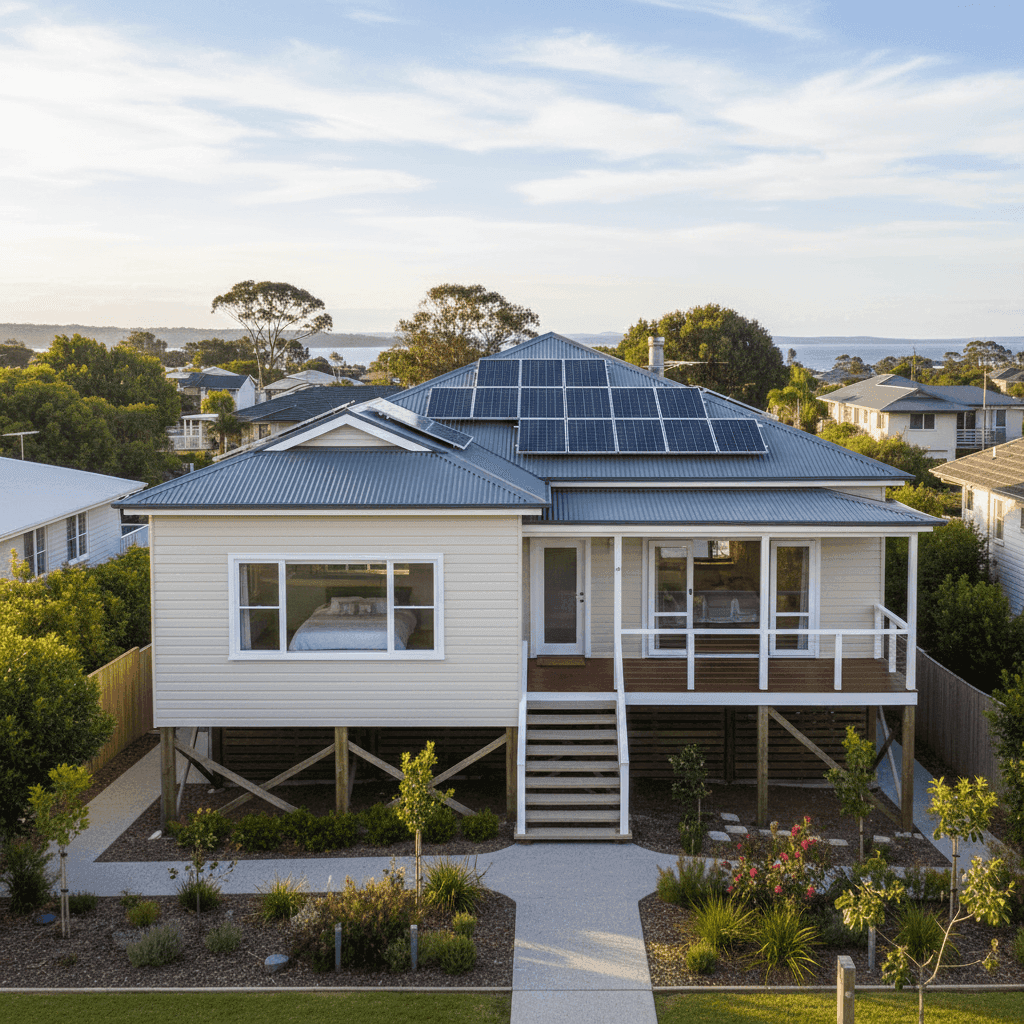
McCrae is a coastal suburb on Victoria's Mornington Peninsula — a relaxed, sun-soaked community that attracts families, retirees, and holiday homeowners alike. It's also a location where home insurance premiums can vary quite significantly depending on your property's features, construction, and proximity to natural hazards. This article breaks down a real home insurance quote for a three-bedroom, two-bathroom free-standing home in McCrae (postcode 3938), helping you understand whether the price stacks up and what's driving the cost.
---
Is This Quote Fair?
The quote in question comes in at $2,697 per year (or $259 per month) for combined home and contents cover, with a building sum insured of $482,000 and contents valued at $50,000. Both the building and contents excesses are set at $1,000.
Our price rating for this quote is Fair — Around Average, which is a reasonable outcome for a property in this part of Victoria. It's not the cheapest on the market, but it's sitting comfortably within a normal range for the suburb and reflects the property's characteristics honestly.
To put that in context: the suburb average premium in McCrae is $3,022 per year, and the suburb median sits at $3,202 per year. This quote comes in noticeably below both of those figures — roughly 11% under the average and 16% under the median. That's a meaningful saving for a homeowner who might otherwise assume they're paying the going rate.
The spread of premiums in McCrae is also worth noting. The 25th percentile sits at $2,079 per year, while the 75th percentile reaches $3,780 per year. That's a wide band, which tells us that insurers are pricing McCrae properties quite differently depending on individual risk factors. At $2,697, this quote falls in the lower half of that range — a positive sign.
---
How McCrae Compares
Understanding your quote means looking beyond the suburb. Here's how McCrae stacks up against broader benchmarks:
| Benchmark | Average Premium | Median Premium |
|---|---|---|
| McCrae (VIC 3938) | $3,022/yr | $3,202/yr |
| Mornington Peninsula LGA | $2,652/yr | — |
| Victoria (State) | $3,000/yr | $2,718/yr |
| National | $5,347/yr | $2,764/yr |
A few things stand out here. McCrae's average premium is slightly above the Victorian state average of $3,000/yr, though the state median of $2,718 is lower — suggesting that a handful of high-cost properties are pulling the VIC average upward. McCrae sits in a similar position.
What's striking is the national average of $5,347 per year. This figure is heavily influenced by high-risk regions in Queensland, Western Australia, and the Northern Territory — areas exposed to cyclones, flooding, and extreme weather. Victoria, and the Mornington Peninsula specifically, benefits from a comparatively lower natural hazard profile, which keeps premiums more grounded.
Interestingly, the Mornington Peninsula LGA average of $2,652 per year is actually lower than McCrae's suburb average. This suggests that while McCrae is a desirable coastal location, some of its properties — particularly those on stumps or elevated sites near the waterfront — attract slightly higher premiums than inland Peninsula properties.
You can explore the full breakdown of McCrae insurance data here.
---
Property Features That Affect Your Premium
Every home is different, and insurers assess a range of construction and site characteristics when calculating your premium. Here's how the features of this particular property likely influence the quote:
Hardiplank / Hardiflex Cladding Fibre cement cladding like Hardiplank is generally viewed favourably by insurers. It's non-combustible, resistant to rot and termites, and holds up well in coastal environments. Compared to weatherboard or timber, it typically attracts a lower fire risk loading — a useful advantage in a state that takes bushfire risk seriously.
Steel / Colorbond Roof Colorbond roofing is a popular choice across coastal Victoria, and for good reason. It's durable, low-maintenance, and performs well in wind and rain events. Insurers tend to rate steel roofing positively, particularly when compared to older tile or terracotta roofs that can crack or leak over time.
Elevated on Stumps This is one of the more interesting features of this property. Being elevated by at least one metre on stumps can actually work in a homeowner's favour in flood-prone areas, as it reduces the risk of inundation. However, elevated homes can also be more exposed to wind uplift, and the subfloor space requires its own maintenance considerations. Overall, the impact on premium is nuanced and varies by insurer.
Solar Panels The property includes solar panels, which are worth noting from an insurance perspective. Most home and contents policies cover solar panels as part of the building sum insured, but it's worth confirming this with your insurer. Panels do add replacement value to the roof structure, so ensuring your building sum insured accounts for this is important.
Construction Year: 2014 A home built in 2014 benefits from relatively modern building codes, including improved standards for energy efficiency, structural integrity, and fire resistance. This works in the homeowner's favour when insurers assess replacement cost and risk.
Tile Flooring Tiled floors are durable and easy to replace, and they don't carry the same water damage risk as timber or carpet. This is a minor factor but can influence contents and building claims assessments.
---
Tips for Homeowners in McCrae
If you own a home in McCrae — or are considering purchasing one — here are a few practical ways to manage your insurance costs:
- Review your building sum insured regularly. Construction costs have risen significantly across Victoria in recent years. Make sure your sum insured reflects what it would actually cost to rebuild your home today, not what you paid for it or what it's worth on the market. Underinsurance is one of the most common and costly mistakes homeowners make.
- Check that your solar panels are covered. Ask your insurer explicitly whether your solar system is included in the building sum insured or whether it needs to be listed separately. Some policies have exclusions or sub-limits that could leave you short in a claim.
- Consider your excess carefully. A $1,000 excess is fairly standard, but increasing it voluntarily (to, say, $2,000 or $2,500) can reduce your annual premium meaningfully. If you have an emergency fund and wouldn't claim for smaller incidents, a higher excess can be a smart trade-off.
- Shop around at renewal time. Loyalty doesn't always pay in insurance. Premiums can shift significantly from year to year, and new quotes from competing insurers often come in lower than your renewal offer. Using a comparison platform like CoverClub makes this process quick and straightforward.
---
Compare Your Options at CoverClub
Whether you're a long-time McCrae local or new to the area, making sure you're getting the right cover at a competitive price is worth a few minutes of your time. At CoverClub, you can compare home and contents quotes for your specific property — so you're not just guessing whether your premium is fair. Enter your address and see how your quote stacks up against real data from your suburb, your state, and across Australia.