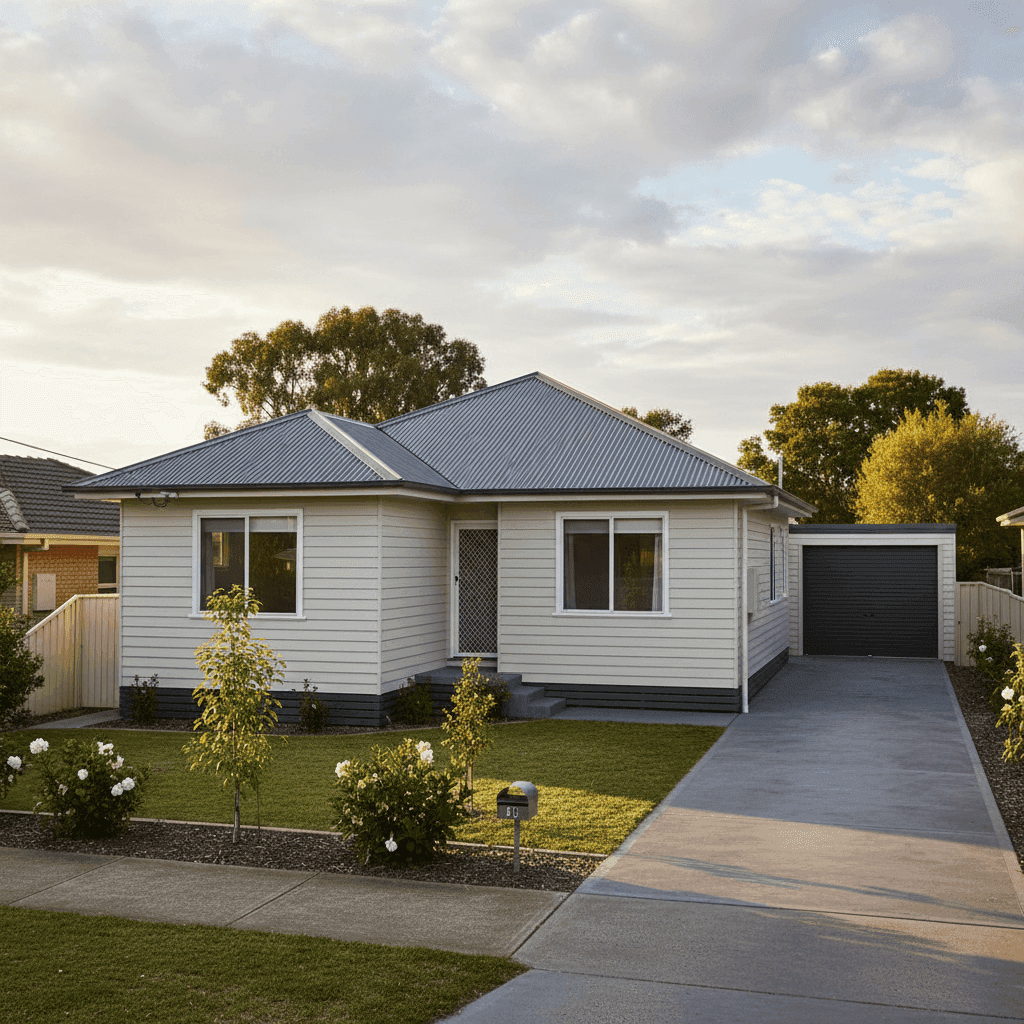
If you own a free standing home in Moe South, VIC 3825, you've probably wondered whether you're paying a fair price for home insurance — or whether there's a better deal waiting to be found. To help answer that question, we've analysed a real home and contents insurance quote for a four-bedroom, two-bathroom weatherboard home in the suburb and compared it against local, state, and national benchmarks.
---
Is This Quote Fair?
The quote in question comes in at $3,530 per year (or $338 per month) for combined home and contents cover, with a building sum insured of $518,000 and contents valued at $50,000. Both the building and contents excess are set at $1,000.
Our price rating for this quote is FAIR — Around Average. That assessment is backed up by the numbers: the quote sits modestly above the suburb average of $3,389/yr but well within the normal range for the area. It's not a bargain, but it's not an outlier either.
For context, the Moe South suburb average sits at $3,389/yr, with a median of $2,644/yr. The spread between the 25th percentile ($1,390/yr) and the 75th percentile ($4,241/yr) is quite wide, which tells us premiums in this postcode can vary significantly depending on property characteristics, insurer, and the level of cover chosen. At $3,530/yr, this quote lands comfortably within the middle band — above the median but below the 75th percentile.
---
How Moe South Compares
Understanding where your premium sits relative to broader benchmarks is one of the most useful tools for evaluating any quote. Here's how Moe South stacks up:
| Benchmark | Average Premium | Median Premium |
|---|---|---|
| Moe South (3825) | $3,389/yr | $2,644/yr |
| Victoria (VIC) | $3,000/yr | $2,718/yr |
| National | $5,347/yr | $2,764/yr |
| Wellington LGA | $4,409/yr | — |
A few things stand out here. First, the Victorian state average of $3,000/yr is notably lower than the Moe South suburb average, suggesting that homes in this postcode carry slightly elevated risk or replacement costs compared to the broader state. This is consistent with regional Victoria, where older housing stock, bushfire proximity, and localised weather risks can push premiums higher than metropolitan Melbourne benchmarks.
Second, the national average of $5,347/yr looks dramatically higher — but this is heavily influenced by high-cost regions like Far North Queensland and parts of Western Australia where cyclone and flood risk drive premiums into the thousands. The national median of $2,764/yr is a more representative figure for typical Australian homeowners, and Moe South's median of $2,644/yr tracks closely to it.
Third, the Wellington LGA average of $4,409/yr is noticeably higher than the Moe South suburb average. This suggests that other areas within the Wellington local government area may carry greater risk profiles — something worth keeping in mind if you're comparing properties across the region.
It's worth noting that the suburb sample size for Moe South is 11 quotes, so while the data is directionally useful, a larger sample would give greater statistical confidence. As more quotes are collected, these figures will become increasingly reliable.
---
Property Features That Affect Your Premium
Several characteristics of this property have a meaningful influence on what insurers charge. Understanding them can help you make sense of your quote — and potentially find ways to reduce it.
Weatherboard timber walls are one of the most significant factors. Timber-clad homes are generally considered higher risk for fire than brick veneer or full brick construction, and this is typically reflected in higher premiums. In bushfire-adjacent areas of regional Victoria, this risk weighting can be pronounced.
Steel/Colorbond roofing is actually a positive from an insurer's perspective. Colorbond is durable, low-maintenance, and performs well in both high-wind and bushfire-prone conditions compared to older tile or terracotta roofs. This may help offset some of the premium loading from the timber walls.
Slab foundation is the most common foundation type in Australia and is generally viewed neutrally by insurers — it doesn't attract the same loading that pier-and-beam or suspended foundations might.
Construction year: 1990 places this home in an era before many modern building codes were standardised. Homes of this age may have older plumbing, electrical systems, or insulation, which can influence claims frequency and, by extension, premium pricing.
Ducted climate control adds to the contents and building value, and is factored into the overall sum insured. It's one of those features that quietly increases your replacement cost if something goes wrong.
Slightly elevated (less than 1 metre) — while this property is modestly raised, it doesn't fall into a high-risk flood exposure category. However, even minor elevation can affect drainage and storm-related claims, so insurers do take note.
The absence of a pool and solar panels simplifies the risk profile and keeps the premium from climbing further.
---
Tips for Homeowners in Moe South
Whether you're reviewing your existing policy or shopping for the first time, here are four practical steps to make sure you're getting the best value.
- Review your sum insured regularly. Building costs in regional Victoria have risen sharply in recent years. A sum insured of $518,000 for a 214 sqm home works out to roughly $2,420/sqm — which is reasonable but worth revisiting annually to ensure you're not underinsured. Use a building cost calculator or speak with a local builder for a current estimate.
- Consider a higher excess to reduce your premium. With both excesses currently set at $1,000, there may be room to increase these if you have savings to cover a larger out-of-pocket cost in the event of a claim. Many insurers offer meaningful premium discounts for excesses of $1,500 or $2,000.
- Bundle your home and contents cover. This quote already combines both, which is smart — most insurers offer a discount for bundling. If you haven't already, make sure you're getting the multi-policy discount applied correctly.
- Shop around at renewal time. Loyalty doesn't always pay in insurance. Insurers frequently offer sharper pricing to new customers, so comparing quotes annually — especially through a platform like CoverClub — can surface meaningful savings without any reduction in cover quality.
---
Compare Your Quote with CoverClub
Whether this quote looks right for your situation or you're keen to see what else is out there, CoverClub makes it easy to compare home and contents insurance options across Australia. Enter your address and property details to get a personalised comparison in minutes — and find out whether you could be paying less for the same level of protection.