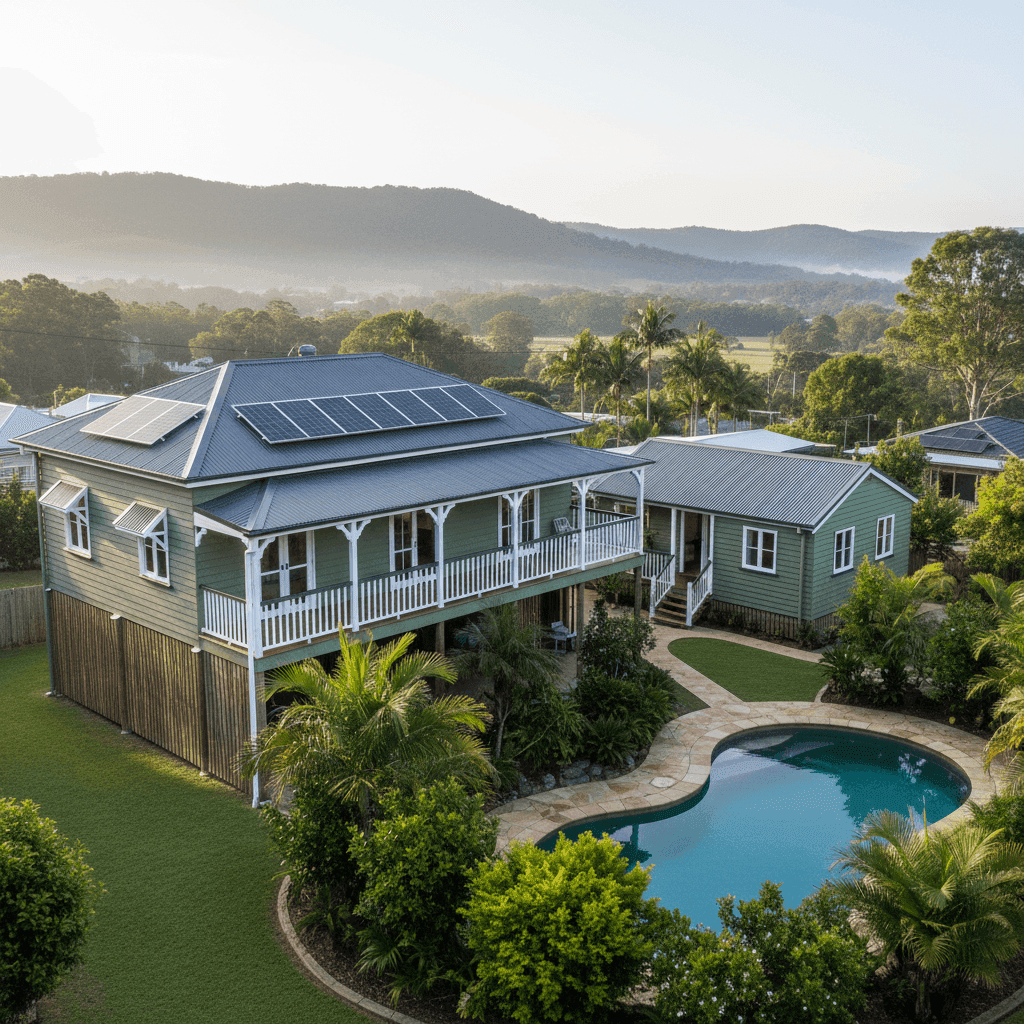
Nestled in the hinterland of the Sunshine Coast, Montville is one of Queensland's most charming villages — known for its misty hillside setting, heritage architecture, and a strong sense of community. But owning a character-filled property here comes with its own insurance considerations. This article breaks down a real building insurance quote for a four-bedroom, four-bathroom free-standing home in Montville (QLD 4560), rated Expensive (Above Average), and helps you understand what's driving the cost — and what you can do about it.
---
Is This Quote Fair?
The quote in question sits at $5,177 per year (or $489/month) for building-only cover on a 169 sqm weatherboard home with a sum insured of $900,000. The building excess is set at $1,000.
Our price rating for this quote is Expensive — Above Average, which means it sits notably higher than what most comparable properties in the area are paying. That said, "expensive" doesn't necessarily mean wrong. A number of property-specific factors (which we'll explore below) can legitimately push a premium above the local norm. The key is understanding why, so you can make an informed decision rather than simply accepting the first number you're given.
At a national level, this quote is actually just below the national average of $5,347/yr, which might seem reassuring — but the national average is heavily skewed by high-risk areas like Far North Queensland. When you look at the national median of $2,764/yr, this quote is nearly double. That's a meaningful gap worth investigating.
---
How Montville Compares
Here's how this quote stacks up against local and broader benchmarks:
| Benchmark | Premium |
|---|---|
| This Quote | $5,177/yr |
| Montville Suburb Average | $4,255/yr |
| Montville Suburb Median | $3,850/yr |
| Montville 25th Percentile | $3,101/yr |
| Montville 75th Percentile | $4,665/yr |
| LGA (Sunshine Coast) Average | $7,249/yr |
| QLD State Average | $9,129/yr |
| QLD State Median | $3,903/yr |
| National Average | $5,347/yr |
| National Median | $2,764/yr |
A few things stand out here. First, this quote exceeds the suburb average of $4,255 and sits above the 75th percentile of $4,665 — meaning it's more expensive than at least 75% of comparable quotes in the Montville area. That's the core reason for the "Expensive" rating.
However, context matters. The Sunshine Coast LGA average is a hefty $7,249/yr, and the Queensland state average is even higher at $9,129/yr (driven largely by cyclone-prone northern regions). So while this quote is above the local suburb norm, it's well below the broader regional average — which suggests the Montville suburb itself is a relatively favourable pocket within Queensland's often costly insurance landscape.
It's also worth noting that the suburb sample size here is 9 quotes, which is a relatively small dataset. As more data comes in, these benchmarks may shift. You can explore the latest figures on the Montville suburb stats page.
---
Property Features That Affect Your Premium
This particular property has a number of characteristics that insurers scrutinise closely. Here's how they likely influence the premium:
Age & Construction (1953, Weatherboard)
Built in 1953, this home is over 70 years old. Older properties — especially those with weatherboard timber walls — are considered higher risk by insurers due to the increased likelihood of maintenance issues, the cost of like-for-like restoration, and greater susceptibility to fire and moisture damage compared to brick or rendered construction. Sourcing period-appropriate materials and tradespeople for repairs also drives up rebuild estimates.
Stump Foundation & Timber Flooring
The home sits on stumps (a classic Queensland construction style) with timber and laminate flooring. While stumped homes are well-suited to the hilly Montville terrain, they can be more expensive to repair after events like subsidence, termite damage, or storm impact. Insurers factor in the elevated replacement cost of subfloor structures.
Steel/Colorbond Roof
On the positive side, a Colorbond steel roof is generally viewed favourably by insurers — it's durable, low-maintenance, and performs well in storms. This may be partially offsetting the premium impact of the weatherboard walls and older construction.
Pool, Solar Panels & Granny Flat
The presence of a swimming pool, solar panels, and a granny flat all add to the insurable value of the property — and rightly so. These features increase both the replacement cost and the liability exposure. A pool alone can add meaningful dollars to a premium due to public liability considerations.
Above Average Fittings
With above-average fittings quality, the cost to rebuild or repair to the same standard is higher than a standard-spec home. Think stone benchtops, quality cabinetry, premium fixtures — all of which are reflected in the $900,000 sum insured and the resulting premium.
Elevation & Location
The property is slightly elevated (less than 1m) and located outside a cyclone risk zone — both modest positive factors. Montville's elevated hinterland position does, however, expose properties to storm, wind, and occasionally bushfire risk, which insurers will price accordingly.
---
Tips for Homeowners in Montville
1. Shop Around — Seriously
With a quote sitting above the local 75th percentile, this is a strong signal to compare. Different insurers price weatherboard homes, older constructions, and features like granny flats very differently. Use CoverClub to compare quotes side by side and see what the market actually looks like for your specific property.
2. Review Your Sum Insured Carefully
At $900,000, this is a substantial sum insured — and it directly drives the premium. It's worth getting an independent building replacement cost estimate (not the market value of the land) to ensure you're not over-insured. At the same time, being under-insured is a serious risk, particularly with a heritage-style home where reconstruction costs can be higher than expected.
3. Ask About Discounts for Safety Features
Solar panels, modern roofing, and security systems can sometimes attract discounts with certain insurers. It's worth asking your insurer directly what credits they apply — many don't advertise these proactively.
4. Consider Your Excess Strategy
This policy carries a $1,000 excess. Opting for a higher voluntary excess (say, $2,500 or $5,000) can meaningfully reduce your annual premium. If your property is well-maintained and you're unlikely to make small claims, this trade-off often makes financial sense over the long run.
---
Compare Your Options with CoverClub
Whether you're renewing your policy or shopping for the first time, it pays to see the full picture. CoverClub aggregates real insurance data from properties across Australia, so you can benchmark your quote against what others in your suburb are actually paying. Get a quote today at CoverClub and find out whether you're getting fair value — or leaving money on the table.