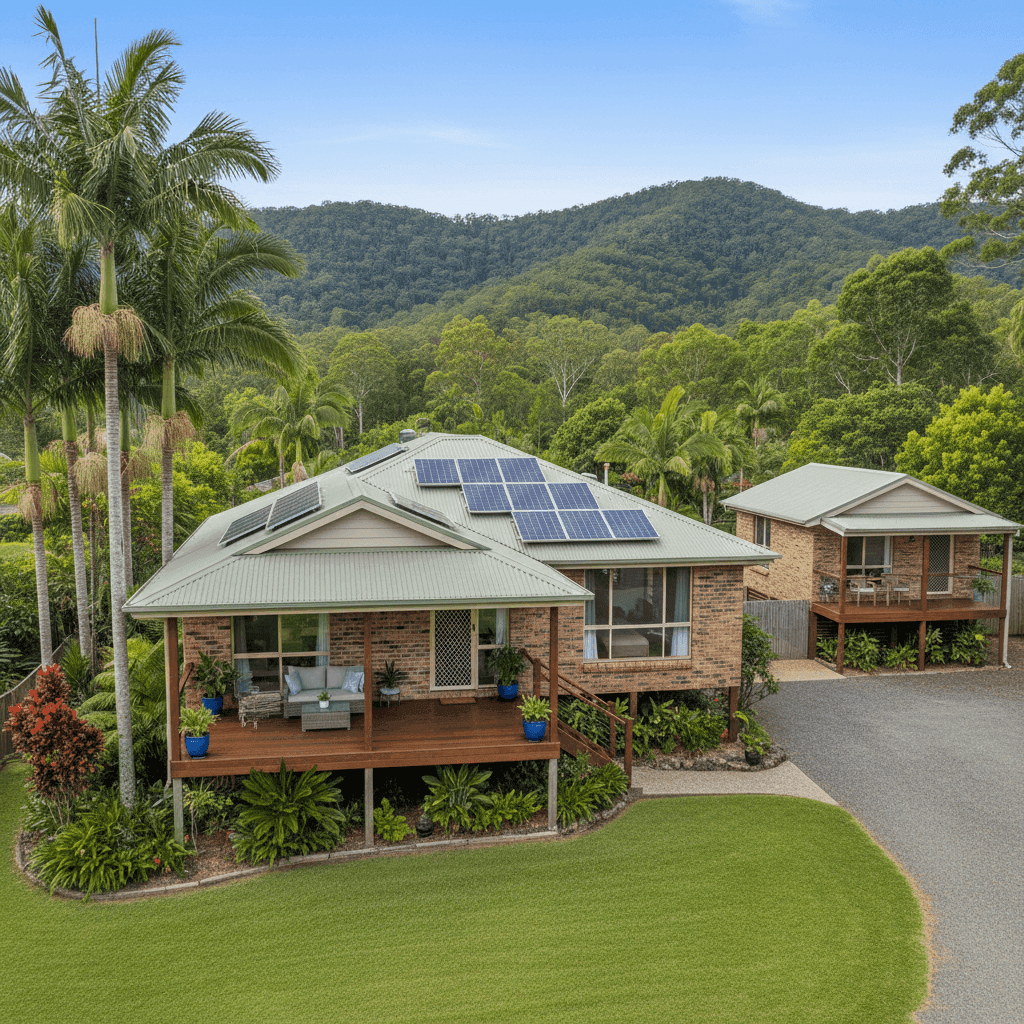
If you own a free standing home in Mooloolah Valley, QLD 4553, you might be wondering whether you're paying a fair price for your home and contents insurance — or leaving money on the table. This article breaks down a real quote for a 1-bedroom, 1-bathroom free standing home in this quiet hinterland suburb on the Sunshine Coast, comparing it against local, state, and national benchmarks so you can make a more informed decision at renewal time.
---
Is This Quote Fair?
The annual premium for this property came in at $2,331 per year (or roughly $228 per month), covering both building (insured for $300,000) and contents ($10,000). Our pricing model rates this quote as CHEAP — below average for the area.
To put that in perspective: the suburb average for Mooloolah Valley sits at $5,676 per year, and the median is $5,180 per year. That means this quote is less than half the typical premium paid by homeowners in the same postcode. Even compared to the 25th percentile — the cheapest quarter of quotes in the suburb — this policy at $2,331 undercuts the $3,326 benchmark comfortably.
So yes, by almost any local measure, this is a genuinely competitive quote. The combination of property characteristics, a modest contents value, and a $1,000 excess on both building and contents has clearly worked in the homeowner's favour here.
---
How Mooloolah Valley Compares
Mooloolah Valley is part of the Sunshine Coast Local Government Area, which carries one of the higher average premiums in Queensland — $7,249 per year across the LGA. That figure reflects the elevated risk profile of many coastal and hinterland properties in the region, including flood-prone low-lying areas and bushfire-adjacent zones.
Zooming out to the state level, the Queensland average home insurance premium is $4,547 per year, with a median of $3,931. Queensland consistently ranks among the most expensive states for home insurance in Australia, largely due to its exposure to cyclones, flooding, and severe storms — all of which drive up insurer risk modelling.
At the national level, the average premium is $2,965 per year and the median is $2,716. Interestingly, this quote actually sits below the national average too — a notable result for a Queensland property, where premiums are typically well above the rest of the country.
You can explore more localised data for this postcode on the Mooloolah Valley insurance stats page, which draws on a sample of 46 quotes to give a reliable picture of the local market.
| Benchmark | Annual Premium |
|---|---|
| This Quote | $2,331 |
| Suburb 25th Percentile | $3,326 |
| Suburb Median | $5,180 |
| Suburb Average | $5,676 |
| QLD Average | $4,547 |
| National Average | $2,965 |
| Sunshine Coast LGA Average | $7,249 |
---
Property Features That Affect Your Premium
Several characteristics of this property likely contribute to its lower-than-average premium:
New construction (2025): A brand-new home is one of the strongest signals of reduced risk for insurers. Modern builds must comply with current Australian building codes, which include improved structural standards, fire resistance requirements, and — in Queensland — updated cyclone and wind-load provisions. Insurers typically reward this with more favourable pricing.
Brick veneer walls and Colorbond roof: Brick veneer is a well-regarded wall construction type from an insurance perspective — it offers solid fire resistance and durability. Paired with a steel Colorbond roof, this home has a robust exterior that performs well in storms and resists ember attack, both relevant considerations in hinterland Queensland.
Stump foundation: Homes on stumps (also known as raised or pier foundations) can be advantageous in areas with flood risk, as the elevated floor level may reduce the likelihood or severity of inundation damage. This could be a contributing factor to the competitive premium.
No pool: Swimming pools add liability exposure and maintenance complexity, both of which can nudge premiums upward. The absence of a pool here keeps the risk profile clean.
Solar panels: Solar panels are increasingly common and most insurers now include them under standard building cover. However, it's worth confirming with your insurer that your panels are explicitly covered under the building sum insured — particularly for damage from storms or hail.
Granny flat: The presence of a granny flat is worth noting. Depending on how it's used — owner-occupied, rented out, or used by family — it may affect your cover. If the granny flat is tenanted, some standard home insurance policies may not automatically cover it, so it's important to declare this to your insurer.
Ducted climate control: Ducted systems are a mechanical asset that adds to the replacement value of the home. Ensuring your building sum insured accounts for this is important — underinsurance remains one of the most common issues at claim time.
Standard fittings: With standard-quality fittings rather than premium or high-end finishes, the cost to rebuild or replace is more predictable and generally lower, which supports a more modest premium.
---
Tips for Homeowners in Mooloolah Valley
1. Review your building sum insured regularly At 214 sqm with a granny flat, ducted climate control, and solar panels, there are meaningful assets tied up in this property. Building costs in Queensland have risen sharply in recent years — make sure your $300,000 sum insured still reflects the true cost to rebuild, not just the market value of the land.
2. Clarify granny flat coverage with your insurer If your granny flat is used as a rental, check whether your policy covers it as a landlord would need. Some home insurance policies exclude rental income loss or limit cover for separately tenanted structures. A quick call to your insurer can save a nasty surprise at claim time.
3. Confirm solar panel coverage Ask your insurer whether your solar panels are included under the building sum insured and whether accidental damage, hail, and storm damage are covered. This is especially relevant in South-East Queensland, where hailstorms can be severe.
4. Don't let a cheap quote become a set-and-forget policy While this quote is well below average, insurance needs change. As the property ages, as you add contents, or if the granny flat circumstances change, your cover requirements will evolve. Set a reminder to review your policy at each renewal rather than simply auto-renewing.
---
Compare Home Insurance for Your Mooloolah Valley Property
Whether you're a new homeowner or coming up for renewal, it pays to see what's available in the market. Premiums for similar properties in Mooloolah Valley vary enormously — from under $3,000 to well over $7,000 per year — so a few minutes of comparison could make a real difference.
Get a home insurance quote for your Mooloolah Valley property at CoverClub and see how your current premium stacks up against the broader market.