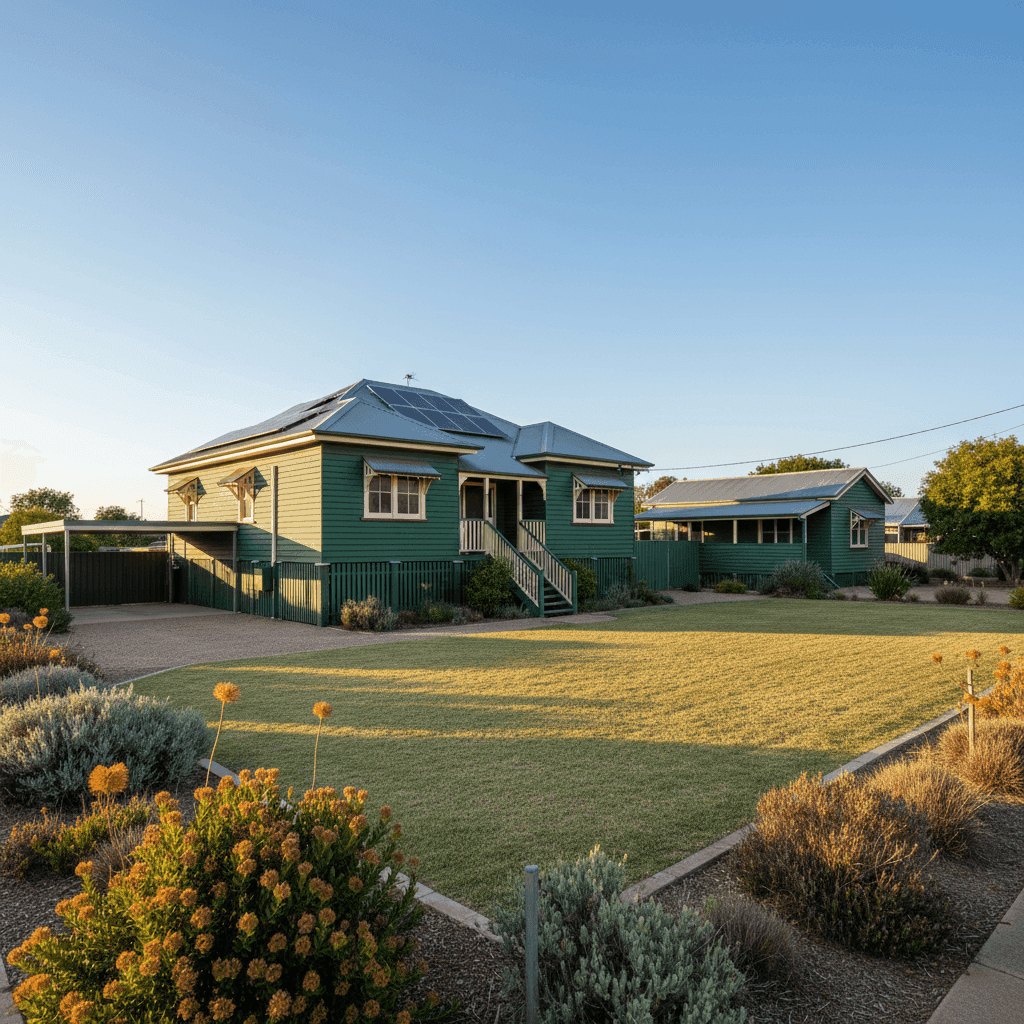
If you own a free standing home in Moree, NSW 2400, you've probably wondered whether you're paying a fair price for your building insurance — or whether there's a better deal out there. Moree is a regional inland town in the Gwydir local government area, known for its artesian hot springs, rich agricultural surrounds, and a housing stock that skews toward older, character-filled homes. In this article, we break down a real building-only insurance quote for a 3-bedroom, 2-bathroom free standing home in Moree, and put it in context against suburb, state, and national benchmarks.
---
Is This Quote Fair?
The quote in question comes in at $3,533 per year (or $332/month) for building-only cover, with a sum insured of $589,000 and a building excess of $5,000. Our price rating for this quote is FAIR — Around Average.
That assessment holds up well when you look at the numbers. The suburb median premium for Moree sits at $3,822 per year, meaning this quote lands roughly $289 below the local median — a modest but meaningful saving. It also falls comfortably within the interquartile range for the suburb: the 25th percentile is $2,538/yr and the 75th percentile is $5,113/yr, placing this quote right in the middle of the pack for comparable Moree properties.
In short, this isn't a bargain-basement price, but it's also not an outlier on the expensive end. For a weatherboard home built in 1960 with a granny flat and solar panels, landing near the median is a reasonable outcome.
---
How Moree Compares
Understanding how your premium stacks up requires looking beyond just your street. Here's how Moree sits against broader benchmarks:
| Benchmark | Average Premium | Median Premium |
|---|---|---|
| Moree (NSW 2400) | $43,287/yr | $3,822/yr |
| New South Wales | $9,528/yr | $3,770/yr |
| National | $5,347/yr | $2,764/yr |
The first thing you'll notice is the dramatic gap between the suburb average ($43,287) and the suburb median ($3,822). This is a classic sign of a small sample size — Moree's data is drawn from just 18 quotes, meaning a handful of high-value or high-risk properties can pull the average skyward. The median is a far more reliable indicator here, and it tells a much more grounded story.
Compared to the NSW median of $3,770/yr, Moree's median is only marginally higher — a difference of just $52. Against the national median of $2,764/yr, Moree does sit somewhat higher, which reflects the realities of insuring older regional properties with specific risk characteristics (more on those below).
The LGA (Gwydir) average mirrors the suburb average at $43,287/yr — again, likely driven by a small number of very high-risk or high-value rural properties in the region. Don't let that figure alarm you; the median is your friend when sample sizes are small.
---
Property Features That Affect Your Premium
Several characteristics of this particular property are worth unpacking, as they each play a role in how insurers price the risk.
Weatherboard Timber Walls
Weatherboard timber construction is common in older Australian homes and is generally considered a higher risk by insurers compared to brick veneer or double brick. Timber is more susceptible to fire, termite damage, and general wear over time. Homes built before 1980 can also face additional scrutiny around building standards and materials.
Age of Construction (1960)
At over 60 years old, this home falls into a category where insurers may apply age-loading to premiums. Older homes can have ageing wiring, plumbing, and structural elements that increase the likelihood of a claim. The sum insured of $589,000 needs to reflect full replacement cost at today's construction rates — which for a 186 sqm home with standard fittings and a granny flat is a figure worth reviewing periodically.
Elevated Foundation
The property is elevated by at least 1 metre. In flood-prone inland NSW towns like Moree — which has a documented history of flooding from the Mehi and Gwydir rivers — elevation can be a meaningful risk mitigant. Some insurers factor this in favourably, as elevated homes are less likely to sustain flood damage to the main living areas.
Granny Flat
The presence of a granny flat adds to the insurable value of the property and increases the complexity of the risk. Ensure your sum insured accounts for the full replacement cost of the granny flat structure, not just the main dwelling.
Solar Panels & Ducted Climate Control
Solar panels and ducted climate control are both assets that add to the replacement cost of the home. Solar systems in particular can be expensive to replace and are worth confirming are explicitly covered under your building policy.
Steel/Colorbond Roof
Colorbond roofing is generally viewed positively by insurers — it's durable, fire-resistant, and low-maintenance compared to older roofing materials like terracotta tiles or asbestos sheeting sometimes found on homes of this era.
Slab Foundation & Tile Flooring
A concrete slab foundation with tile flooring is a practical combination for a regional NSW home. Tiles are durable and resistant to moisture damage, which matters in a town with flood history.
---
Tips for Homeowners in Moree
Whether you're reviewing your current policy or shopping for the first time, here are four practical steps Moree homeowners can take to get better value from their building insurance.
- Review your sum insured annually. Construction costs have risen significantly across Australia in recent years. A sum insured set three or four years ago may no longer cover the full cost of rebuilding your home — especially with a granny flat, solar panels, and ducted air conditioning factored in. Use a building cost calculator or speak to a local builder for a current estimate.
- Ask about flood cover specifically. Moree has experienced significant flooding events historically. Make sure your policy explicitly includes flood cover (not just storm or rainwater damage), and understand exactly what triggers a flood claim under your insurer's definition. This is a critical distinction in inland NSW towns.
- Consider your excess level carefully. This quote carries a $5,000 building excess — on the higher end of the scale. A higher excess typically reduces your premium, but it also means a larger out-of-pocket cost at claim time. Make sure your chosen excess reflects what you could realistically afford to pay in an emergency.
- Compare quotes before renewing. With only 18 quotes in CoverClub's Moree dataset, the local market is not heavily saturated — but that doesn't mean you can't find a better deal. Insurers price risk differently, and a property with the specific characteristics of this home (weatherboard, elevated, with solar and a granny flat) may be rated very differently across providers.
---
Compare Home Insurance Quotes in Moree
Whether this quote matches your situation or you're starting from scratch, comparing multiple insurers is the single most effective way to make sure you're not overpaying. Get a personalised home insurance quote at CoverClub and see how your property stacks up against real data from Moree and across NSW. You can also explore detailed Moree suburb insurance statistics, NSW state-wide data, and national benchmarks to make a truly informed decision.