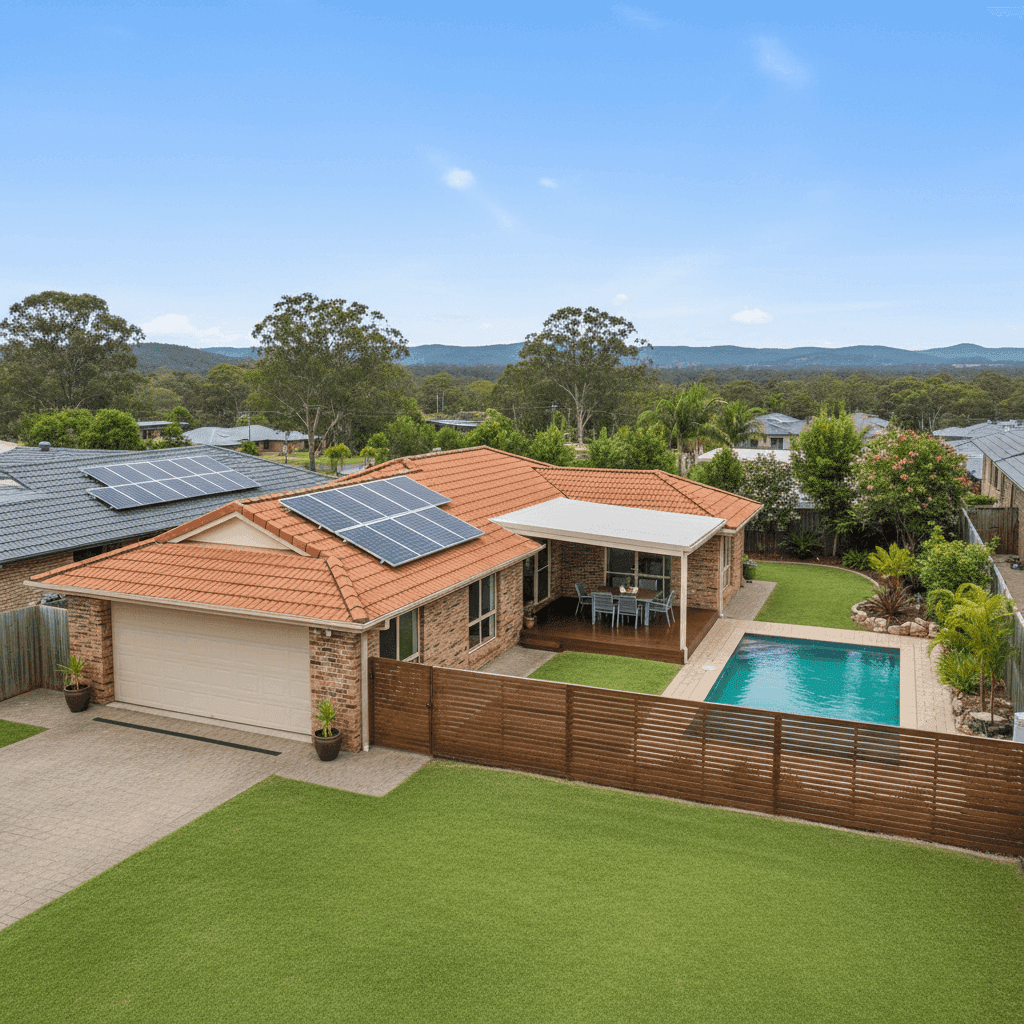
Mudgeeraba is a leafy, relaxed suburb nestled in the Gold Coast hinterland — popular with families drawn to its quiet streets, good schools, and easy access to both the coast and the mountains. If you own a free standing home here, understanding what you should be paying for home and contents insurance is a smart financial move. This article breaks down a real insurance quote for a three-bedroom property in Mudgeeraba (postcode 4213) and puts the numbers in context so you can judge whether your own premium is working hard enough for you.
---
Is This Quote Fair?
The quote in question comes in at $2,931 per year (or roughly $297 per month) for combined home and contents cover. It protects a building insured at $555,000 and contents valued at $249,000, with a building excess of $3,000 and a contents excess of $1,000.
Our pricing analysis rates this quote as Fair — Around Average. That's not a bad outcome. It means the premium sits comfortably within the normal range for the area, without being suspiciously cheap (which can signal under-coverage) or unnecessarily expensive. For a property of this size and specification, paying close to the suburb midpoint suggests the insurer has priced the risk reasonably and that the coverage levels are broadly appropriate.
That said, "fair" doesn't mean you can't do better — and understanding the data behind that rating is the first step.
---
How Mudgeeraba Compares
To put this quote in perspective, here's how it stacks up against Mudgeeraba suburb averages, Queensland state figures, and national benchmarks:
| Benchmark | Premium |
|---|---|
| This quote | $2,931/yr |
| Mudgeeraba suburb average | $3,275/yr |
| Mudgeeraba suburb median | $3,175/yr |
| Mudgeeraba 25th percentile | $2,498/yr |
| Mudgeeraba 75th percentile | $3,719/yr |
| Gold Coast LGA average | $8,161/yr |
| QLD state average | $9,129/yr |
| QLD state median | $3,903/yr |
| National average | $5,347/yr |
| National median | $2,764/yr |
Based on 64 quotes collected in the Mudgeeraba area.
A few things stand out here. First, this quote sits below both the suburb average and median, which is a positive sign. It's in roughly the 40th–45th percentile range for the suburb — meaning most comparable homes in the area are paying more.
Second, the contrast between Queensland's state average ($9,129) and its median ($3,903) is striking. That enormous gap is driven by high-risk coastal and cyclone-prone areas in Far North Queensland, which dramatically pull the average upward. Mudgeeraba, fortunately, is not classified as a cyclone risk area, which keeps premiums far more manageable than many other parts of the state.
Third, while the national median of $2,764 is lower than this quote, the national average of $5,347 is considerably higher — again reflecting the outsized influence of high-risk regions around Australia. For a Gold Coast hinterland suburb, $2,931 is a very reasonable outcome.
---
Property Features That Affect Your Premium
Several characteristics of this property influence how insurers assess and price the risk.
Brick veneer construction and tiled roof are generally viewed favourably by insurers. Brick veneer offers good fire resistance and structural durability, while a tiled roof — though heavier than Colorbond — tends to perform well in storms and has a long lifespan. Together, these materials typically attract lower premiums compared to timber-framed or clad homes with metal sheet roofing.
Slab foundation is the standard for Queensland homes of this era and presents no particular concern for insurers. Combined with tiled flooring throughout, the property has a low moisture and flood-damage profile from a claims perspective.
Built in 1995, the home is old enough to have some maintenance considerations, but not so old that insurers apply significant age loadings. Homes from this period are generally well-understood by underwriters.
The swimming pool adds a modest premium loading. Pools introduce liability risk (particularly relevant for families with children or when guests are present) and can be costly to repair or replace if damaged by a storm or subsidence event. It's worth confirming your policy explicitly covers pool infrastructure.
Solar panels are an increasingly common feature on Queensland rooftops, and their inclusion in a sum insured figure is important. At 139 sqm, this home's rooftop solar system should be reflected in the building sum insured — insurers differ on whether panels are automatically covered under the building or require separate declaration, so it pays to check your Product Disclosure Statement carefully.
No ducted climate control simplifies the risk profile slightly — ducted systems can be expensive to repair and are a common source of claims in Queensland's humid climate.
---
Tips for Homeowners in Mudgeeraba
1. Review your building sum insured annually. Construction costs in South East Queensland have risen significantly in recent years. A sum insured of $555,000 for a 139 sqm home works out to roughly $3,993 per sqm — which is within a reasonable range, but worth verifying against current building cost estimates. Being underinsured at claim time can leave you significantly out of pocket.
2. Confirm your solar panels and pool are explicitly covered. Don't assume — read your PDS or call your insurer. Some policies treat solar panels as part of the building automatically; others require them to be listed. The same applies to pool equipment like pumps, filters, and heating systems. A quick phone call could save a nasty surprise after a storm.
3. Consider whether your excess levels are working for you. This policy carries a $3,000 building excess and $1,000 contents excess. A higher excess typically reduces your premium, but make sure you could comfortably cover that amount in the event of a claim. If $3,000 would be a stretch, it may be worth paying a slightly higher premium for a lower excess.
4. Compare quotes before your renewal date. Even a "fair" premium can often be improved. Insurers don't always reward loyalty — in fact, new customers frequently receive better rates. Set a reminder to compare at least 3–4 weeks before your renewal date so you have time to switch without a coverage gap.
---
Ready to See What You Could Be Paying?
Whether you're a new homeowner in Mudgeeraba or simply haven't reviewed your policy in a while, comparing quotes is one of the easiest ways to make sure you're not overpaying. At CoverClub, we help Australian homeowners benchmark their premiums against real data from their suburb and beyond. Get a home insurance quote today and find out where your premium really sits.