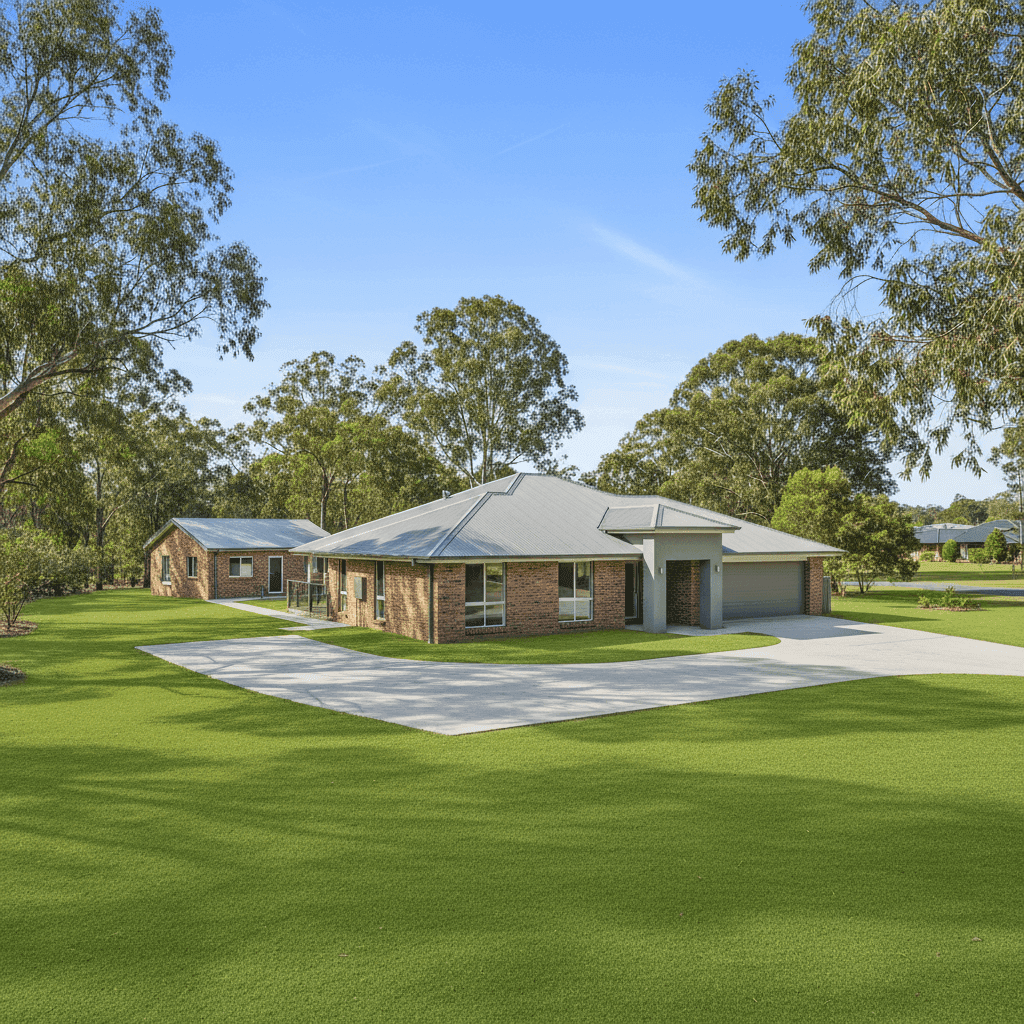
Mudgeeraba is a well-established suburb nestled in the Gold Coast hinterland, known for its leafy streets, relaxed lifestyle, and proximity to both the coast and the Scenic Rim. If you own a free standing home here, understanding what you should be paying for building insurance — and why — can make a real difference to your household budget. This article breaks down a recent building-only insurance quote for a six-bedroom property in Mudgeeraba (postcode 4213) and puts it in context against local, state, and national benchmarks.
---
Is This Quote Fair?
The quote in question comes in at $2,535 per year (or $255 per month) for building-only cover on a 354 sqm free standing home, with a sum insured of $678,000 and a building excess of $5,000.
Our price rating for this quote is FAIR — Around Average, and the data backs that up. At $2,535/yr, this premium sits comfortably between the suburb's 25th percentile ($2,053/yr) and the median ($3,027/yr). In practical terms, roughly half of comparable Mudgeeraba properties are paying more, and about a quarter are paying less. That's a reasonable position to be in — not the cheapest on the block, but certainly not being overcharged either.
It's worth noting that the $5,000 building excess is on the higher end of what's typical. A higher excess is one of the most common ways insurers — and policyholders — bring annual premiums down. If your financial position allows you to absorb a larger out-of-pocket cost in the event of a claim, this is a legitimate trade-off. However, if cashflow is a concern, it may be worth comparing quotes with a lower excess to see what the premium difference actually looks like.
---
How Mudgeeraba Compares
To properly assess value, it helps to zoom out and look at the broader picture. Here's how this quote stacks up across different benchmarks:
| Benchmark | Annual Premium |
|---|---|
| This Quote | $2,535 |
| Mudgeeraba Suburb Average | $3,475 |
| Mudgeeraba Suburb Median | $3,027 |
| Mudgeeraba 25th Percentile | $2,053 |
| Mudgeeraba 75th Percentile | $4,409 |
| QLD State Average | $4,547 |
| QLD State Median | $3,931 |
| National Average | $2,965 |
| National Median | $2,716 |
| Gold Coast LGA Average | $5,494 |
A few things stand out here. First, Queensland premiums are significantly elevated compared to the national average — the state average of $4,547/yr is more than 50% higher than the national average of $2,965/yr. This reflects the heightened risk profile across much of QLD, driven by cyclones, flooding, and severe storm events that are more frequent in this part of the country.
Second, the Gold Coast LGA average of $5,494/yr is notably high — the highest benchmark in this comparison. Much of the Gold Coast faces coastal exposure, flood-prone areas, and high property values that push premiums up considerably. Mudgeeraba, sitting further inland in the hinterland, benefits from a somewhat more favourable risk profile than beachside suburbs, which helps explain why the suburb average ($3,475/yr) is well below the broader LGA figure.
At $2,535/yr, this quote is 27% below the Mudgeeraba suburb average, 44% below the QLD state average, and 15% below the national average. For a large six-bedroom home, that represents genuine value. You can explore more localised data on the Mudgeeraba suburb stats page, or compare against QLD state-wide figures and national benchmarks.
---
Property Features That Affect Your Premium
Several characteristics of this property work in its favour from an insurance risk perspective:
Double Brick Construction Double brick external walls are considered one of the most resilient building materials available. They offer strong resistance to fire, wind, and impact damage, which insurers view favourably. Compared to timber-framed or clad homes, double brick properties often attract lower premiums due to their durability and reduced susceptibility to certain types of damage.
Steel/Colorbond Roof A Colorbond steel roof is another tick in the right column. It's lightweight, corrosion-resistant, and performs well in high-wind conditions. Unlike older terracotta or concrete tile roofs, Colorbond doesn't crack or break under hail impact in the same way, which can reduce the severity of storm-related claims.
Slab Foundation A concrete slab foundation is generally considered low-risk for subsidence and structural movement, particularly compared to older stumped or pier-and-beam homes. This contributes to a stable risk profile for the property.
Tile Flooring Tiled floors are highly resistant to water damage — a key consideration in Queensland where flooding and storm water ingress are real risks. They're also easier to clean and restore after minor water events compared to timber or carpet.
Granny Flat The presence of a granny flat adds complexity to the insurance picture. It increases the total insurable value of the property, which is reflected in the $678,000 sum insured. It's essential to confirm with your insurer that the granny flat is explicitly included in the building cover — some policies may require it to be listed separately or may have specific conditions around its use (e.g., whether it's tenanted).
1992 Construction Built in 1992, the property is over 30 years old. While not considered heritage or particularly aged, it's worth being aware that older homes can have components — plumbing, electrical wiring, roofing fixings — that may be approaching the end of their serviceable life. Insurers may factor this in, and it's prudent to ensure these systems are well-maintained.
---
Tips for Homeowners in Mudgeeraba
1. Review your sum insured regularly Building costs in South East Queensland have risen sharply over the past few years. A sum insured of $678,000 for a 354 sqm home works out to roughly $1,915/sqm — a reasonable estimate, but construction costs vary. Use a building cost calculator annually to ensure you're not underinsured, particularly given the granny flat adds to your rebuild cost.
2. Confirm granny flat coverage explicitly Don't assume your policy covers the granny flat by default. Ask your insurer directly whether it's included, whether any rental income from it affects your policy terms, and whether there are any exclusions that apply to secondary dwellings on the same title.
3. Consider the excess trade-off carefully A $5,000 building excess is a meaningful financial commitment. Before renewing, model the difference: how much would your annual premium increase if you dropped the excess to $2,500 or $1,000? If the savings are modest, a lower excess may offer better overall protection without a dramatic cost increase.
4. Shop around at renewal time Even with a fair-rated quote, the home insurance market is competitive. Insurers reprice risk differently, and a quote that's average today may be beatable with minimal effort. Use a comparison platform like CoverClub to benchmark your renewal premium before you simply auto-renew.
---
Compare Your Home Insurance Today
Whether you're a new homeowner in Mudgeeraba or simply due for a renewal review, it pays to compare. CoverClub makes it easy to see how your current premium stacks up against real quotes from across the market. Get a quote today at CoverClub and find out if you're getting the best deal on your building insurance.