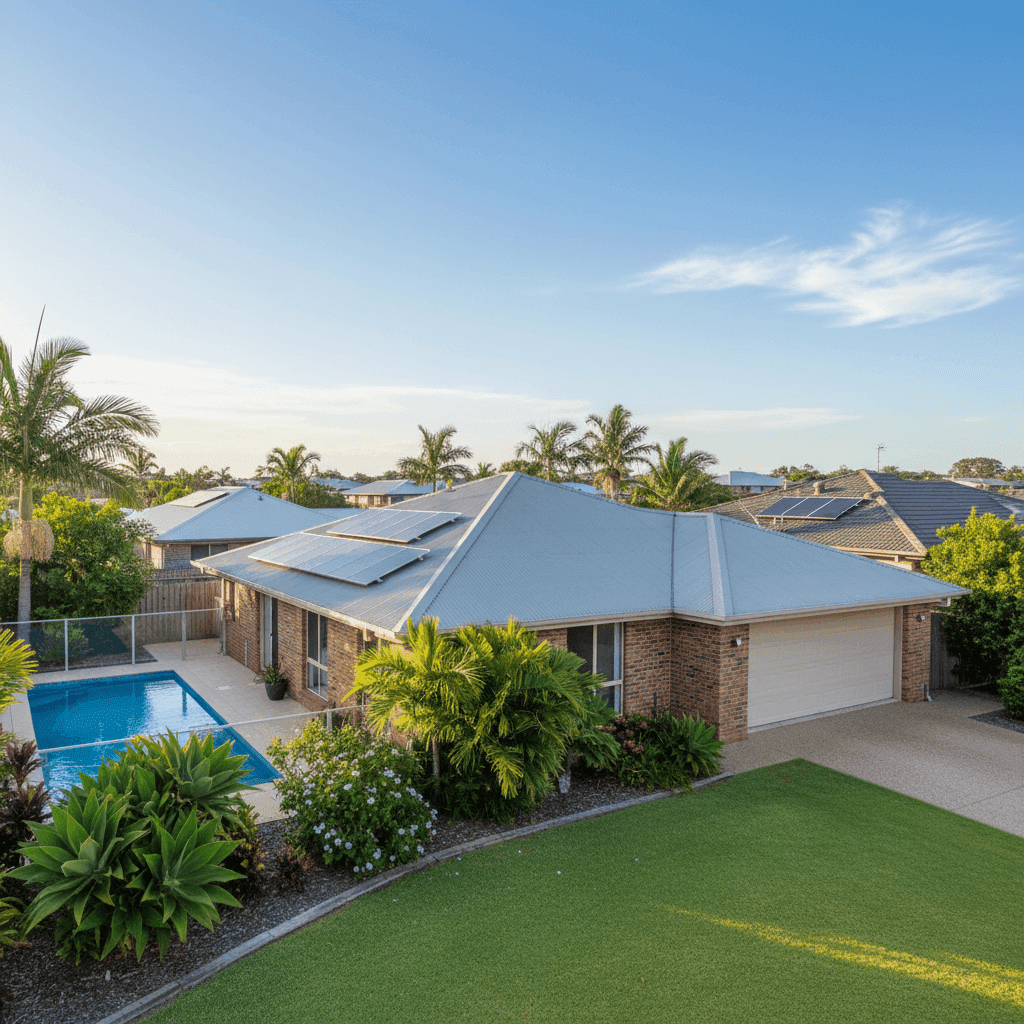
Mudjimba is a laid-back coastal suburb on Queensland's Sunshine Coast, sitting just north of Maroochydore and a short stroll from the beach. It's the kind of place where brick veneer homes from the 1970s still stand proud, and a backyard pool is practically a rite of passage. But with lifestyle appeal comes insurance complexity — and for owners of a four-bedroom free standing home here, understanding what you're paying and why matters more than ever.
This article breaks down a recent home and contents insurance quote for a property in Mudjimba, benchmarks it against local, state, and national data, and offers practical guidance for getting the best value on your cover.
---
Is This Quote Fair?
The quote in question comes in at $4,673 per year (or $453 per month) for combined home and contents cover, with a building sum insured of $997,000 and contents valued at $104,000. Both the building and contents excess sit at $1,000.
Our analysis rates this quote as Expensive — above average for the area.
To put that in perspective: the suburb average for Mudjimba sits at $3,967 per year, and the median is a notably lower $3,111. That means this quote is running $706 above the suburb average and a substantial $1,562 above the suburb median — placing it well outside the typical range most Mudjimba homeowners are paying.
The 75th percentile for the suburb is $3,844 per year, which means this quote exceeds even the most expensive quarter of local policies we've recorded. For a homeowner in Mudjimba, that's a meaningful signal worth investigating before simply accepting the renewal.
---
How Mudjimba Compares
One of the most useful things you can do when assessing any insurance quote is zoom out and look at the broader picture. Here's how Mudjimba stacks up:
| Benchmark | Annual Premium |
|---|---|
| This Quote | $4,673 |
| Mudjimba Suburb Average | $3,967 |
| Mudjimba Suburb Median | $3,111 |
| Mudjimba 25th Percentile | $2,643 |
| Mudjimba 75th Percentile | $3,844 |
| Sunshine Coast LGA Average | $7,249 |
| QLD State Average | $9,129 |
| QLD State Median | $3,903 |
| National Average | $5,347 |
| National Median | $2,764 |
A few things stand out here. First, the Queensland state average of $9,129 is dramatically higher than what Mudjimba homeowners typically pay — largely because QLD's insurance market is heavily influenced by high-risk cyclone and flood zones further north. Mudjimba itself is not classified as a cyclone risk area, which helps keep premiums more moderate relative to the broader state.
Second, when compared to the national average of $5,347, this quote is actually slightly below — which might seem reassuring at first glance. But the national average is skewed upward by extreme-risk postcodes across northern Queensland, Western Australia, and the NT. The more meaningful comparison is the local suburb data, where this quote clearly sits on the expensive side.
The Sunshine Coast LGA average of $7,249 is notably higher than the Mudjimba suburb figures, suggesting that some pockets of the Sunshine Coast carry significantly more risk (or higher-value properties) than Mudjimba itself. This is worth keeping in mind — Mudjimba is relatively well-positioned within its own region.
(Note: Suburb comparison data is based on a sample of 14 quotes, so treat these figures as indicative rather than exhaustive.)
---
Property Features That Affect Your Premium
Several characteristics of this property directly influence what insurers charge — for better and for worse.
Construction Era and Materials
Built in 1970, this home is over 50 years old. Older homes can attract higher premiums because ageing plumbing, wiring, and structural elements carry a greater risk of failure or damage. Brick veneer construction is generally viewed favourably by insurers — it's durable and fire-resistant — but the age of the property may offset some of that benefit.
Roof Type
A steel/Colorbond roof is a solid asset from an insurance perspective. Colorbond is lightweight, resistant to corrosion, and performs well in high-wind events. It's a preferred roofing material for many Australian insurers and is unlikely to be pushing the premium up.
Slab Foundation and Flooring
A concrete slab foundation is generally low-risk and well-regarded by insurers. However, the timber and laminate flooring throughout does introduce some vulnerability — particularly to water damage from burst pipes or flooding — which may be reflected in the pricing.
Swimming Pool
A pool adds value to the property but also adds liability and maintenance risk. Most insurers factor in the presence of a pool when calculating premiums, and it can contribute a modest uplift to the overall cost.
Solar Panels
Solar panels are increasingly common on Australian homes, but they do add to the replacement cost of a property and can be damaged by hail or storms. With a building sum insured of $997,000, the inclusion of solar panels is likely already factored into that figure — but it's worth confirming with your insurer that panels are explicitly covered under your policy.
High Building Sum Insured
At $997,000, the building sum insured is substantial for a 268 sqm home. While it's important to be adequately insured (underinsurance is a serious risk), it's worth obtaining an independent building replacement cost estimate to ensure this figure is accurate. Overinsuring can unnecessarily inflate your premium.
---
Tips for Homeowners in Mudjimba
1. Get an independent rebuild cost estimate With a building sum insured approaching $1 million, it's worth commissioning a professional quantity surveyor's report to verify the replacement value. If the figure is higher than necessary, you may be paying more in premiums than you need to. Equally, if it's too low, you could face a significant shortfall at claim time.
2. Shop around — and use comparison tools This quote is rated expensive relative to the local market. Insurers price risk differently, and the same property can attract very different premiums across providers. Use CoverClub's free quote comparison tool to benchmark your options before committing to a policy.
3. Review your contents sum insured $104,000 in contents cover is a reasonable figure, but it's worth doing a proper home inventory to confirm it's accurate. Many Australians are either underinsured (risking a shortfall) or overinsured (paying unnecessarily). A detailed room-by-room list can help you land on the right number.
4. Ask about discounts for home security and safety features Some insurers offer premium discounts for homes with monitored alarms, deadbolts, or smoke detectors. Given the age of this property, ensuring these features are in place — and flagging them with your insurer — could help reduce your annual cost.
---
Compare Your Options with CoverClub
Whether you're reviewing an existing policy or shopping for cover for the first time, CoverClub makes it easy to see how your quote stacks up. Our platform aggregates real quote data from across Australia so you can make an informed decision — not just accept the first number you're given.
Get a home insurance quote for your Mudjimba property today and see how much you could save by comparing your options. You can also explore detailed Mudjimba insurance statistics to understand what others in your suburb are paying.