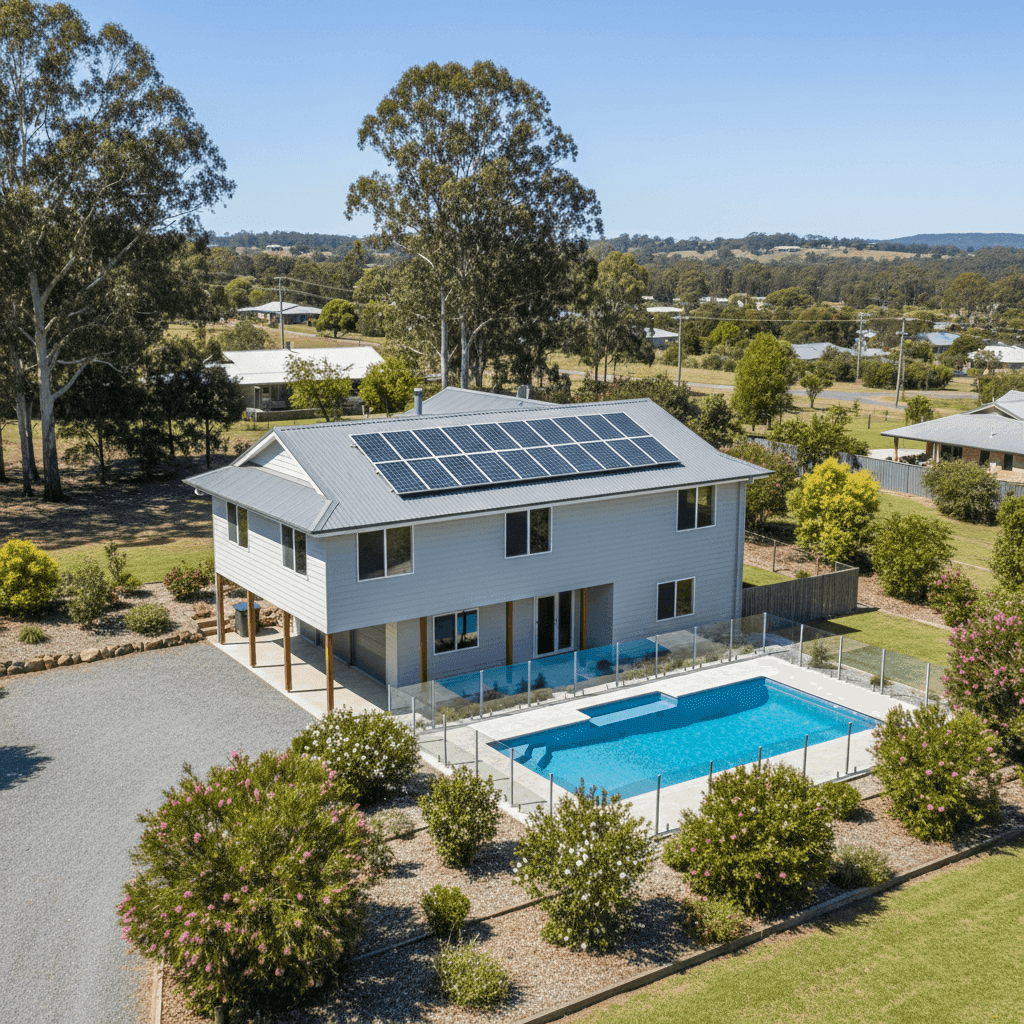
Mulbring is a quiet semi-rural locality in the Hunter Region of New South Wales, sitting within the Lake Macquarie Local Government Area. It's the kind of place where larger blocks, established homes, and a relaxed pace of life attract families looking for space without straying too far from the conveniences of the Hunter Valley. For owners of free standing homes in this area, understanding what you're paying for home insurance — and whether it's reasonable — is an important part of protecting one of your biggest assets.
This article breaks down a real home and contents insurance quote for a four-bedroom, two-bathroom free standing home in Mulbring (postcode 2323), compares it against local, state, and national benchmarks, and offers practical advice for homeowners looking to get better value.
---
Is This Quote Fair?
The annual premium on this quote comes in at $5,630 per year (or $540/month), covering both building (insured at $845,000) and contents ($100,000), each with a $1,000 excess.
Our price rating for this quote is Expensive — Above Average.
To put that in context: the average home and contents premium across Mulbring and the surrounding 2323 postcode sits at around $4,565 per year, with a median of $4,741. This quote sits well above the suburb's 75th percentile of $4,995, meaning it's pricier than roughly three-quarters of comparable quotes in the area.
That said, "expensive" doesn't automatically mean "wrong." A higher sum insured ($845,000 for the building alone is substantial), additional features like a pool, solar panels, and ducted climate control, and the specific characteristics of this property all influence the final premium. The question worth asking is whether the cover level and insurer genuinely justify the gap — or whether shopping around could deliver similar protection at a lower price point.
---
How Mulbring Compares
Understanding where this quote sits relative to broader benchmarks helps frame the conversation. Here's a snapshot:
| Benchmark | Average Premium |
|---|---|
| Mulbring / 2323 suburb average | $4,565/yr |
| Mulbring / 2323 suburb median | $4,741/yr |
| NSW state average | $9,528/yr |
| NSW state median | $3,770/yr |
| National average | $5,347/yr |
| National median | $2,764/yr |
| Lake Macquarie LGA average | $11,064/yr |
A few things stand out here. The NSW state average of $9,528 is heavily skewed upward by high-risk and high-value properties — coastal flood zones, bushfire-prone areas, and expensive Sydney metro homes all pull that figure up. The state median of $3,770 is a more grounded reference point, and this quote exceeds it by nearly $1,900.
Nationally, the picture is similar: the average of $5,347 is close to this quote, but the median of $2,764 reflects that most Australian homeowners are paying considerably less. The Lake Macquarie LGA average of $11,064 is strikingly high, likely influenced by waterfront and flood-affected properties across the broader LGA — Mulbring itself is less exposed to those specific risks.
You can explore more detailed local data on the Mulbring insurance stats page, compare it against NSW-wide figures, or benchmark against national averages.
> Note: The suburb sample size for this comparison is 7 quotes, so while directionally useful, the local averages should be treated as indicative rather than definitive.
---
Property Features That Affect Your Premium
Several characteristics of this home play a direct role in shaping the insurance premium. Understanding them helps explain why this quote may be higher than the suburb average.
Hardiplank / Hardiflex Cladding Fibre cement cladding like Hardiplank is generally viewed favourably by insurers — it's non-combustible, durable, and resistant to rot and termites. This is a positive factor for the premium compared to older timber-clad homes.
Steel / Colorbond Roof Colorbond roofing is another tick in the right column. It's resilient, low-maintenance, and performs well in storms and high winds. Insurers typically price metal roofs more competitively than terracotta or concrete tiles.
Stump Foundation The home sits on stumps, which is common for properties of this era (built in 1975) in regional NSW. While stumps can be a concern for subsidence or pest damage over time, the elevation of less than 1 metre is noted — this mild elevation may offer marginal flood drainage benefit without introducing the structural complexity of a fully elevated Queenslander-style home.
Timber and Laminate Flooring Timber floors add to the character of older homes but can be costly to repair or replace after water damage or flooding. This is factored into both building and contents assessments.
Swimming Pool Pools increase liability exposure and add to the insured value of the property. Most insurers include pool cover under the building policy, but it's worth confirming what's covered — including the pool equipment and fencing.
Solar Panels Solar systems are typically covered under building insurance, but the sum insured should reflect their replacement value. With energy prices rising, solar systems are increasingly valuable — and increasingly targeted by thieves. Make sure your policy explicitly covers panels for storm damage, hail, and theft.
Ducted Climate Control Ducted systems are expensive to repair and replace. Their inclusion adds to the overall replacement cost of the home and can nudge premiums upward, particularly if the system is original to the property or ageing.
1975 Construction Older homes often attract slightly higher premiums due to the age of electrical wiring, plumbing, and structural components. A home built in 1975 is over 50 years old — insurers may factor in the increased likelihood of wear-related claims.
---
Tips for Homeowners in Mulbring
1. Review your sum insured carefully A building sum insured of $845,000 is significant. Make sure this figure reflects the actual cost to rebuild — not the market value of the property. Overinsuring drives up your premium unnecessarily, while underinsuring can leave you exposed at claim time. Use a building cost calculator or speak to a quantity surveyor to validate the figure.
2. Shop around — seriously With this quote rated as expensive relative to the suburb average, comparing offers from multiple insurers is the single most effective thing you can do. Premiums for the same property can vary by hundreds or even thousands of dollars between providers. Get a comparison quote at CoverClub to see what else is available for your address.
3. Ask about discounts for security and safety features Some insurers offer reduced premiums for homes with monitored alarms, deadbolts, or smoke detectors. If your home has any of these — or if you're willing to install them — it's worth asking your insurer directly whether they factor this into pricing.
4. Consider your excess level This policy carries a $1,000 excess on both building and contents. Opting for a higher excess (say, $2,000 or $2,500) can meaningfully reduce your annual premium. If you have the financial buffer to absorb a larger out-of-pocket cost in the event of a claim, this trade-off often makes sense — particularly for a property where the main risk is a large, infrequent event rather than frequent small claims.
---
Compare Your Options with CoverClub
Whether you're renewing your existing policy or shopping for the first time, it pays to compare. CoverClub makes it easy to benchmark your home insurance quote against real data from properties like yours across Mulbring, NSW, and Australia. Start a quote today and find out if you're getting the cover you deserve at a price that makes sense.