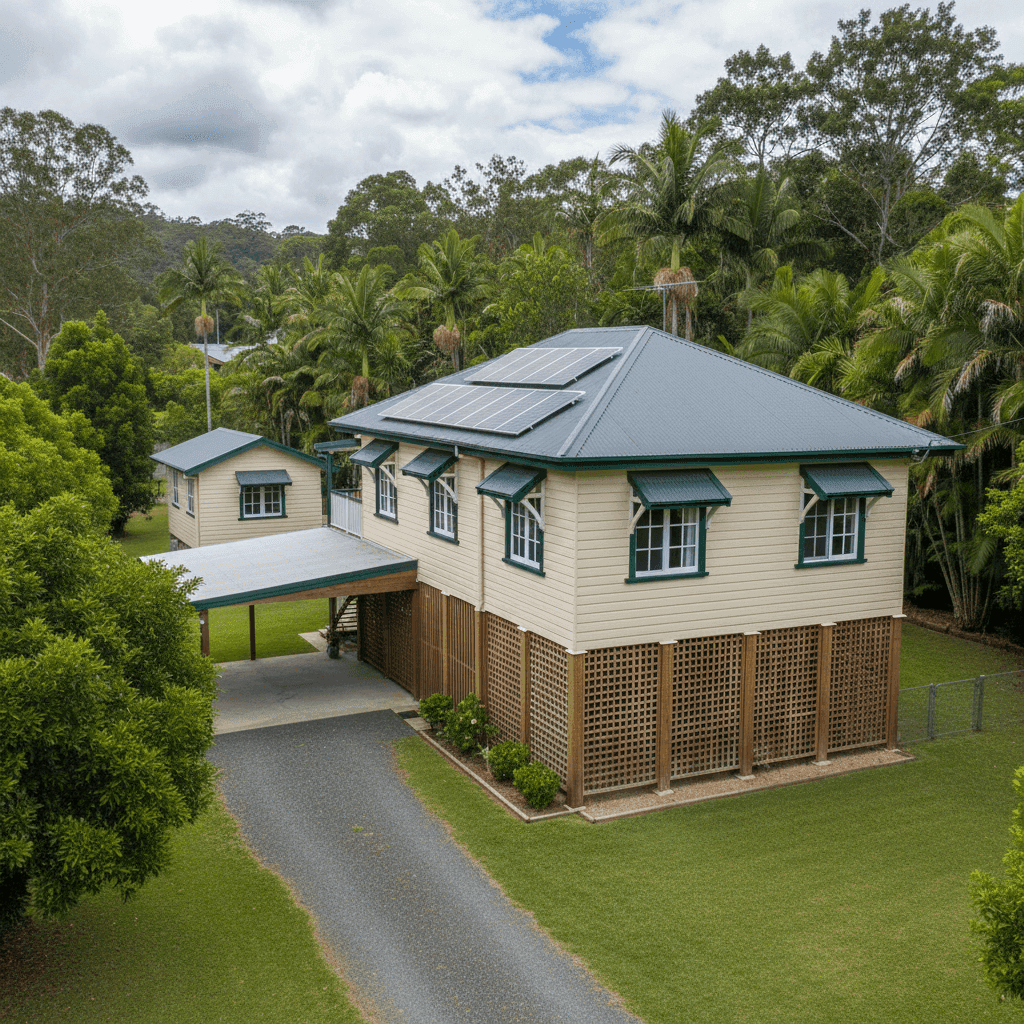
Murwillumbah is a charming hinterland town in the Tweed Valley of northern New South Wales, sitting at the foot of Mount Warning and surrounded by World Heritage-listed rainforest. It's a sought-after location — but like many regional NSW towns, home insurance here can vary enormously depending on your property's characteristics. This article breaks down a real building insurance quote for a three-bedroom, two-bathroom free standing home in Murwillumbah (postcode 2484), and puts that figure into context against local, state, and national benchmarks.
---
Is This Quote Fair?
The annual premium on this quote comes in at $1,717 per year (or $169/month) for building-only cover on a home insured for $550,000, with a building excess of $3,000. Our price rating for this quote is CHEAP — below the suburb average — and the data backs that up convincingly.
To put it plainly: this is an excellent result. The suburb average for Murwillumbah sits at $5,040 per year, meaning this quote is roughly 66% cheaper than what many locals are paying. Even against the suburb's 25th percentile — the cheapest quarter of quotes — this premium still comes in well below at $3,439/year. In other words, this homeowner is paying less than virtually anyone else in the postcode based on our dataset.
It's worth noting that the higher excess of $3,000 on the building component does play a role here. Choosing a higher excess is one of the most effective levers for reducing your premium, and it's a trade-off that works well for homeowners who have some financial buffer to cover smaller claims out of pocket.
---
How Murwillumbah Compares
Understanding where your premium sits relative to broader benchmarks is key to knowing whether you're getting a fair deal. Here's how the numbers stack up:
| Benchmark | Premium |
|---|---|
| This quote | $1,717/yr |
| Murwillumbah suburb average | $5,040/yr |
| Murwillumbah suburb median | $3,576/yr |
| NSW state average | $9,528/yr |
| NSW state median | $3,770/yr |
| National average | $5,347/yr |
| National median | $2,764/yr |
| Kyogle LGA average | $9,180/yr |
The Murwillumbah suburb average of $5,040/yr is already notably higher than the national median of $2,764/yr, which reflects the elevated risk profile of the Tweed region — flood plains, severe storm activity, and the occasional landslip all contribute to insurers pricing this area at a premium. The NSW state average of $9,528/yr is skewed heavily upward by high-risk postcodes along the coast and in flood-prone inland areas, so the median of $3,770/yr is a more useful reference point for most homeowners.
The Kyogle LGA average of $9,180/yr is a striking figure and reflects just how heavily risk-rated some parts of the Northern Rivers and hinterland region can be. Murwillumbah's own suburb median of $3,576/yr suggests that while the area carries risk, it's not uniformly priced at the extreme end — and savvy shoppers can clearly find competitive rates.
---
Property Features That Affect Your Premium
Several characteristics of this particular home are worth examining, as they directly influence how insurers assess and price the risk.
Weatherboard Timber Construction (1927)
This home was built in 1927 with external weatherboard timber walls — a classic construction style for the region. Older timber homes can attract higher premiums from some insurers due to the perceived risk of fire and the higher cost of like-for-like repairs or restoration. That said, well-maintained weatherboard homes are structurally sound, and many insurers price them competitively when the overall risk profile is favourable.
Steel/Colorbond Roof
A Colorbond steel roof is generally viewed positively by insurers. It's durable, resistant to ember attack, and holds up well in high-wind events — all relevant considerations in northern NSW. This is a premium-reducing feature compared to older tile or fibrous cement roofing.
Stump Foundation & Elevated by at Least 1 Metre
The home sits on stumps and is elevated by at least one metre — a classic Queenslander-style construction. Elevation is a significant factor in flood-prone areas like the Tweed Valley. Homes raised above ground level are substantially less vulnerable to inundation, and insurers recognise this. It's likely one of the key reasons this quote is so competitive relative to the suburb average.
Timber/Laminate Flooring & Standard Fittings
Timber and laminate floors are relatively straightforward to repair or replace, and standard-quality fittings mean the cost to rebuild or restore is predictable. High-end custom fittings can push rebuild costs — and therefore premiums — considerably higher.
Solar Panels
The presence of solar panels adds a modest amount to the insured replacement value, as panels themselves can be damaged by hail or storm events and are expensive to replace. However, most standard building policies cover solar panels as a fixed fixture, and the impact on premium is generally modest.
Granny Flat
The property includes a granny flat, which increases the total insurable area and replacement cost. It's important to ensure the sum insured of $550,000 adequately covers both the main dwelling and the secondary structure — underinsurance is a real risk when ancillary structures are present.
---
Tips for Homeowners in Murwillumbah
1. Review your sum insured carefully — especially with a granny flat With a granny flat on the property, the total rebuild cost is higher than a standard single-dwelling home. Use a building cost calculator or consult a quantity surveyor to confirm your $550,000 sum insured is sufficient. Underinsurance can leave you significantly out of pocket after a major claim.
2. Consider the flood risk in your specific location Murwillumbah and the broader Tweed Valley have experienced significant flooding events, including the devastating 2022 Northern Rivers floods. Check whether your policy includes flood cover as standard or as an optional add-on, and verify your property's flood risk rating with your insurer or via the NSW Flood Check tool.
3. Use your elevation as a negotiating point If you're shopping around, make sure every insurer is aware that your home is elevated by at least one metre on stumps. This detail can meaningfully reduce your quoted premium, and it's easy to overlook in an online quoting process.
4. Compare at least three quotes before renewing The spread of premiums in Murwillumbah is enormous — from under $2,000 to well over $5,000 per year for similar properties. Loyalty rarely pays in home insurance. Get a fresh quote at CoverClub each year to ensure you're not overpaying.
---
Ready to Compare Your Home Insurance?
Whether you're a long-time Murwillumbah local or new to the area, it pays to shop around. The difference between the cheapest and most expensive quotes in this postcode can be thousands of dollars annually. At CoverClub, you can compare building and contents insurance quotes side by side in minutes — no jargon, no pressure. Start your free quote today and see how your current premium stacks up.