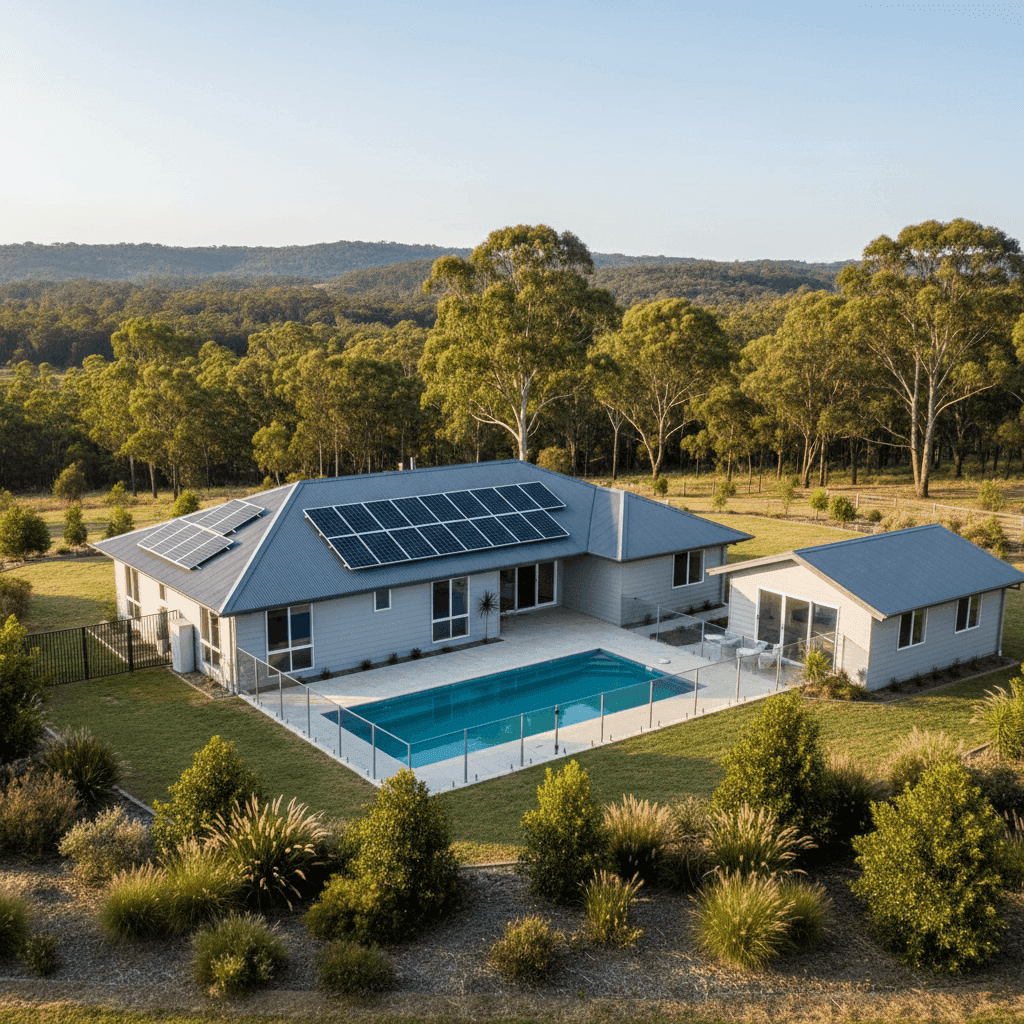
Nabiac is a quiet rural township in the Mid-Coast region of New South Wales, sitting roughly halfway between Newcastle and Port Macquarie. It's an area that attracts families and tree-changers drawn to its spacious blocks and relaxed lifestyle. But with more space often comes more to insure — and for owners of larger free standing homes in the area, understanding whether you're paying a fair premium is genuinely worth your time.
This article breaks down a recent home and contents insurance quote for a five-bedroom free standing home in Nabiac, NSW 2312, examining how it stacks up against local, state, and national benchmarks.
---
Is This Quote Fair?
The quote in question comes in at $3,205 per year (or $313/month) for combined home and contents cover, with a building sum insured of $653,000 and contents valued at $110,000. The building excess sits at $3,000 and contents excess at $1,000.
Our price rating for this quote is Expensive (Above Average).
Compared to the suburb average of $2,509/yr and the suburb median of $2,297/yr, this premium is noticeably higher — roughly 28% above the local average and 39% above the median. That said, it does fall within the suburb's 75th percentile of $3,123/yr, sitting just above that threshold, which tells us it's not wildly out of line for the upper end of the local market.
Several factors justify a higher-than-average premium here. The property is a substantial 214 sqm home with five bedrooms, two bathrooms, a swimming pool, solar panels, ducted climate control, and a granny flat — all of which add to the insurer's risk exposure and replacement cost calculations. The $653,000 building sum insured also reflects a larger-than-typical dwelling, which naturally pushes the premium upward.
So while the label "expensive" is accurate relative to the suburb average, it's worth noting that this isn't a typical Nabiac property — it's a well-appointed, feature-rich home with meaningful additional structures and systems to protect.
---
How Nabiac Compares
To put this quote into proper context, here's how Nabiac's insurance costs sit against broader benchmarks:
| Benchmark | Average Premium | Median Premium |
|---|---|---|
| Nabiac (2312) | $2,509/yr | $2,297/yr |
| NSW State | $3,801/yr | $3,410/yr |
| National | $2,965/yr | $2,716/yr |
| Mid-Coast LGA | $4,463/yr | — |
A few things stand out here. First, Nabiac's local averages are well below the NSW state average — homeowners in the suburb are generally paying significantly less than the typical NSW policyholder. This likely reflects the area's lower density, reduced crime risk, and the fact that it sits outside designated cyclone zones.
Second, and perhaps most striking, is the Mid-Coast LGA average of $4,463/yr. This figure is considerably higher than the Nabiac suburb average, suggesting that other parts of the Mid-Coast council area — particularly coastal towns more exposed to storm and flood risk — are pulling the LGA figure upward. Nabiac itself, being further inland, appears to benefit from a more favourable risk profile.
Compared to the national average of $2,965/yr, this quote is about 8% higher. But when you factor in the property's size and features, and compare it to the NSW state average of $3,801/yr, it's actually sitting comfortably below what a typical NSW homeowner pays — which is a more relevant comparison for a property of this scale.
(Note: Nabiac suburb data is based on a sample of 13 quotes, so averages should be treated as indicative rather than definitive.)
---
Property Features That Affect Your Premium
Several characteristics of this property have a direct bearing on the premium quoted:
Hardiplank/Hardiflex cladding is a fibre cement product that performs well in terms of fire resistance compared to timber weatherboard. Insurers generally view it favourably, and it's a common choice in regional NSW. This is unlikely to be a premium driver — if anything, it may help keep costs in check.
Steel/Colorbond roofing is similarly well-regarded by insurers. It's durable, low-maintenance, and handles storm and hail events better than older tile or terracotta roofs. This is a positive factor for your premium.
Stump foundations are common in older regional homes (this property was built in 1995) and can be a consideration for insurers, particularly in areas prone to soil movement or flooding. They're not a red flag on their own, but they are noted in underwriting assessments.
Swimming pool adds liability exposure and increases the overall replacement cost of the property. Most insurers include pool cover under the building policy, but it does contribute to a higher sum insured and, therefore, a higher premium.
Solar panels are increasingly common but do add to the insurable value of the home. Make sure your building sum insured specifically accounts for the replacement cost of your solar system — many homeowners underestimate this.
Granny flat is a significant addition. A secondary dwelling on the property increases both the replacement cost and the complexity of any claim. It's essential that your sum insured reflects the full rebuild cost of both structures, not just the main home.
Ducted climate control is another high-value fixture that contributes to the building's replacement cost and should be factored into your sum insured calculation.
---
Tips for Homeowners in Nabiac
1. Review your sum insured regularly With a granny flat, solar panels, and ducted climate control, your property has more insurable assets than a standard home. Building costs have risen significantly in regional NSW over the past few years — make sure your $653,000 sum insured still reflects the true cost to rebuild, not just the market value of the land and home.
2. Shop around — even if your current quote seems reasonable The Nabiac suburb average sits well below the NSW state average, which means there's genuine competition among insurers for regional properties with lower risk profiles. Use a comparison tool to ensure you're not overpaying simply out of inertia.
3. Consider your excess strategically This quote carries a $3,000 building excess, which is on the higher side. A higher excess typically reduces your premium, but it means a significant out-of-pocket cost if you need to claim. Assess whether that trade-off makes sense for your financial situation — particularly for a property with a pool and secondary dwelling where claims could arise from multiple sources.
4. Check your contents cover reflects reality At $110,000, the contents value is a reasonable starting point for a five-bedroom home — but with a granny flat potentially housing additional furniture and appliances, it's worth doing a proper stocktake. Underinsurance on contents is one of the most common issues Australian homeowners face at claim time.
---
Compare Your Options with CoverClub
Whether you're reviewing your existing policy or shopping for the first time, CoverClub makes it easy to see how your premium stacks up. Our data is drawn from real quotes across Australia, giving you a clear picture of what's fair for your suburb and property type. Get a quote today and find out if you could be paying less — or make sure the cover you have is truly worth what you're paying for it.