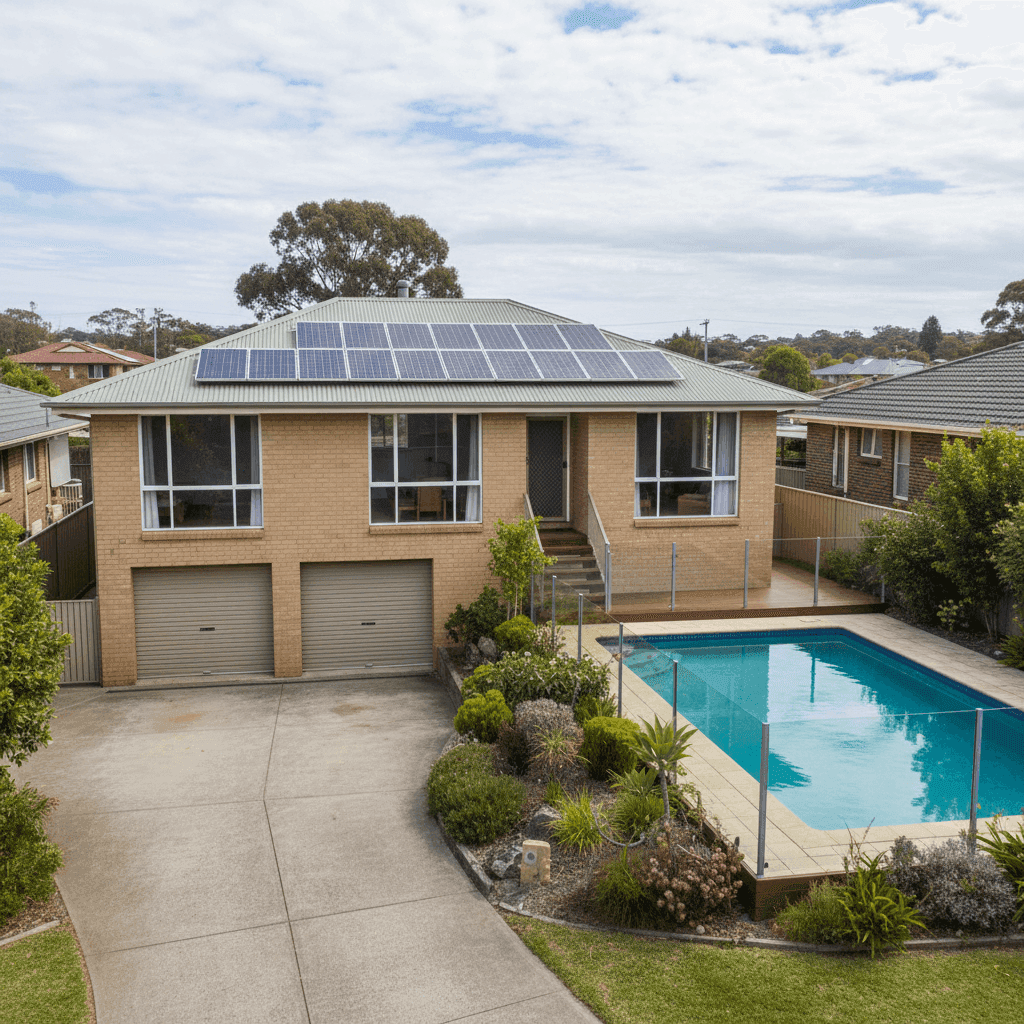
If you own a free standing home in Oak Flats, NSW 2529, you're living in one of the Illawarra region's more relaxed coastal suburbs — part of the Shellharbour local government area, sitting just south of Lake Illawarra. It's a well-established neighbourhood with a mix of older and newer homes, and like most of coastal New South Wales, home insurance here is a genuine line item worth scrutinising. This article breaks down a recent home and contents insurance quote for a five-bedroom property in Oak Flats, compares it against local, state, and national benchmarks, and offers some practical tips for keeping your premiums in check.
---
Is This Quote Fair?
The quote in question came in at $3,529 per year (or $338/month) for a combined home and contents policy. The building is insured for $874,000 and contents for $248,000, with a $1,000 excess applying to both.
Our price rating for this quote is EXPENSIVE — above average for the area.
To put that in context: the average home and contents premium across Oak Flats sits at just $1,325 per year, with a median of $1,279. This quote is more than 2.6 times the suburb average. Even at the 75th percentile — meaning only 25% of quotes in the suburb are higher — the benchmark is $1,666/yr. This quote sits well above that mark.
That said, it's important to understand why a quote might be higher. A five-bedroom home with a $874,000 building sum insured is a significantly larger and more valuable asset than the typical Oak Flats property. The contents cover of $248,000 is also substantial. Higher insured values naturally translate to higher premiums, so the comparison isn't entirely apples-to-apples. Still, the gap is wide enough to warrant shopping around.
---
How Oak Flats Compares
Here's how the Oak Flats suburb stacks up against broader benchmarks, based on data from CoverClub's Oak Flats insurance statistics:
| Benchmark | Average Premium | Median Premium |
|---|---|---|
| Oak Flats (suburb) | $1,325/yr | $1,279/yr |
| Shellharbour LGA | $1,744/yr | — |
| NSW (state) | $9,528/yr | $3,770/yr |
| National | $5,347/yr | $2,764/yr |
A few things stand out here. Oak Flats is actually quite affordable compared to the broader NSW state average of $9,528/yr — though that figure is heavily influenced by high-value properties and flood- or fire-prone areas across the state. The national average of $5,347/yr tells a similar story: coastal and disaster-exposed regions pull the average up considerably.
At $1,325/yr on average, Oak Flats is a relatively low-risk suburb from an insurer's perspective. It's not in a cyclone zone, doesn't appear on major flood mapping overlays, and benefits from established infrastructure. That makes the quote under review stand out even more — it's a reminder that individual property characteristics, sum insured levels, and the insurer's own pricing models can push a premium well above the local norm.
---
Property Features That Affect Your Premium
Several characteristics of this particular property will be influencing the premium, both positively and negatively.
What's likely pushing the premium up
- High sum insured: A building replacement value of $874,000 is the single biggest driver. Insurers price proportionally to what they'd need to pay out, and this is a large, well-appointed home.
- Swimming pool: Pools add liability risk and can increase the cost of a claim if surrounding structures are damaged. Most insurers factor this into their pricing.
- Large home (214 sqm, 5 bedrooms, 3 bathrooms): Size matters. More rooms, more bathrooms, and a larger floor area all increase the cost to rebuild.
- Ducted climate control: Ducted HVAC systems are expensive to repair or replace, and their presence signals a higher-spec home overall.
- Solar panels: Panels on the roof add replacement cost and can complicate claims involving roof damage. Some insurers treat them as a separate risk factor.
What's likely keeping the premium in check
- Double brick construction: One of the most insurer-friendly wall types in Australia. Double brick is durable, fire-resistant, and less susceptible to storm damage than timber or clad alternatives.
- Colorbond steel roof: Modern, low-maintenance, and highly regarded by insurers for its resilience in storms and bushfire conditions.
- Concrete slab foundation: Slabs are stable and less prone to subsidence issues than pier-and-beam or strip footings.
- Tile flooring: Durable and resistant to water damage — a minor but positive signal for insurers.
- No cyclone risk: Oak Flats falls outside Australia's cyclone belt, which removes a significant premium loading that applies to properties in Queensland's far north or WA's Pilbara coast.
- Construction year (1989): Homes built in the late 1980s are generally post-asbestos in terms of common building materials and predate some of the more problematic construction trends of the early 2000s.
---
Tips for Homeowners in Oak Flats
If you're a homeowner in Oak Flats reviewing your insurance options, here are four practical steps worth taking:
1. Review your sum insured carefully
The building sum insured should reflect the cost to rebuild, not the market value of your property. These can differ significantly. Use a building cost calculator or ask a quantity surveyor to get an accurate figure — being over-insured means you're paying more than you need to, while being under-insured can leave you badly exposed at claim time.
2. Compare at least three quotes
Given that this quote came in at more than double the suburb average, the value of comparison shopping is obvious. Premiums for the same property can vary by hundreds — sometimes thousands — of dollars between insurers. Get a quote through CoverClub to see what multiple insurers would charge for your specific home.
3. Check what's included for your pool and solar panels
Not all policies treat pools and solar panels the same way. Some include them automatically under the building sum insured; others require separate listing or have specific sub-limits. Make sure your policy wording is clear on both, and that your sum insured accounts for their replacement cost.
4. Consider a higher excess to reduce your premium
If you're in a stable, low-risk suburb like Oak Flats and you have a financial buffer, opting for a higher excess (say, $2,000 instead of $1,000) can meaningfully reduce your annual premium. Just make sure the saving justifies the additional out-of-pocket exposure if you do need to claim.
---
Find a Better Deal with CoverClub
Whether you're renewing an existing policy or shopping around for the first time, comparing quotes is the most effective way to make sure you're not overpaying. CoverClub makes it easy to see how your premium stacks up against what others in Oak Flats and across NSW are paying. Start your comparison today and find cover that fits your home — and your budget.