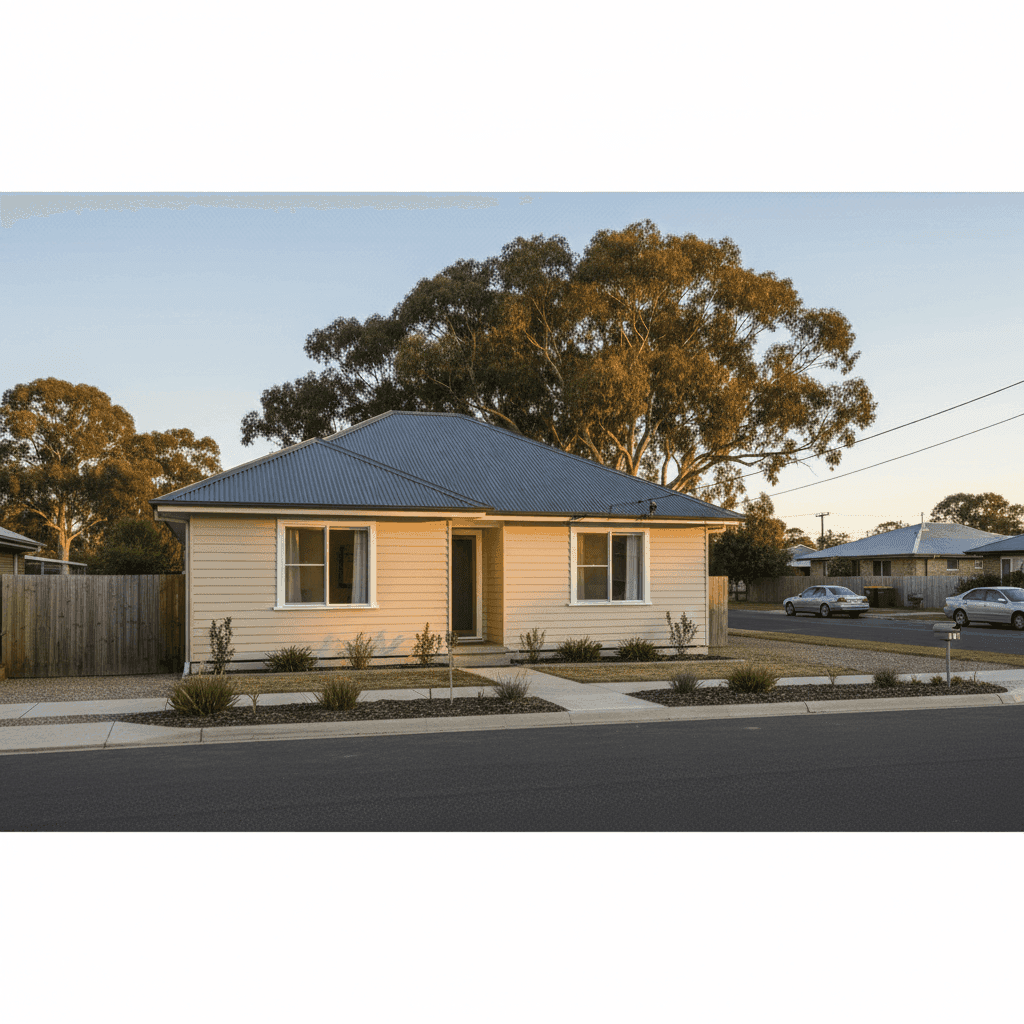
If you own a free standing home in Oaks Estate, ACT 2620, you've probably noticed that home insurance can feel like a significant line item in your household budget. This small riverside suburb, nestled on the southern fringe of Canberra near the Molonglo River, has a distinct character — a mix of older homes, leafy streets, and a tight-knit community. But what does it actually cost to insure a property here, and is the quote you've received a fair deal?
We recently analysed a Home and Contents insurance quote for a 3-bedroom, 1-bathroom free standing home in Oaks Estate. Here's what we found.
---
Is This Quote Fair?
The quote in question came in at $5,380 per year (or $516 per month), covering a building sum insured of $497,000 and contents valued at $50,000, with a $1,000 excess on both building and contents.
Our assessment: this quote is rated Expensive — above average for the area.
To put that in perspective, the suburb average annual premium for Oaks Estate sits at just $2,328/yr, and the median is even lower at $2,239/yr. That means this quote is more than double what most homeowners in the suburb are paying. Even at the 75th percentile — meaning 75% of local quotes are cheaper — the figure is only $2,662/yr, still well below this premium.
So why is this quote so high? A combination of factors are likely at play, including the age of the property, its construction materials, and the relatively high building sum insured. We'll dig into each of these below.
---
How Oaks Estate Compares
Understanding where your premium sits relative to local, state, and national benchmarks is one of the most useful tools a homeowner has. Here's how the numbers stack up:
| Benchmark | Average Premium | Median Premium |
|---|---|---|
| Oaks Estate (suburb) | $2,328/yr | $2,239/yr |
| ACT (state) | $2,288/yr | $2,186/yr |
| National | $5,347/yr | $2,764/yr |
A few things stand out here. First, Oaks Estate premiums are broadly in line with the rest of the ACT — the suburb average of $2,328 is almost identical to the ACT state average of $2,288. This suggests that, as a suburb, Oaks Estate doesn't carry an unusual risk premium compared to the broader territory.
Second — and this is important — the national average of $5,347/yr is actually close to the quote being analysed. This tells us the quote may have been benchmarked against national pricing norms rather than local ACT conditions, or that specific property characteristics are pushing it into a higher-risk category that aligns more with the national average than the local one.
You can explore the full Oaks Estate insurance statistics or compare against national home insurance data to see how your own situation stacks up.
> Note: The suburb sample size for Oaks Estate is 5 quotes, so while the local data is a useful guide, it's worth gathering multiple quotes to get a clearer picture of the market.
---
Property Features That Affect Your Premium
Several characteristics of this particular home are worth examining in the context of insurance pricing.
Age of Construction (1938)
This home was built in 1938, making it nearly 90 years old. Older homes are generally more expensive to insure because they may contain materials or building methods that are costly to repair or replace — and because ageing infrastructure (plumbing, electrical wiring, structural elements) can increase the likelihood of a claim. Insurers typically apply a loading to pre-war and early post-war homes.
Weatherboard Timber Walls
Weatherboard wood external walls are a classic feature of homes from this era, and they're charming — but from an insurer's perspective, timber construction carries a higher fire risk than brick or rendered masonry. This is a meaningful factor in premium calculations, particularly in the ACT where bushfire risk is an ever-present consideration for surrounding regions.
Steel/Colorbond Roof
On the positive side, a steel Colorbond roof is generally viewed favourably by insurers. It's durable, low-maintenance, and performs well in hail events compared to terracotta or concrete tiles. This may partially offset the risk loading from the timber walls.
Slab Foundation & Tile Flooring
A concrete slab foundation is considered stable and low-risk. Combined with tile flooring, these features reduce exposure to water damage and subsidence claims — both positives from an underwriting standpoint.
Ducted Climate Control
The presence of ducted climate control adds to the replacement value of the home's fixtures and fittings. While this doesn't dramatically shift the risk profile, it does contribute to the overall cost to rebuild, which flows through to the building sum insured and ultimately the premium.
Building Sum Insured: $497,000
At $497,000, the building sum insured is a significant driver of this premium. For a 130 sqm home, this equates to roughly $3,823 per square metre — which is on the higher end for a standard-quality home, though not unusual given construction cost inflation in recent years. It's worth reviewing whether this figure accurately reflects your rebuild cost, as over-insuring can mean you're paying more than necessary.
---
Tips for Homeowners in Oaks Estate
If you're looking to bring your premium down — or simply want to make sure you're getting the best value — here are four practical steps worth considering.
1. Compare multiple quotes With only 5 quotes in our local dataset, the Oaks Estate market is relatively small. Different insurers price older weatherboard homes very differently, so shopping around is particularly valuable here. Use CoverClub's free quote comparison tool to see what multiple providers would charge for your specific property.
2. Review your building sum insured Make sure your sum insured reflects the actual cost to rebuild your home — not its market value. An independent building valuation can help ensure you're not over-insured (and overpaying) or under-insured (and exposed to risk). For a 130 sqm home with standard fittings, it may be worth getting a professional estimate.
3. Consider a higher excess Both the building and contents excess on this policy are set at $1,000. Opting for a higher voluntary excess — say $2,000 or $2,500 — can meaningfully reduce your annual premium. Just make sure you can comfortably cover that amount out of pocket if you do need to make a claim.
4. Ask about loyalty discounts and bundling Some insurers offer discounts for combining home and contents cover (as this policy does), paying annually rather than monthly, or maintaining a long claim-free history. It's always worth asking your insurer directly what discounts are available — you may be surprised.
---
Ready to Find a Better Deal?
Whether you're renewing your existing policy or shopping for the first time, comparing quotes is the single most effective way to make sure you're not overpaying. At CoverClub, we make it easy to see how your premium stacks up against real data from homes in your area.