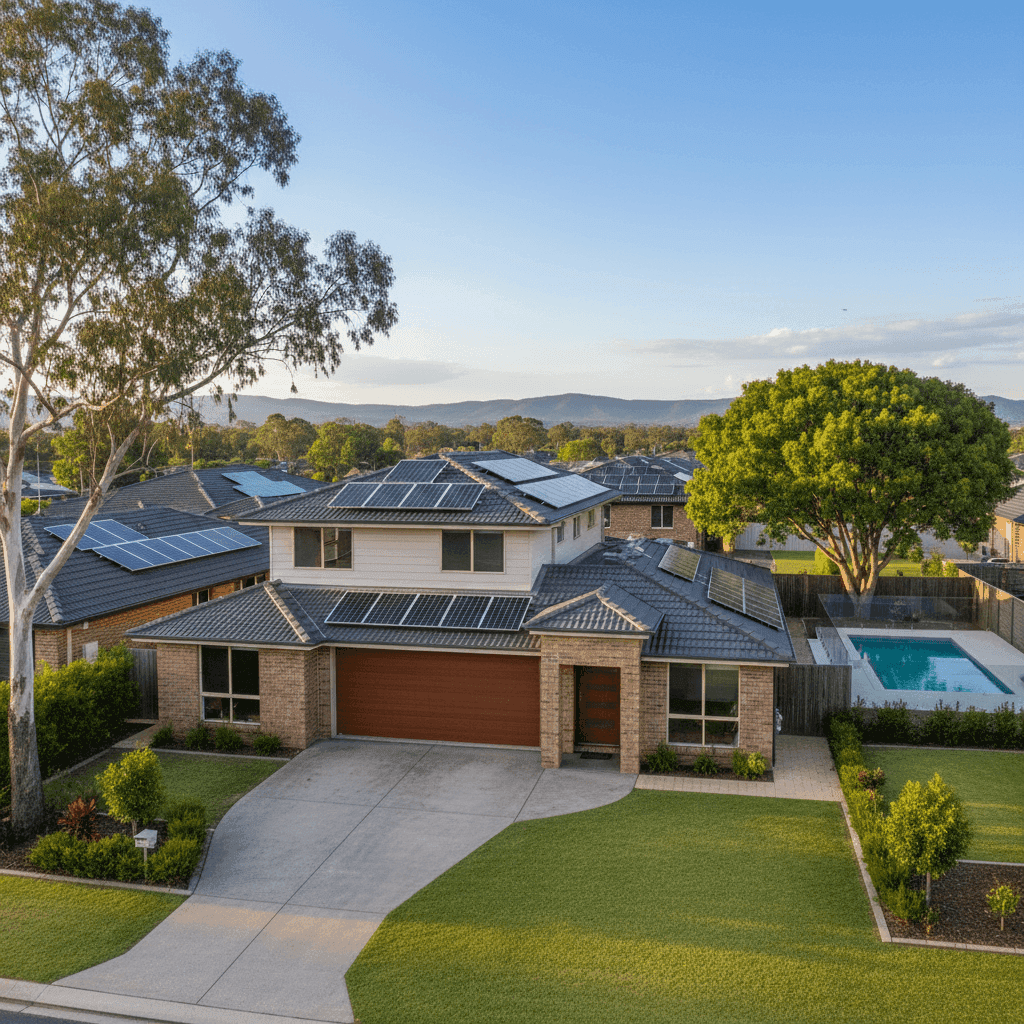
Oxenford, nestled in the northern Gold Coast corridor of Queensland, is a well-established suburb popular with families drawn to its proximity to theme parks, good schools, and the M1 motorway. It's also a suburb where home insurance premiums can vary quite significantly — making it worth taking a close look at any quote before you sign on the dotted line. This article breaks down a recent home and contents insurance quote for a four-bedroom, three-bathroom free standing home in Oxenford (postcode 4210), and puts the numbers in context so you can make a more informed decision.
---
Is This Quote Fair?
The quoted annual premium of $3,480 (or $327/month) covers a brick veneer home built in 1986, insured for $865,000 in building cover and $135,000 in contents — with a $1,000 excess applying to both. Our price rating for this quote is FAIR, meaning it sits around the average for the area.
To put that in perspective: the suburb median premium in Oxenford is $3,274 per year, so this quote comes in just slightly above the midpoint. It's not the cheapest available — the 25th percentile of quotes sits at $2,357/yr — but it's also well below the 75th percentile of $4,722/yr, meaning roughly three-quarters of comparable properties in the suburb are paying either a similar amount or more.
In short, while there may be room to do better, this is not an overpriced quote by any stretch. It reflects a reasonably competitive position in the local market.
---
How Oxenford Compares
One of the most striking things about this quote is how favourably Oxenford compares to the broader Queensland and national landscape. Check out the numbers:
| Benchmark | Average Premium | Median Premium |
|---|---|---|
| Oxenford (suburb) | $4,299/yr | $3,274/yr |
| Gold Coast LGA | $8,161/yr | — |
| Queensland (state) | $9,129/yr | $3,903/yr |
| National | $5,347/yr | $2,764/yr |
(Based on [121 quotes analysed for Oxenford](https://coverclub.com.au/stats/QLD/4210/oxenford). See also [QLD state stats](https://coverclub.com.au/stats/QLD) and [national stats](https://coverclub.com.au/stats/national).)
The Queensland state average of $9,129/yr is eye-watering — driven largely by high-risk coastal and far-north Queensland properties facing cyclone, flood, and storm surge exposure. The Gold Coast LGA average of $8,161/yr reflects similar dynamics across the broader region. By contrast, Oxenford's suburb average of $4,299/yr is considerably more moderate, and this particular quote at $3,480/yr sits below even that.
It's worth noting that the national median of $2,764/yr is lower than this quote — but national figures are heavily influenced by lower-risk areas in southern states where weather events are less frequent and less severe. Queensland homeowners, even in relatively sheltered suburbs like Oxenford, tend to face higher base premiums due to the state's exposure to severe storms and flooding.
---
Property Features That Affect Your Premium
Several characteristics of this property have a meaningful influence on what insurers charge. Here's how each one plays into the equation:
Brick veneer walls and tiled roof — This is a solid, well-regarded construction combination in the eyes of insurers. Brick veneer offers good fire resistance and structural durability, while a tiled roof is considered more resilient than Colorbond or corrugated iron in many storm scenarios. Together, they generally attract more favourable premiums compared to lightweight cladding or older fibrous cement construction.
Stump foundation — The home sits on stumps, which is common for Queensland homes of this era. While stumps allow for good airflow underneath (important in a subtropical climate), they can be a flag for some insurers around subsidence risk or pest damage. It's worth ensuring your policy clearly covers the subfloor structure.
Timber and laminate flooring — These floor types are generally not a major premium driver, though they can be a consideration in contents claims if flooding or water damage occurs. Ensuring your contents cover adequately reflects the replacement value of flooring is worthwhile.
Swimming pool — A pool adds both value and liability considerations. Some insurers factor in the increased risk of accidental damage or public liability associated with a pool. Make sure your policy includes adequate liability cover.
Solar panels — Solar panels are an increasingly common feature on Australian homes, but they're not always automatically covered under standard building policies. Check whether your insurer covers the panels as part of the building sum insured or whether they require separate listing.
Ducted climate control — Ducted air conditioning systems are expensive to repair or replace. At $865,000 building sum insured, this system should be captured, but it's a good idea to confirm with your insurer that fixed mechanical systems are included.
1986 construction — Homes built in the mid-1980s are now approaching 40 years old. While well-maintained brick veneer homes of this era can be very sound, older properties can attract slightly higher premiums due to the increased likelihood of needing repairs to ageing plumbing, wiring, or roofing.
---
Tips for Homeowners in Oxenford
1. Review your building sum insured regularly At $865,000, this property is insured for a substantial amount — but construction costs have risen sharply in recent years. It's worth getting an independent building replacement estimate every couple of years to ensure you're not underinsured. Underinsurance is one of the most common and costly mistakes Australian homeowners make.
2. Check your solar panel coverage explicitly Don't assume your solar system is covered. Ask your insurer whether panels are included in the building sum insured, whether storm and hail damage is covered, and whether there's any exclusion for electrical faults originating from the system.
3. Shop around — even if your current quote seems reasonable A "fair" rating means you're around average, not that you're getting the best deal. Using a comparison service like CoverClub can surface quotes from multiple insurers quickly, potentially saving hundreds of dollars annually without sacrificing cover quality.
4. Consider your excess strategy Both building and contents excesses sit at $1,000 here. Opting for a higher voluntary excess — say, $2,000 — can meaningfully reduce your annual premium. This strategy works well if you have the financial buffer to cover a larger out-of-pocket cost in the event of a claim.
---
Compare Your Options with CoverClub
Whether you're renewing your existing policy or shopping for the first time, it pays to compare. CoverClub makes it easy for Australian homeowners to see how their quote stacks up and find better value cover. Enter your address and get started today — it only takes a few minutes and could save you a meaningful amount each year.