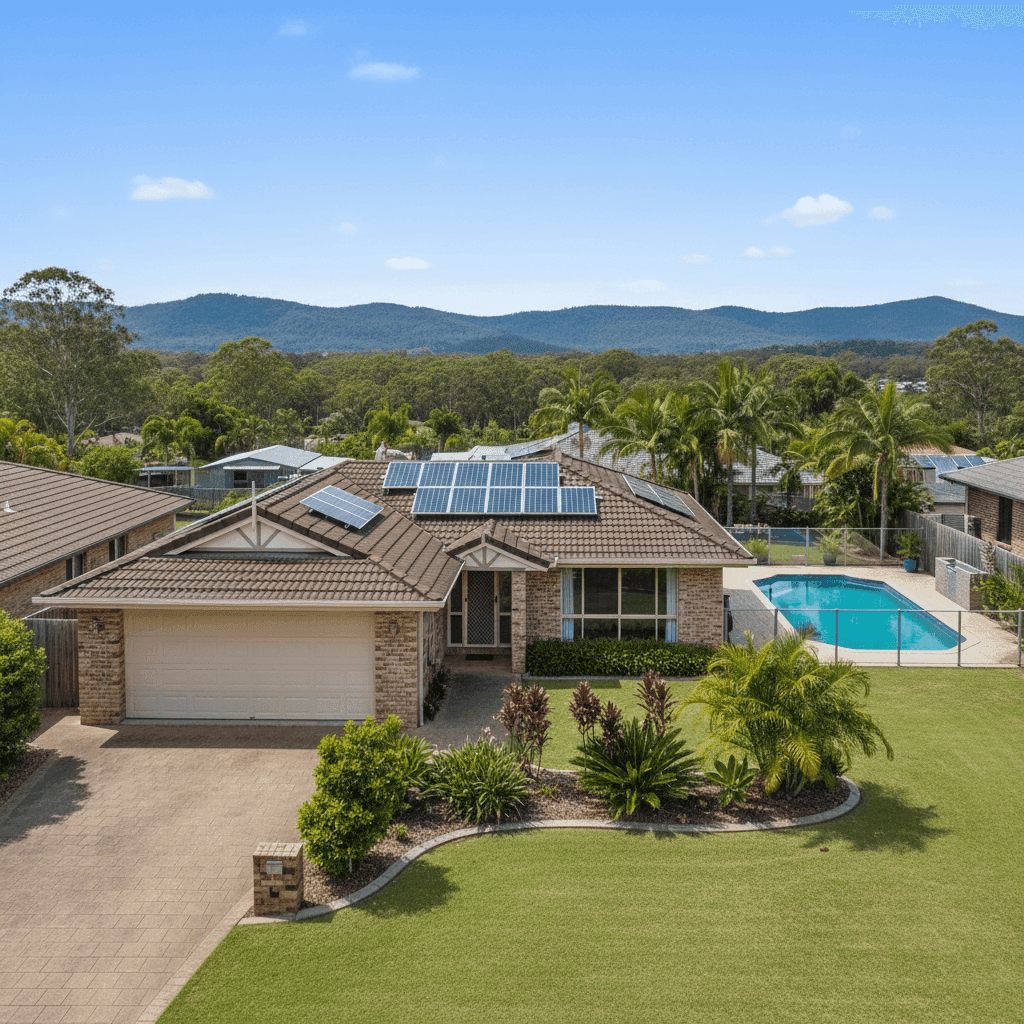
Pacific Pines is a well-established residential suburb on Queensland's Gold Coast, sitting in the foothills between Helensvale and Mudgeeraba. It's a popular choice for families, thanks to its leafy streets, good schools, and easy access to the M1. For homeowners here, understanding what drives the cost of home insurance — and whether your quote is competitive — can make a real difference to your household budget.
This article breaks down a recent home and contents insurance quote for a four-bedroom, brick veneer free standing home in Pacific Pines, and puts it in context against local, state, and national benchmarks.
---
Is This Quote Fair?
The quote in question comes in at $2,954 per year (or $293/month) for combined home and contents cover, with a building sum insured of $764,000 and contents valued at $50,000. Both the building and contents excess are set at $1,000.
Our price rating for this quote is FAIR — Around Average, and the data backs that up. The suburb median premium for Pacific Pines sits at $2,880 per year, meaning this quote lands just $74 above the midpoint of what other homeowners in the area are paying. It also falls comfortably within the interquartile range — between the 25th percentile of $2,267/yr and the 75th percentile of $3,620/yr — which tells us it's neither a standout bargain nor an overpriced outlier.
In short, this is a reasonable quote for the property and location, but there's still room to explore whether a better price is available elsewhere.
---
How Pacific Pines Compares
To really understand what this quote means, it helps to zoom out and look at the broader picture. Here's how Pacific Pines stacks up against Queensland and the rest of the country:
| Benchmark | Average Premium | Median Premium |
|---|---|---|
| Pacific Pines (suburb) | $3,347/yr | $2,880/yr |
| Queensland (state) | $9,129/yr | $3,903/yr |
| National | $5,347/yr | $2,764/yr |
| Scenic Rim LGA | $8,744/yr | — |
(Based on [Pacific Pines suburb data](https://coverclub.com.au/stats/QLD/4211/pacific-pines) from 57 quotes, [QLD state data](https://coverclub.com.au/stats/QLD), and [national benchmarks](https://coverclub.com.au/stats/national).)
A few things stand out here. Queensland's state average of $9,129/yr is dramatically higher than the suburb average of $3,347/yr — a gap largely driven by high-risk areas in Far North Queensland, flood-prone inland regions, and cyclone-exposed coastal communities. Pacific Pines benefits from its relatively benign risk profile compared to much of the state.
The Scenic Rim LGA average of $8,744/yr is also notably elevated, likely reflecting rural and semi-rural properties in that broader local government area that face higher bushfire and flood exposure. Pacific Pines, as an urban Gold Coast suburb, sits in a much more favourable position.
Compared to the national median of $2,764/yr, this quote is only marginally higher — a reassuring sign that Pacific Pines homeowners aren't being penalised by their postcode.
---
Property Features That Affect Your Premium
Several characteristics of this property influence how insurers assess and price the risk:
Brick Veneer Walls and Tiled Roof Brick veneer construction with a tiled roof is generally viewed favourably by insurers. Brick veneer offers good fire resistance and structural durability, while tiles are more resilient than Colorbond or corrugated iron in many weather scenarios. This combination tends to attract more competitive premiums compared to lightweight cladding or older fibro construction.
Slab Foundation A concrete slab foundation is the standard for homes built in Queensland from the 1980s onwards and is typically considered low-risk by insurers. It reduces the likelihood of subsidence-related claims and is less susceptible to termite damage compared to timber stumped homes.
Timber and Laminate Flooring The flooring type matters for contents and internal damage claims. Timber and laminate floors can be costly to repair or replace after a water damage event, which is worth keeping in mind when reviewing your contents and building cover limits.
Swimming Pool A pool adds value to the property but also introduces some liability and maintenance considerations. Some insurers factor pool-related liability into their assessment, so it's worth confirming your policy includes adequate cover for pool-related incidents.
Solar Panels Solar panels are increasingly common on Gold Coast homes and are generally covered under building insurance — but not always as a default. It's important to confirm with your insurer that your panels (and inverter) are explicitly included in your building sum insured, particularly given the replacement cost of a modern solar system.
Ducted Climate Control Ducted air conditioning is a fixed building asset and should be included in your building sum insured. At $764,000, the building cover here appears to account for a well-appointed home, but it's always worth reviewing whether your sum insured reflects current rebuilding costs, which have risen significantly across Queensland in recent years.
1995 Construction At roughly 30 years old, this home is mature but not aging. Homes of this era are generally well-regarded by insurers — past the teething problems of new builds, but not yet showing the wear associated with much older properties. That said, it's worth ensuring plumbing and electrical systems have been updated, as ageing infrastructure can affect both risk and premiums.
---
Tips for Homeowners in Pacific Pines
1. Review your building sum insured annually Construction costs in South East Queensland have risen sharply since 2020. If your sum insured hasn't kept pace, you could be underinsured in the event of a total loss. Use a building cost calculator or speak with a quantity surveyor to validate your figure.
2. Confirm solar panels and pool equipment are covered Don't assume these are automatically included. Ask your insurer specifically whether solar panels, the inverter, pool pumps, and filtration equipment are covered under your building policy — and at what value.
3. Shop around at renewal time A "Fair" rating means this quote is around average — but average isn't the same as the best available. Insurers reprice risk differently, and loyalty doesn't always pay. Comparing quotes at renewal is one of the simplest ways to reduce your premium without reducing your cover.
4. Consider your excess carefully Both the building and contents excess on this policy are set at $1,000. Opting for a higher excess (say, $2,000) can meaningfully reduce your annual premium — a worthwhile trade-off if you have the savings buffer to cover a larger out-of-pocket cost in the event of a claim.
---
Compare Your Home Insurance Options with CoverClub
Whether you're reviewing an existing policy or shopping for the first time, CoverClub makes it easy to see how your quote compares against real data from homeowners in your suburb. Get a home insurance quote today and find out if you're paying a fair price — or if there's a better deal waiting for you.