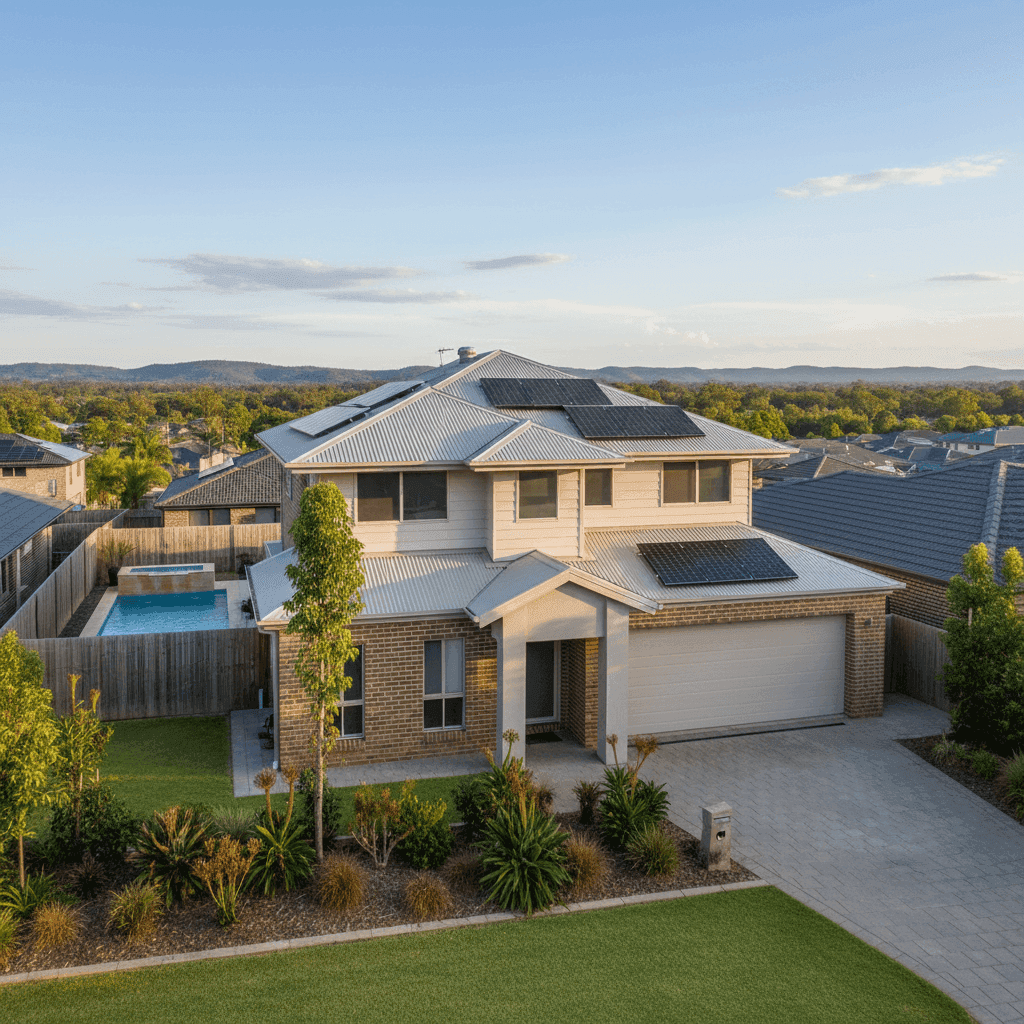
If you own a four-bedroom free standing home in Pacific Pines, QLD 4211, you're probably curious whether your home and contents insurance premium is competitive — or whether you're quietly paying more than you need to. This article breaks down a real quote for a property in this suburb, comparing it against local, state, and national benchmarks to help you make a more informed decision at renewal time.
---
Is This Quote Fair?
The quote in question sits at $2,880 per year (or $276 per month) for combined home and contents cover, with a $705,000 building sum insured and $102,000 in contents cover. Both the building and contents excesses are set at $2,000.
Our pricing tool rates this quote as FAIR — Around Average, which is a reasonable outcome for a well-appointed property in this part of South East Queensland. It's not a standout bargain, but it's also not cause for alarm. The "fair" rating reflects that the premium sits above the suburb median but comfortably within the normal range of what Pacific Pines homeowners are paying.
For context, the property is a 244 sqm brick veneer home built in 2012, with a Colorbond steel roof, slab foundation, tiled flooring, above-average fittings, a swimming pool, and solar panels. These features — particularly the pool and the above-average fittings quality — do push premiums upward compared to a more basic property, so the rating makes sense when you factor those in.
---
How Pacific Pines Compares
Understanding where your premium sits relative to others is one of the most useful things you can do as a homeowner. Here's how this quote stacks up:
| Benchmark | Premium |
|---|---|
| This quote | $2,880/yr |
| Pacific Pines suburb average | $2,372/yr |
| Pacific Pines suburb median | $2,152/yr |
| Pacific Pines 25th percentile | $1,709/yr |
| Pacific Pines 75th percentile | $3,199/yr |
| QLD state average | $4,547/yr |
| QLD state median | $3,931/yr |
| National average | $2,965/yr |
| National median | $2,716/yr |
(Based on 61 quotes collected for Pacific Pines. [View full suburb stats](https://coverclub.com.au/stats/QLD/4211/pacific-pines).)
A few things stand out here. First, Pacific Pines homeowners are paying significantly less than the Queensland state average — the suburb average of $2,372 is nearly half the state average of $4,547. This reflects the fact that much of Queensland carries elevated risk from cyclones, flooding, and severe storms, particularly in northern and western parts of the state. Pacific Pines, located in the Gold Coast hinterland fringe, benefits from a relatively benign risk profile by QLD standards.
Second, this quote of $2,880 sits above the suburb average and median, but still well below the 75th percentile of $3,199. That means roughly three-quarters of comparable properties in Pacific Pines are paying less — but the gap is partly explained by the property's size, pool, and above-average fittings.
Compared to the national average of $2,965, this quote is actually slightly below — a positive sign. And when viewed against QLD state figures, it looks very reasonable indeed.
One figure worth noting: the LGA average for Scenic Rim sits at a striking $8,744 per year. Pacific Pines falls under the City of Gold Coast council area rather than Scenic Rim, but the contrast highlights just how much localised risk factors — particularly flood and bushfire exposure — can drive premiums sky-high in certain pockets of South East Queensland.
---
Property Features That Affect Your Premium
Several characteristics of this property have a direct bearing on its insurance cost:
Brick veneer construction and Colorbond roof are both viewed favourably by insurers. Brick veneer offers solid fire and impact resistance, while steel roofing is durable and performs well in high-wind events. Together, they typically attract lower premiums than, say, weatherboard walls or terracotta tile roofs.
Slab foundation is standard for Queensland homes of this era and doesn't carry the subsidence or moisture risks associated with older stumped or suspended floor systems — another tick from an underwriting perspective.
Above-average fittings quality means the cost to rebuild or repair the interior is higher than a standard home. Insurers price this in, as replacing premium joinery, stone benchtops, or high-end appliances costs considerably more than standard finishes.
Swimming pool adds liability exposure and increases the overall replacement cost of the property. Most insurers factor pool infrastructure — fencing, pumps, filtration equipment — into the building sum insured, which nudges the premium upward.
Solar panels are an increasingly common feature on Queensland rooftops, and while they add value to a property, they also represent an additional asset to insure. Panels can be damaged by hail, storm debris, or falling branches, so their presence is reflected in the premium.
No cyclone risk is a meaningful factor in keeping this premium well below the Queensland state average. Homes in Far North Queensland, for instance, can face premiums several times higher purely due to cyclone exposure.
The 2012 construction year is another positive. Modern homes built to post-2011 building codes — which were significantly tightened following the 2010–11 Queensland floods — generally attract more competitive premiums than older stock.
---
Tips for Homeowners in Pacific Pines
1. Review your sum insured annually. With construction costs rising across South East Queensland, it's worth checking that your $705,000 building sum insured still reflects the true cost of rebuilding your home — not just its market value. Underinsurance is one of the most common and costly mistakes homeowners make.
2. Consider raising your excess to reduce your premium. Both excesses on this policy are set at $2,000. If you have a solid emergency fund and are unlikely to make small claims, increasing your excess further could meaningfully reduce your annual premium. Just make sure the saving is worth the out-of-pocket exposure.
3. Bundle building and contents cover. This quote already combines home and contents, which is smart. Many insurers offer a discount for bundling, and managing a single policy is far simpler come renewal time. If you're currently holding separate policies, it's worth getting a combined quote.
4. Compare at least every two years. Insurers regularly adjust their pricing models, and loyalty doesn't always pay. Even if your current insurer has treated you well, running a comparison at renewal — especially given the competitive market in Pacific Pines — could uncover meaningful savings without sacrificing cover quality.
---
Ready to Compare?
Whether you're happy with your current premium or suspect you might be overpaying, the smartest move is to see what else is on the market. Get a home insurance quote at CoverClub and find out in minutes how your property stacks up — no obligation, no hassle. You can also explore the latest Pacific Pines insurance data to see how your premium compares to your neighbours.