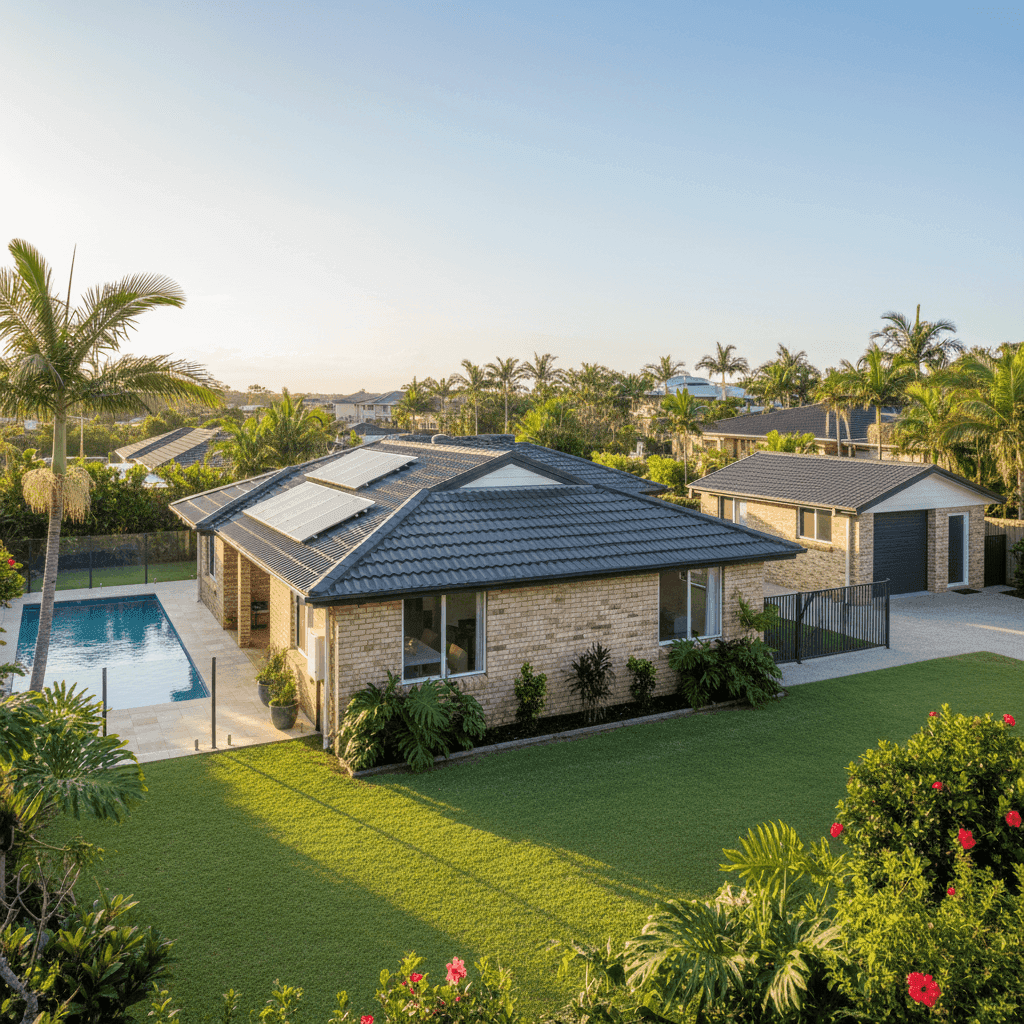
Palm Beach, nestled along Queensland's stunning Gold Coast, is one of those suburbs that manages to feel relaxed and coastal while still being close to everything. For homeowners here, protecting a property is a serious consideration — and understanding what you're paying for home insurance, and whether it's a fair price, can make a real difference to your household budget.
This article breaks down a recent home and contents insurance quote for a four-bedroom, three-bathroom free standing home in Palm Beach (QLD 4221), built in 1980 with brick veneer walls, a tiled roof, and a slab foundation. The property also features a pool, solar panels, timber and laminate flooring, a granny flat, and standard-quality fittings — covering 214 sqm of living space.
---
Is This Quote Fair?
The annual premium on this quote comes in at $3,283 per year (or $293/month), covering $700,000 in building sum insured and $70,000 in contents, each with a $5,000 excess. Our independent price rating for this quote is Fair — around average for the area.
To put that in context: based on 57 quotes collected for Palm Beach 4221, the suburb median sits at $3,911/year, and the average is $5,459/year. This quote falls below both of those benchmarks, landing just above the 25th percentile of $2,719/year and well under the 75th percentile of $5,275/year.
In plain terms, roughly half of Palm Beach homeowners are paying more than this quote, and only a quarter are paying notably less. For a property with a pool, solar panels, and a granny flat — all of which add complexity and replacement cost — landing near the median is a reasonable outcome. That said, there's still room to explore whether a lower premium is achievable without sacrificing meaningful cover.
---
How Palm Beach Compares to State and National Averages
Home insurance pricing across Queensland can vary enormously, and Palm Beach sits in an interesting position relative to broader benchmarks.
| Benchmark | Average Premium | Median Premium |
|---|---|---|
| Palm Beach 4221 | $5,459/yr | $3,911/yr |
| Gold Coast LGA | $8,161/yr | — |
| Queensland | $9,129/yr | $3,903/yr |
| National | $5,347/yr | $2,764/yr |
A few things stand out here. Queensland's average premium of $9,129/year is extraordinarily high compared to the national average of $5,347 — largely because the state average is pulled upward by high-risk areas like Far North Queensland, where cyclone exposure drives premiums sky-high. The median, however, tells a different story: Queensland's median of $3,903 is almost identical to Palm Beach's median of $3,911, suggesting that for a mid-range property in a lower-risk coastal suburb, Palm Beach pricing is broadly in line with the Queensland mainstream.
Nationally, the median is $2,764/year — lower than Palm Beach's median, which reflects the premium that coastal Queensland living commands. You can explore Queensland-wide insurance data here or compare against national figures to get a fuller picture.
The Gold Coast LGA average of $8,161/year is notably higher than Palm Beach's suburb average, which suggests Palm Beach may benefit from relatively favourable risk characteristics compared to some other Gold Coast postcodes.
---
Property Features That Affect Your Premium
Several characteristics of this property will be influencing the quoted premium — some pushing it up, others keeping it in check.
Brick veneer walls and tiled roof are generally viewed favourably by insurers. Brick veneer is durable, fire-resistant, and widely used in Australian construction, making it straightforward to price. Tiled roofs similarly have a long track record and are considered lower risk than some alternatives like Colorbond or older materials.
Slab foundation is the most common foundation type in Queensland and presents few complications for insurers. It's worth noting, however, that slab homes can be vulnerable to subsidence in certain soil conditions — something to keep in mind for a 1980s build.
The pool adds to the replacement cost of the property and may also carry liability considerations. Ensure your policy's liability cover is adequate, particularly if the pool is accessible to visitors or guests staying in the granny flat.
Solar panels are increasingly common across Queensland, but they're not automatically covered under all home insurance policies. It's essential to confirm whether your panels are included in the building sum insured and what the insurer's position is on damage from storms or hail.
The granny flat is a significant addition. Secondary dwellings can be a grey area in home insurance — some policies cover them as part of the main dwelling, while others require a separate listing or endorsement. Homeowners should verify explicitly that the granny flat is covered under the policy and that the $700,000 building sum insured accounts for its full rebuild cost.
Timber and laminate flooring can be more expensive to replace than ceramic tiles, and this may be factored into the contents or building valuation depending on how the flooring is classified.
No cyclone risk is a meaningful factor. Palm Beach falls outside designated cyclone risk zones, which keeps premiums considerably lower than properties further north along the Queensland coast.
---
Tips for Homeowners in Palm Beach
1. Double-check your building sum insured includes the granny flat A common underinsurance trap is failing to account for secondary structures. Get a current rebuild cost estimate that explicitly includes the granny flat, and make sure your insurer acknowledges it in writing.
2. Confirm solar panel cover before you need to claim Ask your insurer directly: are the solar panels covered for storm damage, hail, and electrical faults? If not, you may need to add an endorsement or look at a specialist policy. Given Queensland's storm season, this isn't a question to leave unanswered.
3. Review your $5,000 excess carefully A $5,000 excess on both building and contents is on the higher end. While it likely reduces your premium, it also means smaller claims won't be worth lodging. Make sure you have sufficient savings to cover this out of pocket if needed, and consider whether a lower excess option makes financial sense for your situation.
4. Compare quotes annually — not just at renewal The insurance market shifts constantly, and loyalty doesn't always pay. Insurers may offer better rates to new customers than to existing policyholders. Running a fresh comparison at CoverClub before your renewal date takes only a few minutes and could reveal meaningful savings.
---
Ready to Compare Home Insurance in Palm Beach?
Whether you're reviewing your current policy or shopping for cover on a new property, it pays to see what the market is offering. CoverClub makes it easy to compare home and contents insurance quotes tailored to your suburb, property type, and cover needs. Get a quote today at CoverClub and find out if you're getting a fair deal — or if there's a better one waiting for you.