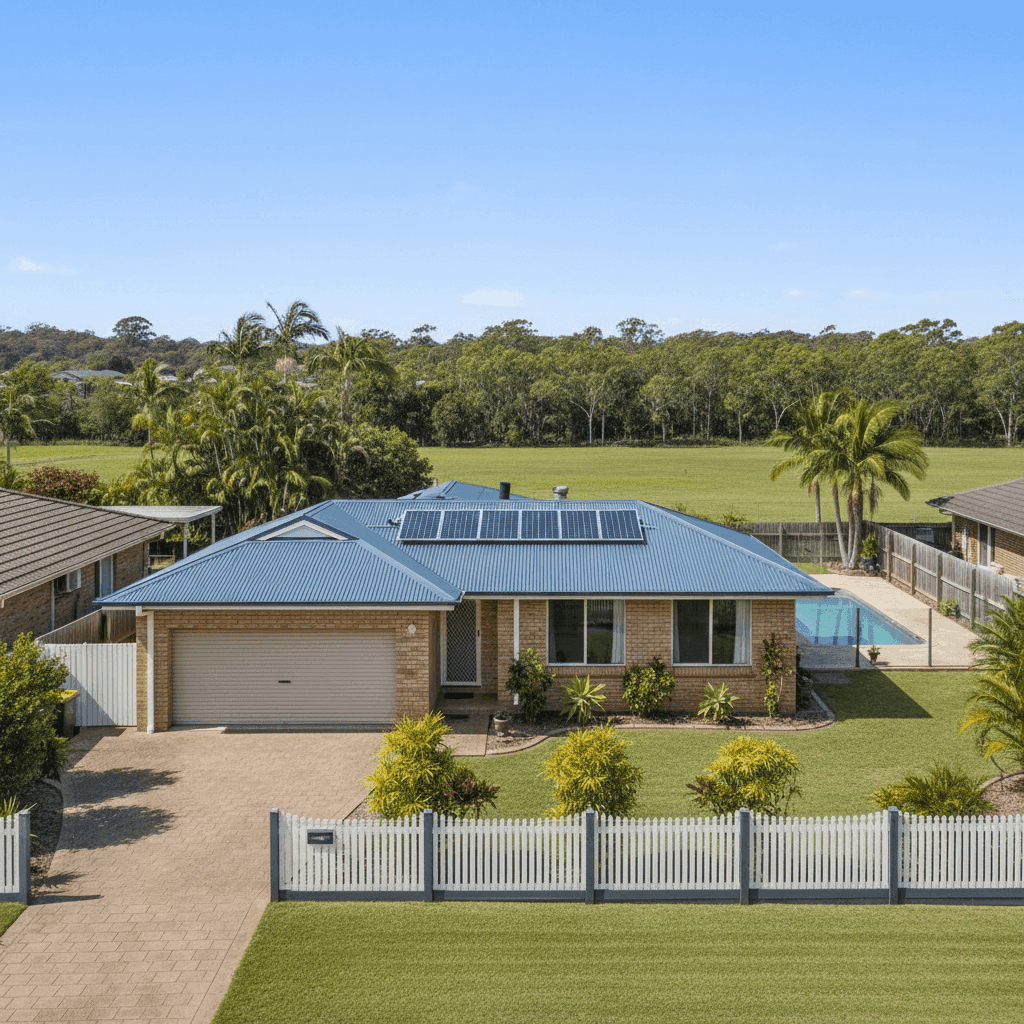
Palm Beach, nestled on the southern Gold Coast in Queensland, is one of those suburbs that effortlessly blends laid-back coastal living with strong property values. For owners of free standing homes here, understanding what you should be paying for home insurance — and why — can make a meaningful difference to your household budget. This article breaks down a real home and contents insurance quote for a three-bedroom, two-bathroom free standing home in Palm Beach (QLD 4221), and puts the numbers into context against local, state, and national benchmarks.
---
Is This Quote Fair?
The short answer: yes — and then some. This quote comes in at $2,652 per year (or $259/month), covering both building ($610,000 sum insured) and contents ($10,000), with a $2,000 excess on each. Our pricing engine rates this as CHEAP — below average for the area.
To put that in perspective, the suburb average for Palm Beach sits at $6,364 per year, and the median is $4,195 per year. Even the 25th percentile — meaning the cheapest quarter of quotes we've seen in this postcode — sits at $3,248 per year. This quote comfortably beats all of those benchmarks, coming in well below even the most competitive tier of local pricing.
That's a potential saving of over $1,500 per year compared to the cheapest quarter of Palm Beach quotes, and more than $3,700 per year against the suburb average. Over a five-year period, that difference compounds into genuinely significant money.
---
How Palm Beach Compares
Palm Beach is not a cheap suburb to insure — and the data reflects that clearly. Based on 57 quotes collected for this postcode, premiums vary enormously, ranging from around $3,248 at the 25th percentile all the way up to $8,202 at the 75th percentile. That's a spread of nearly $5,000 within the same suburb, which tells you just how much individual property characteristics and insurer pricing models can diverge.
Here's how Palm Beach stacks up against broader benchmarks:
| Benchmark | Average Premium | Median Premium |
|---|---|---|
| Palm Beach (QLD 4221) | $6,364/yr | $4,195/yr |
| Gold Coast LGA | $5,494/yr | — |
| Queensland | $4,547/yr | $3,931/yr |
| National | $2,965/yr | $2,716/yr |
You can explore Queensland-wide insurance data and national home insurance statistics to see how your area compares at a broader level.
Palm Beach premiums run notably higher than both the Queensland state average and the national average. This is driven by a combination of factors: high coastal property values, proximity to waterways, and the general risk profile of Gold Coast properties. The Gold Coast LGA average of $5,494 per year is itself well above the Queensland state figure, underscoring that this is a premium-priced insurance market.
---
Property Features That Affect Your Premium
Several characteristics of this particular property work in its favour from an insurance pricing perspective — and a few add complexity worth understanding.
Brick veneer external walls are generally well-regarded by insurers. They offer solid fire resistance and structural durability compared to timber or fibro cladding, which can translate to lower premiums. Combined with a Colorbond steel roof, the property has a modern, low-maintenance roofing system that holds up well in coastal conditions and is resistant to corrosion — an important factor in a beachside suburb like Palm Beach.
Stump foundations are common in older Queensland homes and reflect the building era (1975 in this case). While stumps can raise questions around subfloor maintenance and potential moisture issues, they're a well-understood construction type for Queensland insurers and don't typically attract significant loading on premiums. The timber and laminate flooring throughout is consistent with this style of home.
The property's 1975 construction year is worth noting. Homes of this vintage can sometimes attract slightly higher premiums due to older wiring, plumbing, or roofing systems, but this appears to have been well-accounted for in the quote.
Two features add both value and some premium consideration: the swimming pool and solar panels. Pools are a liability exposure — they require specific coverage for the structure itself and can affect public liability considerations. Solar panels add replacement cost to the building sum insured and require coverage against storm, hail, and electrical fault damage. Both are factored into a comprehensive home and contents policy, and it's worth confirming the specifics of what's covered with your insurer.
The absence of ducted climate control keeps things simpler, and Palm Beach falling outside a designated cyclone risk zone is a meaningful factor — cyclone-rated properties in North Queensland can see dramatic premium loadings that simply don't apply here.
---
Tips for Homeowners in Palm Beach
1. Review your building sum insured regularly. A $610,000 building sum insured is a substantial figure, but construction costs have risen sharply in recent years. Make sure your sum insured reflects current rebuild costs — not purchase price or market value — to avoid being underinsured in the event of a total loss. Tools like the Cordell Cost Calculator can help you estimate this.
2. Don't underestimate your contents. A $10,000 contents value is on the lower end for a three-bedroom, two-bathroom home. Take the time to do a proper room-by-room inventory of your belongings — furniture, appliances, clothing, electronics, and valuables. Underinsuring your contents is a common mistake that only becomes apparent at claim time.
3. Understand your pool and solar panel cover. Ask your insurer specifically how your policy treats the pool shell and equipment, as well as your solar panel system. Some policies cover these as standard; others require endorsements or have specific sub-limits. Getting clarity upfront avoids surprises later.
4. Compare quotes at renewal — every year. The Palm Beach insurance market is wide-ranging, with premiums spanning thousands of dollars for similar properties. As this quote demonstrates, significant savings are available. Don't let your policy auto-renew without checking the market. Shopping around annually is one of the simplest ways to keep your insurance costs in check.
---
Compare Your Own Quote
Whether you're a Palm Beach local or researching home insurance across the Gold Coast, the best way to know if you're getting a fair deal is to compare. At CoverClub, we make it easy to benchmark your premium against real data from your suburb, state, and across Australia. Get a quote today and see how your current policy stacks up — you might be surprised by how much room there is to save.