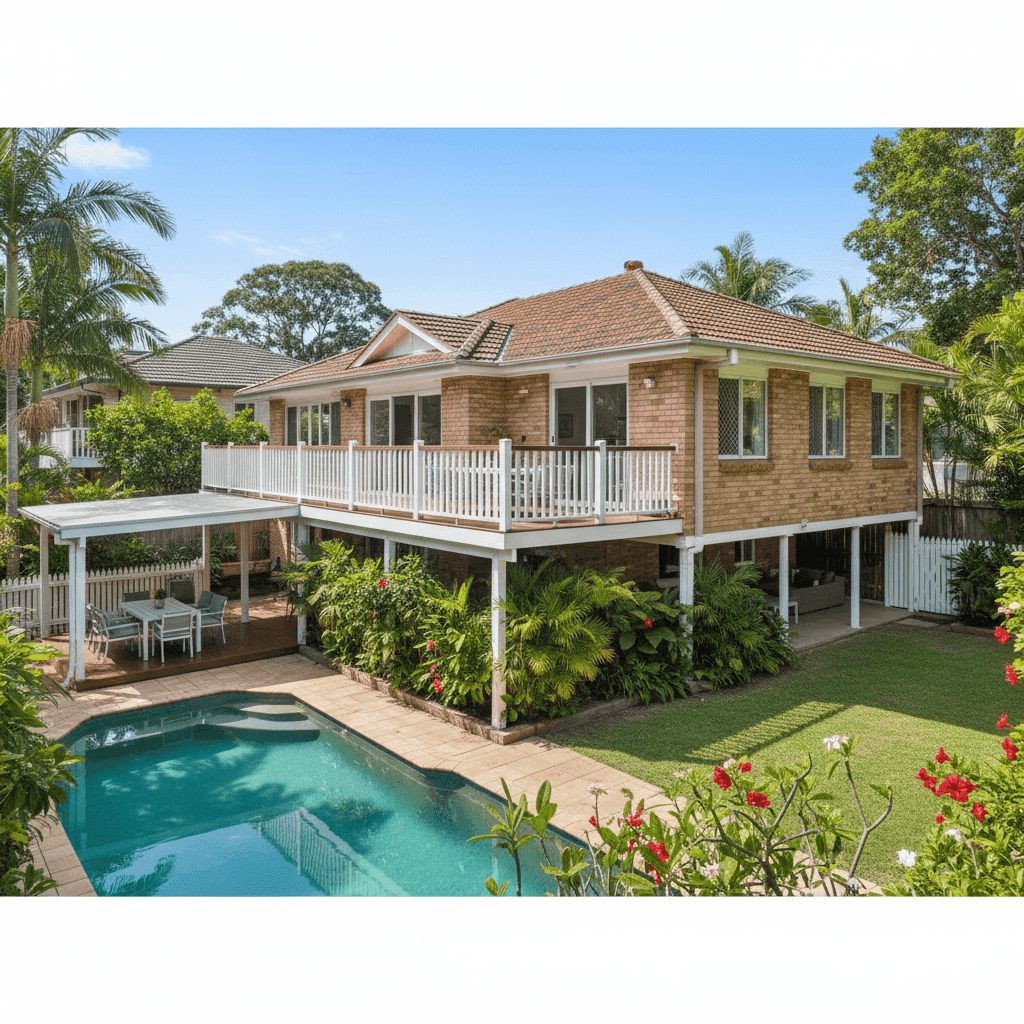
Palm Beach is one of the Gold Coast's most sought-after coastal suburbs — a laid-back strip of golden beaches, leafy streets, and a mix of classic Queensland homes and modern renovations. For owners of free standing homes in this postcode, understanding what you're paying for home insurance — and whether that price is fair — is an important part of protecting one of your biggest assets.
This article breaks down a real home and contents insurance quote for a four-bedroom, three-bathroom free standing home in Palm Beach (QLD 4221), comparing it against local, state, and national benchmarks to help you make sense of the numbers.
---
Is This Quote Fair?
The quote in question comes in at $3,617 per year (or $340 per month) for combined home and contents cover, with a building sum insured of $649,000 and contents valued at $50,000. Both the building and contents excess are set at $1,000.
Our pricing engine rates this quote as Fair — Around Average, which is a solid result for a property of this size and age in a coastal Queensland suburb.
To put that in context: the median home insurance premium across Palm Beach sits at $3,911 per year, based on 57 quotes collected for this suburb. This quote lands comfortably below that median, meaning the homeowner is paying less than half of Palm Beach residents while still carrying meaningful cover for a well-appointed property.
It's worth noting the distinction between average and median here. The suburb average of $5,459/yr is pulled upward by a small number of very high premiums — often properties with significant flood, storm surge, or other elevated risk factors. The median is generally a more reliable benchmark for a "typical" Palm Beach home, and this quote sits roughly $300 below it.
---
How Palm Beach Compares
One of the more striking things about this quote is how favourably it stacks up across multiple levels of comparison.
| Benchmark | Premium |
|---|---|
| This Quote | $3,617/yr |
| Palm Beach Suburb Median | $3,911/yr |
| Palm Beach Suburb Average | $5,459/yr |
| QLD State Median | $3,903/yr |
| QLD State Average | $9,129/yr |
| National Median | $2,764/yr |
| National Average | $5,347/yr |
| Gold Coast LGA Average | $8,161/yr |
Queensland is one of the most expensive states in the country for home insurance, largely driven by cyclone risk in the north, widespread flood plains, and a history of severe storm events. The QLD state average of $9,129/yr reflects just how dramatically risk can vary within the state — from Cairns and Townsville at the top end, to the southern Gold Coast at the lower end.
The national average of $5,347/yr tells a similar story: Australia-wide, home insurance is expensive, and coastal properties tend to sit above the midpoint. That this Palm Beach quote falls below both the state and national medians is a positive sign.
The Gold Coast LGA average of $8,161/yr is particularly eye-opening. It reflects the heavy weighting of higher-risk properties across the broader Gold Coast region — particularly those in flood-prone or storm-surge-exposed areas closer to waterways and canals. Palm Beach, while coastal, benefits from its position and elevation relative to some of these higher-risk pockets.
---
Property Features That Affect Your Premium
Several characteristics of this particular property influence what insurers are willing to charge.
Brick veneer construction and tiled roof are generally viewed favourably by insurers. Brick veneer offers solid weather resistance and structural integrity, while tiled roofs — when well-maintained — provide good protection against wind and rain. Together, these features typically attract more competitive premiums compared to, say, a weatherboard home with a corrugated iron roof.
Stump foundations are common in older Queensland homes (this one was built in 1975) and indicate a slightly elevated structure. At less than one metre of elevation, this property sits in a transitional category — elevated enough to provide some protection from minor surface water events, but not classified as a fully raised Queenslander. Insurers assess this carefully, as foundation type can affect both flood risk and structural repair costs.
Timber and laminate flooring is worth noting from a contents and building perspective. Timber floors can be costly to repair or replace if water damage occurs, which may factor into how the building sum insured is calculated.
Above average fittings quality — think stone benchtops, quality appliances, premium fixtures — increases the cost to rebuild or repair the home to its current standard. This is accurately reflected in the $649,000 building sum insured, which accounts for full replacement at today's construction costs.
The pool adds a modest premium loading in most policies, as it represents an additional liability and an asset that needs to be covered under the building component.
Ducted climate control is another above-average inclusion that adds to the overall replacement value of the home — and is appropriately captured in the sum insured.
Notably, this property is not in a cyclone risk area, which is a meaningful factor in keeping the premium lower than many Queensland equivalents further north.
---
Tips for Homeowners in Palm Beach
1. Review your sum insured regularly Construction costs have risen significantly across South East Queensland in recent years. A building sum insured set a few years ago may no longer reflect the true cost to rebuild. Use a building cost calculator or speak with a quantity surveyor to ensure $649,000 still covers full replacement — especially given the above-average fittings in this home.
2. Consider your excess strategically Both the building and contents excess are set at $1,000 here. Increasing your excess — say, to $2,000 or $2,500 — can meaningfully reduce your annual premium. If you have a solid emergency fund and are unlikely to make small claims, a higher excess can be a smart trade-off.
3. Check what's covered for your pool and outdoor areas Pools, outdoor entertaining areas, and landscaping are often subject to specific sub-limits or exclusions in home insurance policies. Make sure your policy clearly covers the pool structure, pump, and filtration system — and understand what's excluded in the event of storm damage or a liability claim.
4. Don't over-insure your contents A $50,000 contents value is relatively modest for a four-bedroom home with above-average fittings. Do a proper home contents inventory to make sure this figure is accurate — both under-insuring and over-insuring carry real costs. Many insurers offer online calculators to help you arrive at the right number.
---
Compare Your Options with CoverClub
Whether you're renewing your existing policy or shopping for the first time, it pays to compare. CoverClub makes it easy to see how your premium stacks up against real quotes from across your suburb and state — so you can walk into any renewal conversation with confidence.
Get a home insurance quote today and find out if you're getting a fair deal on your Palm Beach property.