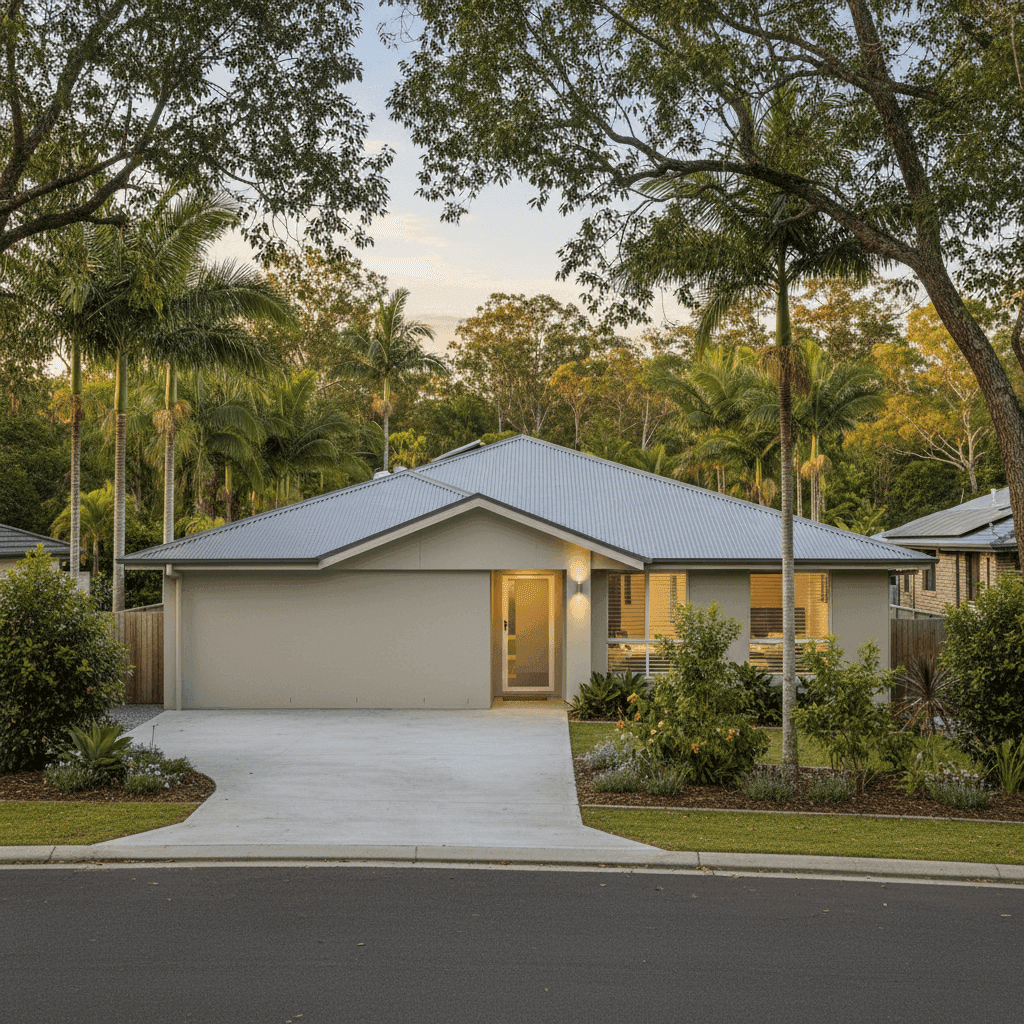
Palmwoods is a charming hinterland suburb on Queensland's Sunshine Coast — known for its lush greenery, relaxed lifestyle, and a growing number of modern residential builds. This article takes a close look at a real home and contents insurance quote for a 2-bedroom, 2-bathroom free standing home in Palmwoods (QLD 4555), built in 2022, and breaks down exactly what the numbers mean for homeowners in this area.
---
Is This Quote Fair?
The short answer: yes — and then some. This quote comes in at $1,838 per year (or $176/month), and it carries a "Cheap" price rating, meaning it sits well below the average for the area. For a combined home and contents policy covering a $650,000 building sum insured and $60,000 in contents, that's a genuinely competitive outcome.
To put it in context, the suburb average for Palmwoods sits at $3,076/year, and the median is $2,834/year. This quote is priced below even the 25th percentile of $2,211/year — meaning it's cheaper than at least 75% of quotes recorded in the area. That's a strong result by any measure.
Both the building and contents excess are set at $2,000, which is fairly standard for policies in this range. A higher excess is one of the levers insurers use to reduce premiums, so it's worth keeping that trade-off in mind when assessing value.
---
How Palmwoods Compares
Home insurance pricing in Queensland can vary enormously depending on where you live, and Palmwoods sits in an interesting position relative to broader benchmarks. Here's how the numbers stack up:
| Benchmark | Annual Premium |
|---|---|
| This Quote | $1,838 |
| Palmwoods Suburb Average | $3,076 |
| Palmwoods Suburb Median | $2,834 |
| Palmwoods 25th Percentile | $2,211 |
| Sunshine Coast LGA Average | $7,249 |
| QLD State Average | $9,129 |
| QLD State Median | $3,903 |
| National Average | $5,347 |
| National Median | $2,764 |
The contrast with the Sunshine Coast LGA average of $7,249 and the Queensland state average of $9,129 is striking. Much of that state-level inflation is driven by high-risk coastal and cyclone-prone areas — think Cairns, Townsville, and parts of the Far North — where premiums can run into the tens of thousands annually.
Palmwoods, being inland and elevated in the Sunshine Coast hinterland, avoids many of the coastal risk factors that push Queensland premiums sky-high. You can explore more detailed pricing data for this postcode at the Palmwoods suburb stats page, or compare it against the broader Queensland insurance landscape and national benchmarks.
---
Property Features That Affect Your Premium
Several characteristics of this particular property work in the homeowner's favour from an insurance pricing perspective.
Modern construction (2022): Newer homes are generally cheaper to insure. A 2022 build means the property was constructed to current building codes, which typically incorporate improved structural integrity, fire resistance, and weatherproofing standards. Insurers reward this with lower risk assessments.
Hebel external walls: Autoclaved aerated concrete (AAC) panels like Hebel are increasingly popular in Australian residential construction. They offer excellent fire resistance and thermal performance — both factors that can positively influence underwriting decisions. Compared to older brick veneer or weatherboard homes, Hebel-clad properties are viewed as lower risk for certain perils.
Steel/Colorbond roof: Colorbond roofing is widely regarded as one of the most durable and low-maintenance roofing options in Australia. It performs well in high winds, resists corrosion, and has a long service life. For insurers, this translates to a reduced likelihood of weather-related claims.
Slab foundation: A concrete slab foundation is a solid, stable base that eliminates the risk of subfloor moisture, pest ingress, and the structural vulnerabilities sometimes associated with raised timber stumps. It's a preferred foundation type from an underwriting standpoint.
No pool, no solar panels: While neither of these features is inherently problematic, their absence does simplify the risk profile. Pools introduce liability considerations, and solar panel systems can complicate roof claims. Not having either keeps the policy straightforward.
Above-average fittings quality: The property is noted as having above-average internal fittings. This is reflected in the $650,000 building sum insured — a figure that accounts for the cost to rebuild, not the market value. Timber and laminate flooring, quality fixtures, and ducted climate control all contribute to a higher rebuild cost, which is appropriately captured in the sum insured.
No cyclone risk: Palmwoods falls outside designated cyclone risk zones, which is a significant pricing advantage in Queensland. Cyclone-rated policies in northern parts of the state can cost multiples of what's quoted here.
---
Tips for Homeowners in Palmwoods
1. Review your sum insured regularly Construction costs have risen significantly in recent years. A home built in 2022 for a certain cost may now be more expensive to rebuild due to labour and materials inflation. Make sure your $650,000 sum insured still reflects current rebuild costs — your insurer or a quantity surveyor can help you assess this.
2. Don't over-insure your contents $60,000 in contents cover is a reasonable starting point, but it's worth doing a room-by-room inventory to check you're not paying for cover you don't need — or worse, under-insured for what you actually own. High-value items like jewellery, art, or electronics may need to be listed separately.
3. Compare quotes at renewal time Even with a cheap quote like this one, the insurance market shifts constantly. Insurers reprice risk annually, and loyalty doesn't always pay. Running a fresh comparison at renewal — rather than simply accepting the rollover price — is one of the easiest ways to stay ahead.
4. Understand your excess before you claim Both the building and contents excess on this policy are set at $2,000. That means for smaller incidents — a broken window, minor water damage — it may not be worth claiming at all. Keeping a small emergency fund for sub-excess repairs can save you from premium increases triggered by claims history.
---
Compare Your Own Quote
Whether you're a Palmwoods local or looking at property in the Sunshine Coast hinterland, it pays to know where your premium sits relative to the market. CoverClub makes it easy to see real quote data for your area and find cover that suits your property and budget. Get a quote today and see how your home stacks up.