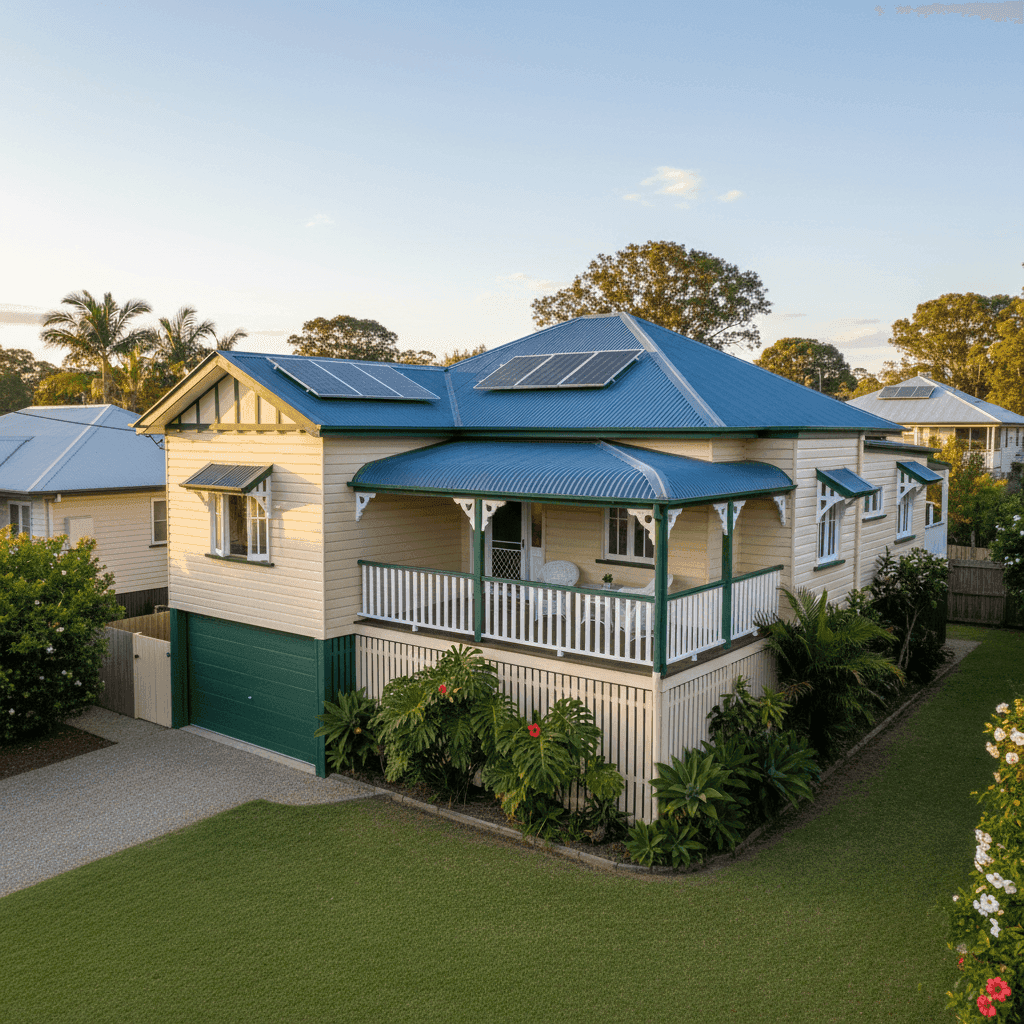
Palmwoods is a charming hinterland town nestled in the Sunshine Coast region of Queensland — known for its lush greenery, relaxed lifestyle, and a strong sense of community. If you own a free standing home here, you're likely wondering whether what you're paying for building insurance is reasonable. In this article, we break down a real building-only insurance quote for a four-bedroom, two-bathroom home in Palmwoods (postcode 4555) and put it in context against local, state, and national benchmarks.
---
Is This Quote Fair?
The quote in question comes in at $3,191 per year (or around $299 per month) for building-only cover, with a building excess of $5,000. Our analysis rates this as FAIR — Around Average.
That rating reflects where this premium sits relative to other quotes we've seen for comparable properties in the same suburb. It's not the cheapest option on the market, but it's also well within the range of what Palmwoods homeowners are typically paying. For a 1930s weatherboard home of 214 sqm with a Colorbond roof, solar panels, and ducted climate control, a premium in this ballpark is broadly in line with expectations.
It's worth noting that the $5,000 building excess is on the higher side. A higher excess generally reduces your annual premium, so if you were to lower that excess, you might see the annual cost rise. It's a trade-off worth considering based on your financial comfort level.
---
How Palmwoods Compares
To understand whether this quote represents good value, it helps to look at the broader picture. Here's how the $3,191 annual premium stacks up:
| Benchmark | Premium |
|---|---|
| This quote | $3,191/yr |
| Palmwoods suburb average | $3,076/yr |
| Palmwoods suburb median | $2,834/yr |
| Palmwoods 25th percentile | $2,211/yr |
| Palmwoods 75th percentile | $3,718/yr |
| QLD state average | $9,129/yr |
| QLD state median | $3,903/yr |
| National average | $5,347/yr |
| National median | $2,764/yr |
| Sunshine Coast LGA average | $7,249/yr |
Based on 68 quotes collected for Palmwoods, this premium sits slightly above the suburb average of $3,076 and notably above the median of $2,834 — but comfortably within the interquartile range (between $2,211 and $3,718). In other words, roughly half of Palmwoods homeowners are paying less, but a quarter are paying considerably more.
Zooming out, Palmwoods homeowners are actually in a relatively favourable position compared to the rest of Queensland. The QLD state average of $9,129 is heavily skewed by high-risk coastal and cyclone-prone areas in North Queensland, which push the mean well above what most South East Queensland residents pay. The state median of $3,903 is a more realistic comparison point — and this quote sits below it.
Against national figures, the story is similar. The national average of $5,347 is dragged upward by high-risk regions, while the national median of $2,764 reflects that many Australian homeowners pay less. Palmwoods, sitting in a non-cyclone zone with relatively moderate risk, tends to attract more manageable premiums than many parts of the country.
The Sunshine Coast LGA average of $7,249 is also worth noting — it's significantly higher than what this homeowner is paying, likely reflecting the diversity of risk profiles across the broader LGA, including beachside and flood-prone properties.
---
Property Features That Affect Your Premium
Several characteristics of this property directly influence what insurers charge. Understanding these factors can help you make sense of your quote — and potentially find ways to reduce it.
Age of construction (1930): Older homes, particularly those built in the 1930s, can attract higher premiums due to the cost and complexity of repairs or rebuilds. Sourcing period-appropriate materials and skilled tradespeople is more expensive, and older structures may have outdated wiring, plumbing, or structural elements that increase risk.
Weatherboard timber walls: Timber weatherboard is a beloved feature of Queensland heritage homes, but it does carry a higher fire risk compared to brick or fibre cement. Insurers factor this in when calculating premiums. It also has different maintenance requirements, and deterioration (such as rot or termite damage) can affect the integrity of the structure.
Steel/Colorbond roof: On the positive side, a Colorbond steel roof is generally viewed favourably by insurers. It's durable, low-maintenance, resistant to ember attack, and performs well in storms — all of which can help moderate your premium.
Slab foundation: A concrete slab is typically considered a stable and low-risk foundation type, which is a plus from an insurer's perspective.
Solar panels: The presence of solar panels adds to the replacement value of the property and can slightly increase premiums, but the impact is usually modest. Importantly, confirm with your insurer that your panels are explicitly covered under your building policy.
Ducted climate control: Like solar panels, ducted air conditioning systems are a fixed building feature and should be covered under building insurance. Their inclusion contributes to the overall sum insured, which at $824,000 reflects the cost to fully rebuild this property — not its market value.
No pool, no cyclone risk zone: The absence of a pool removes one source of liability and maintenance risk. And being outside a designated cyclone risk area is a meaningful premium advantage in Queensland, where cyclone-prone postcodes can see dramatically higher costs.
---
Tips for Homeowners in Palmwoods
1. Review your sum insured regularly. Construction costs have risen significantly in recent years. The $824,000 sum insured should reflect the full cost to rebuild your home from the ground up — including demolition, materials, and labour. An underinsured property can leave you seriously out of pocket after a major claim. Consider a professional building valuation every few years.
2. Ask about your excess options. The $5,000 building excess on this policy is relatively high. While it reduces your annual premium, it means a significant out-of-pocket cost if you need to make a claim. Ask your insurer what the premium difference would be with a lower excess — the saving might not be as large as you expect.
3. Maintain your weatherboard exterior. Insurers can reduce or deny claims if they determine that poor maintenance contributed to damage. Regularly painting, sealing, and inspecting your weatherboard walls for rot, pest damage, or warping not only protects the home but also keeps you in good standing with your insurer.
4. Compare quotes before renewal. Insurance loyalty rarely pays off. Premiums can vary significantly between providers for the same property and level of cover. Use a comparison tool like CoverClub to check whether you're getting a competitive rate at renewal time — you might be surprised by what's available.
---
Find a Better Deal with CoverClub
Whether you're reviewing your current policy or shopping for cover on a new home, it pays to compare. CoverClub helps Australian homeowners see real quotes side by side, with suburb-level data to give you the context you need. Get a quote today and find out if you could be paying less for the same protection.