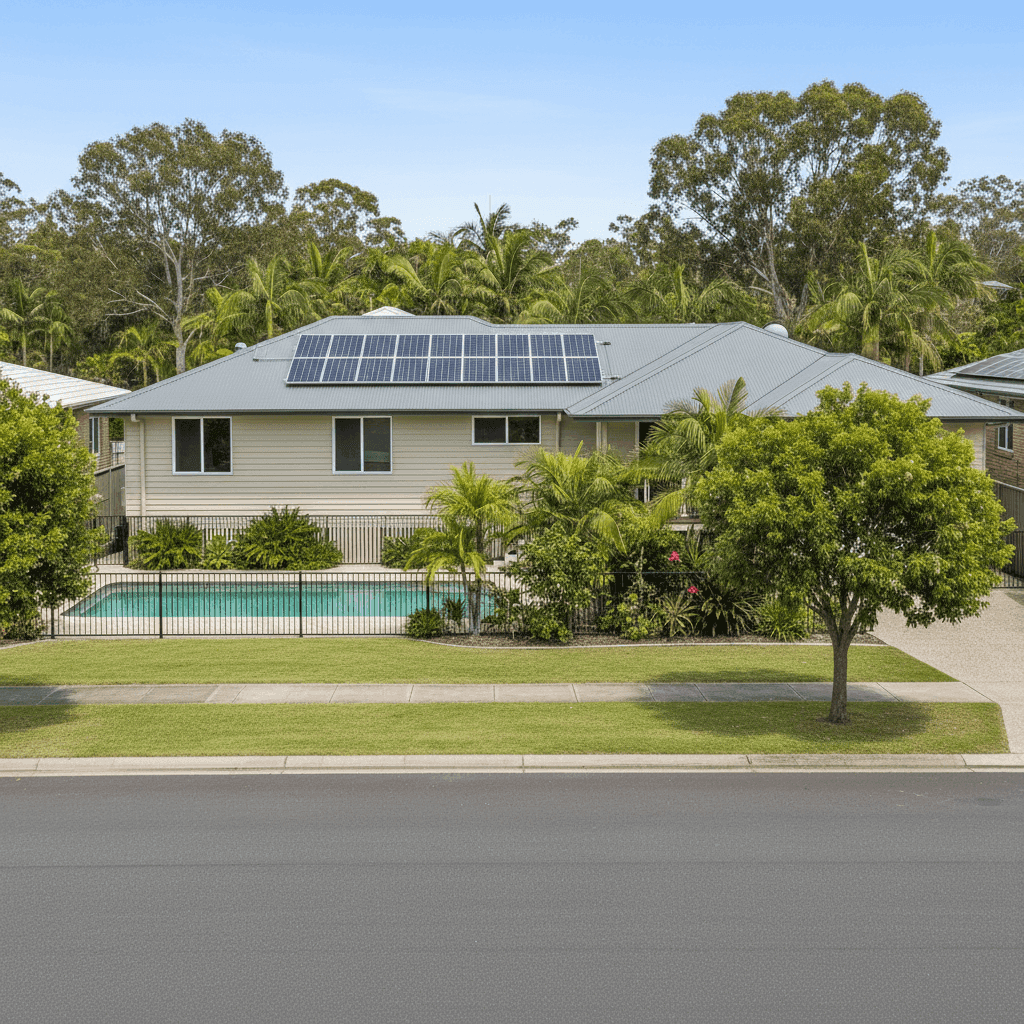
Paradise Point is one of the Gold Coast's most sought-after waterside suburbs — a leafy peninsula community in postcode 4216 where well-established homes sit close to the Broadwater and canals. For owners of free standing homes in this area, understanding what drives home insurance premiums is just as important as finding the right cover. This article breaks down a real home and contents insurance quote for a four-bedroom, two-bathroom free standing home in Paradise Point, and benchmarks it against local, state, and national data to help you make an informed decision.
---
Is This Quote Fair?
The annual premium for this property came in at $4,041 per year (or $360/month), covering a building sum insured of $683,000 and $68,000 in contents. The price rating for this quote is FAIR — around average.
That "fair" rating is well-supported by the numbers. Based on 53 quotes collected for Paradise Point (postcode 4216), the suburb's median premium sits at $4,519/year, meaning this quote lands comfortably below the midpoint. It also falls within the interquartile range — between the 25th percentile of $3,289/yr and the 75th percentile of $7,193/yr — which confirms it's a broadly competitive result rather than an outlier in either direction.
For a property of this size and specification, with a pool, solar panels, and ducted climate control adding to the insured risk, a premium below the suburb median is a reasonable outcome. That said, there's still meaningful room to potentially improve — the cheapest quarter of comparable quotes in the suburb come in under $3,289/yr, so it's worth exploring whether a different insurer or policy structure could close that gap.
---
How Paradise Point Compares
Context is everything when evaluating an insurance quote, and Paradise Point presents an interesting picture when stacked up against broader benchmarks.
| Benchmark | Average Premium | Median Premium |
|---|---|---|
| Paradise Point (4216) | $5,492/yr | $4,519/yr |
| Gold Coast LGA | $8,161/yr | — |
| Queensland | $9,129/yr | $3,903/yr |
| National | $5,347/yr | $2,764/yr |
A few things stand out here. The Queensland state average of $9,129/yr is dramatically higher than both the suburb average and this individual quote — largely because QLD premiums are skewed upward by high-risk coastal and cyclone-prone regions in the north of the state. The Gold Coast LGA average of $8,161/yr tells a similar story, with many canal-front and flood-adjacent properties pulling the local average up significantly.
Interestingly, the national average of $5,347/yr is actually higher than the Paradise Point suburb average of $5,492/yr — though the national median of $2,764/yr is far lower, reflecting how broadly premiums vary across Australia depending on risk profile and property type.
For Paradise Point homeowners, the key takeaway is that this suburb sits in a relatively moderate risk band compared to much of Queensland, and a well-priced policy here should realistically land somewhere between $3,300 and $5,500 per year for a home of this calibre.
---
Property Features That Affect Your Premium
Several characteristics of this particular property have a direct bearing on what insurers charge — for better and for worse.
Weatherboard timber walls are one of the more significant premium drivers. Timber-clad homes are considered higher risk than brick veneer or double brick constructions due to their susceptibility to fire and moisture damage. Insurers typically price this in, so it's worth understanding that a comparable brick home in the same street would likely attract a lower premium.
Steel/Colorbond roofing is generally viewed favourably by insurers. It's durable, low-maintenance, and performs well in high-wind events — a meaningful consideration in South East Queensland where severe storms are not uncommon. This likely helps offset some of the premium loading from the timber walls.
The concrete slab foundation is another positive factor. Slab homes tend to be more resistant to subsidence and termite ingress than homes on stumps or piers, which insurers reward with more stable pricing.
Timber and laminate flooring can influence contents and building claims, particularly in flood or water damage events, but is a relatively neutral factor in premium calculations for this region.
The swimming pool adds a modest premium loading — pools are considered an insurable asset that increases both the building sum insured and liability exposure. Similarly, solar panels increase the replacement cost of the building and are a growing consideration for insurers as panel values rise.
Ducted climate control is another feature that adds to the building's replacement value. At $683,000 sum insured for a 139 sqm home, the building valuation appears to account well for these inclusions — avoiding the risk of being underinsured if a major claim were to occur.
Finally, it's worth noting that this property is not in a designated cyclone risk area, which is a meaningful premium advantage for a Queensland home. Properties further north on the coast can pay significantly more for this reason alone.
---
Tips for Homeowners in Paradise Point
1. Review your sum insured annually. Construction costs have risen sharply in recent years, and a building sum insured set even two or three years ago may no longer reflect the true cost of rebuilding. At $683,000 for a 139 sqm home with premium finishes and a pool, this quote appears well-calibrated — but it's worth revisiting each renewal with a building cost calculator to stay protected.
2. Consider the impact of your excess settings. This policy carries a $2,000 building excess and $1,000 contents excess. Opting for a higher voluntary excess can reduce your annual premium, but make sure you could comfortably cover that amount out of pocket in the event of a claim. For many Gold Coast homeowners, a higher excess on building cover (where claims tend to be larger) makes more financial sense than on contents.
3. Don't overlook storm and water damage clauses. South East Queensland is no stranger to severe storms, flash flooding, and hail. Review your policy's definitions around storm damage, rainwater ingress, and flood carefully — these are not always the same thing under an insurance policy, and exclusions in this area can catch homeowners off guard.
4. Compare at renewal, not just at purchase. Insurers often reserve their best pricing for new customers. If you've been with the same provider for several years, there's a good chance a comparable policy is available at a lower price elsewhere. Using a comparison platform like CoverClub makes it straightforward to benchmark your renewal quote against the current market.
---
Ready to Compare Home Insurance in Paradise Point?
Whether you're assessing your current policy or shopping for cover on a new purchase, it pays to see how your quote stacks up against real data from your suburb. Get a home insurance quote at CoverClub and instantly compare your premium against suburb, state, and national benchmarks — so you always know exactly where you stand.