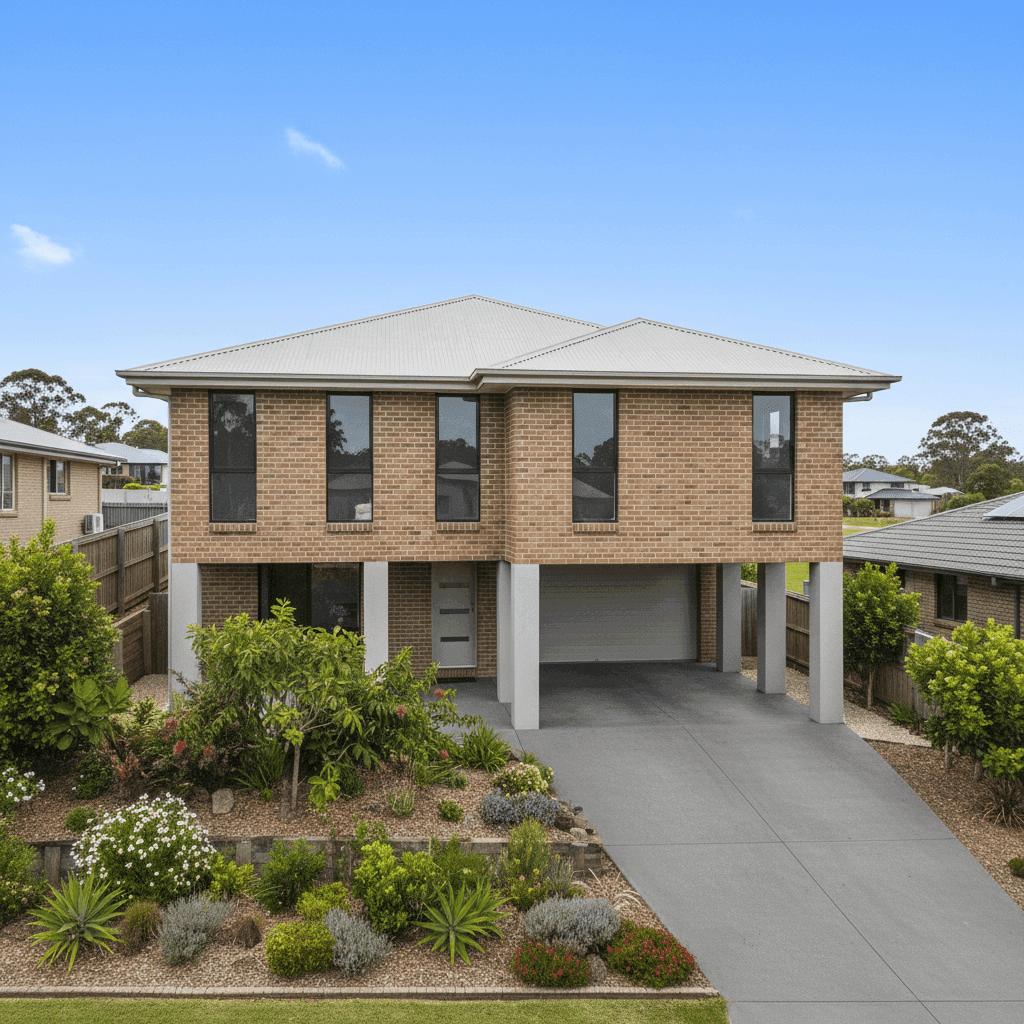
If you own a free standing home in Park Ridge, QLD 4125, you've probably wondered whether you're paying a fair price for your building insurance — or whether you're leaving money on the table. This article breaks down a real building-only insurance quote for a three-bedroom, three-bathroom brick veneer home in Park Ridge, comparing it against suburb, state, and national benchmarks so you can see exactly where it sits.
---
Is This Quote Fair?
The short answer? Yes — and then some. This quote came in at $1,113 per year (or roughly $109 per month), which CoverClub rates as CHEAP — meaning it sits well below the average for the area.
To put that in perspective:
- The suburb average for Park Ridge is $1,832/yr, and the median sits slightly higher at $1,915/yr
- Even the 25th percentile — the cheapest quarter of quotes in the suburb — is $1,290/yr
- This quote at $1,113 undercuts even that lower benchmark
That means this premium is genuinely competitive, not just by local standards, but by any measure. Homeowners paying close to the suburb average are spending $719 more per year for equivalent cover. Over a decade, that's a meaningful difference.
Of course, premiums vary based on insurer appetite, the specific property features, and the excess you're willing to accept. This policy carries a $3,000 building excess, which is on the higher side and does contribute to a lower upfront premium. It's worth factoring that in when comparing — if you needed to make a claim, you'd be covering the first $3,000 yourself.
---
How Park Ridge Compares
Park Ridge sits within the Logan LGA, a broad council area that spans a wide range of property types and risk profiles. Here's how the numbers stack up across different comparison points:
| Benchmark | Annual Premium |
|---|---|
| This quote | $1,113 |
| Park Ridge suburb average | $1,832 |
| Park Ridge suburb median | $1,915 |
| Park Ridge 25th percentile | $1,290 |
| Park Ridge 75th percentile | $2,517 |
| Logan LGA average | $3,411 |
| QLD state average | $4,547 |
| QLD state median | $3,931 |
| National average | $2,965 |
| National median | $2,716 |
The contrast with Queensland's state average is particularly striking. At $4,547/yr, the QLD average is more than four times this quote. That figure is heavily skewed by high-risk coastal and cyclone-prone regions in Far North Queensland, where premiums can be eye-watering. Park Ridge, being located in South East Queensland and not classified as a cyclone risk area, benefits from a far more moderate risk profile.
Even compared to the national average of $2,965/yr, this quote is less than half the cost — a strong result by any measure. You can explore how Queensland premiums compare broadly or dive into Park Ridge-specific data to see the full picture.
---
Property Features That Affect Your Premium
Several characteristics of this particular home work in its favour when it comes to pricing:
Brick Veneer Construction Brick veneer is one of the more insurer-friendly wall materials. It's durable, fire-resistant, and widely understood by underwriters. Compared to weatherboard or other timber-based cladding, brick veneer typically attracts lower premiums due to its resilience.
Steel/Colorbond Roof Colorbond steel roofing is another tick in the box. It performs well in storms, resists corrosion, and is far less susceptible to hail damage than older tile roofs. Insurers generally view it favourably, particularly in Queensland where severe weather events are a real consideration.
Slab Foundation A concrete slab foundation is a solid, low-maintenance base that presents minimal risk of subsidence or pest-related structural issues. Combined with a relatively modern construction year of 2013, this home benefits from being built to more contemporary building codes.
Elevated by at Least 1 Metre This is an interesting feature. While elevation can sometimes raise questions around storm and wind exposure, in Queensland it often signals a property designed with flood resilience in mind. Depending on the insurer's interpretation, this can work in your favour — particularly in areas where localised flooding has historically been a concern.
Ducted Climate Control The presence of ducted air conditioning adds to the replacement value of the home, which is reflected in the sum insured of $464,000. This is appropriately captured in the building cover, ensuring the system would be replaced in the event of a total loss.
No Pool, No Solar The absence of a pool and solar panels simplifies the risk profile. Both can add complexity (and cost) to a policy, so their absence contributes to a cleaner, more straightforward quote.
---
Tips for Homeowners in Park Ridge
1. Review your sum insured regularly Construction costs have risen significantly in recent years. A sum insured of $464,000 for a 139 sqm home built in 2013 looks reasonable, but it's worth reassessing annually — especially as labour and materials costs continue to shift. Underinsurance is one of the most common and costly mistakes homeowners make.
2. Understand your excess before you claim A $3,000 building excess is a meaningful out-of-pocket cost if something goes wrong. If you'd prefer a lower excess, it's worth getting comparison quotes to see what the premium difference looks like. Sometimes paying slightly more upfront gives you much better protection when you actually need it.
3. Don't assume your current insurer is still competitive The insurance market reprices constantly. Even if you got a great deal last year, your renewal premium may have crept up. Use tools like CoverClub to benchmark your renewal against current market rates before you automatically pay.
4. Consider contents cover separately This policy covers the building only. Your furniture, appliances, clothing, and personal belongings aren't protected under a building-only policy. If you haven't already arranged separate contents insurance, it's worth exploring — especially given the $1,000 contents excess noted in this quote suggests contents cover may be available as an add-on.
---
Compare Your Own Quote
Whether you're a first-time buyer in Park Ridge or a long-term homeowner wondering if your renewal is still competitive, CoverClub makes it easy to see where your premium stands. Our free comparison tool lets you benchmark your current policy against real market data — no jargon, no pressure.