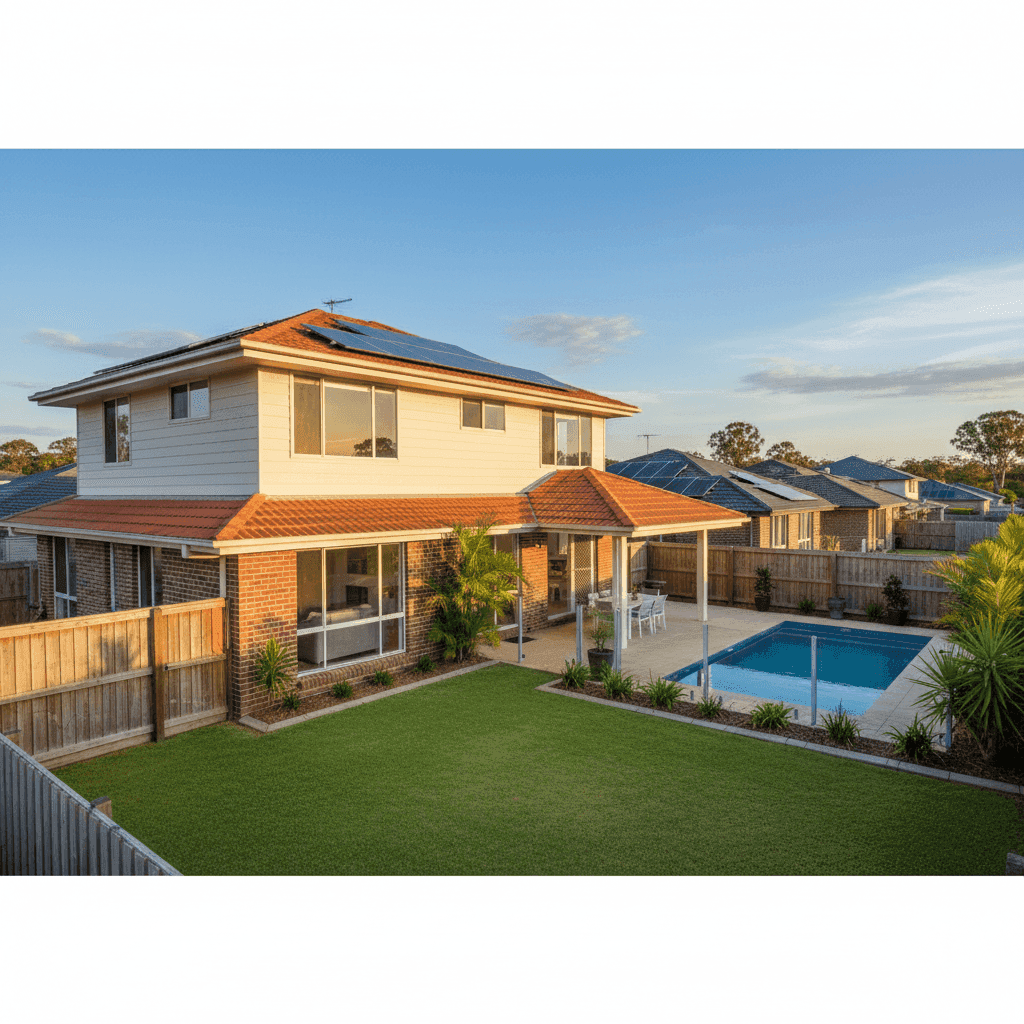
Pimpama is one of South-East Queensland's fastest-growing corridors, sitting roughly halfway between Brisbane and the Gold Coast. With a mix of modern estates and townhouse developments that have sprung up since the early 2000s, it's a suburb where home insurance costs can vary quite significantly — and understanding where your premium sits relative to the market can save you hundreds of dollars a year.
This article breaks down a real building insurance quote for a four-bedroom, two-bathroom brick veneer townhouse in Pimpama (postcode 4209), built in 2006 with a tiled roof, slab foundation, vinyl flooring, above-average fittings, a swimming pool, and solar panels. The property spans 277 sqm and is part of a body corporate arrangement. The sum insured is $1,071,000, with an annual premium of $3,665 (or $351/month) and a building excess of $500.
---
Is This Quote Fair?
The short answer: this quote is rated Expensive — sitting above the suburb average. Based on data from 102 quotes in the Pimpama area, the suburb average premium is $3,055 per year and the median sits at $2,425. This quote of $3,665 lands above the 75th percentile ($3,260), meaning it's pricier than at least three-quarters of comparable quotes in the suburb.
That said, context matters. The sum insured of $1,071,000 is substantial — reflecting the above-average fittings quality, larger floor area, and additional features like a pool and solar panels. Higher rebuild values naturally push premiums upward, so some of the price gap is justifiable. Still, if you're paying above the 75th percentile, it's worth shopping around to confirm you're not overpaying for the same level of cover.
---
How Pimpama Compares
One of the more reassuring takeaways from this data is just how affordable Pimpama is relative to the broader Queensland market. Here's a quick snapshot:
| Benchmark | Average Premium | Median Premium |
|---|---|---|
| Pimpama (4209) | $3,055/yr | $2,425/yr |
| Queensland | $9,129/yr | $3,903/yr |
| Gold Coast LGA | $8,161/yr | — |
| National | $5,347/yr | $2,764/yr |
The Queensland state average of $9,129 is heavily skewed by high-risk coastal and cyclone-prone areas in Far North Queensland — places like Cairns, Townsville, and Mackay, where premiums can be eye-watering. Pimpama, by contrast, is not classified as a cyclone risk area, which keeps premiums considerably lower than the state average suggests.
Even compared to the national average of $5,347, Pimpama looks relatively affordable. And within the Gold Coast LGA, where the average hits $8,161, Pimpama's $3,055 suburb average is a meaningful discount — likely reflecting its inland position, newer housing stock, and lower flood exposure compared to coastal Gold Coast suburbs.
You can explore the full breakdown of Pimpama insurance statistics here, or compare across the broader Queensland market.
---
Property Features That Affect Your Premium
Several characteristics of this property have a direct influence on the premium quoted. Understanding them can help you make sense of the number — and potentially find ways to reduce it.
Brick veneer construction and tiled roof Brick veneer walls paired with a tiled roof is generally considered a mid-to-high resilience combination by insurers. Brick veneer is less expensive to rebuild than full double brick but performs well in storms and resists fire better than timber-clad homes. Tiled roofs are durable but can be more costly to repair after hail events compared to Colorbond.
Slab foundation A concrete slab is the standard foundation type for Queensland homes built in this era and is generally viewed favourably by insurers. It's less susceptible to movement and moisture issues than older stumped or pier-and-beam foundations.
Swimming pool A pool adds to the insured value of the property and may also introduce some liability considerations depending on your policy. Expect it to contribute modestly to the overall premium.
Solar panels Solar systems are now a standard inclusion on many Queensland homes, but they do add to the rebuild cost. Panels, inverters, and associated wiring all need to be covered under the building sum insured. With solar prices having dropped significantly, it's worth confirming your sum insured reflects current replacement costs rather than the original installation price.
Above-average fittings quality This is one of the more significant premium drivers here. Above-average fittings — think stone benchtops, quality cabinetry, premium tapware, and higher-spec flooring — push up the cost per square metre to rebuild, which in turn increases the appropriate sum insured and the premium.
Body corporate / strata property As a townhouse within a body corporate, it's important to understand what the body corporate's strata insurance covers versus what your individual building policy covers. In many cases, the body corporate insures the common areas and the building shell, while owners are responsible for internal fixtures and improvements. Always check your body corporate's certificate of currency to avoid double-insuring — or worse, leaving gaps in cover.
277 sqm floor area At 277 sqm, this is a larger-than-average townhouse. Combined with above-average fittings, the $1,071,000 sum insured works out to roughly $3,866 per sqm — which is on the higher end but not unreasonable for a well-appointed property in South-East Queensland.
---
Tips for Homeowners in Pimpama
1. Review your body corporate coverage before renewing Before paying for a standalone building policy, request an up-to-date copy of the body corporate's insurance certificate. Understand exactly what's covered under the strata policy so you can tailor your own cover to fill the gaps — not duplicate them. This alone can help you avoid overpaying.
2. Reassess your sum insured annually Building costs in Queensland have risen sharply over the past few years due to labour shortages and material price increases. Equally, some costs have stabilised or softened. Review your sum insured each year — ideally using a quantity surveyor's estimate or an online rebuild calculator — to ensure you're neither underinsured nor paying premiums on an inflated figure.
3. Compare at least three quotes before renewing This quote sits above the suburb's 75th percentile. That's a signal to shop around. Premiums for the same property can vary by hundreds of dollars between insurers, even for identical levels of cover. Use a comparison platform like CoverClub to benchmark your renewal quote quickly.
4. Check your excess settings The building excess on this quote is $500 — relatively low, which typically means a higher premium. If you're financially comfortable absorbing a larger out-of-pocket cost in the event of a claim, increasing your excess to $1,000 or $2,000 can meaningfully reduce your annual premium. Just make sure the saving justifies the added risk.
---
Ready to Find a Better Rate?
Whether you're renewing your current policy or insuring a new property, it pays to compare. CoverClub helps Australian homeowners benchmark their premiums against real market data — so you know whether you're getting a fair deal or paying too much. Get a quote and compare today.